


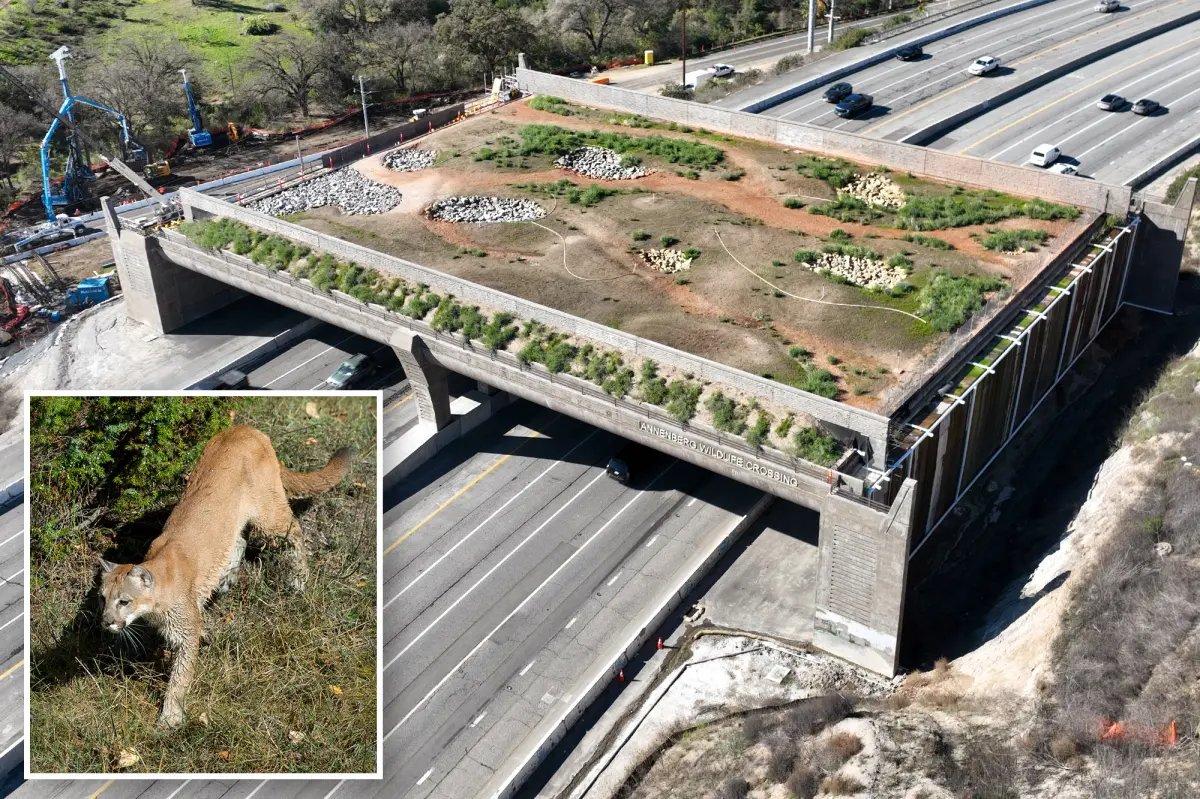

California’s most expensive bridge isn’t for cars or humans, hasn’t been finished, and has already cost more than $100 million.
The Wallis Annenberg Wildlife Crossing, which rises about the lanes of the 101 Freeway in the Los Angeles County mountainside suburb of Agoura Hills, was pitched as a once-in-a-generation conservation fix.
A lush, living bridge designed to reconnect wildlife cut off by freeways and sprawl.
While some call it visionary, others call it a multi-million-dollar gamble
Either way, the cost is very real and still climbing.
The project, once slated to cost $92 million. has now surged now surged to about $114 million, a $21 million overrun.
The timeline has blown out as well, from an expected 2025 finish to late 2026 at the earliest.
And despite the philanthropic branding, taxpayers are footing most of the bill, which is $77 million so far.
The project’s launch came from a good place, inspired by the death of the ‘Hollywood Lion’ or P22, who died from injuries sustained crossing the 101.
P22 earned his name from an iconic National Geographic picture in front of the Hollywood sign in 2012.
His death helped fuel private donations to the bridge, which named after iconic California philanthropist, Wallis Annenberg, who died in 2024.
The idea for a wildlife bridge first emerged in the 1990s, after researchers identified the stretch of land as a critical choke point for wildlife seeking to move between the Santa Monica Mountains and the Simi Hills.
Without a safe crossing point animals, particularly mountain lions, would remain isolated and inbreed, scientists warned.
Gov. Gavin Newsom, who turned soil on the project in 2022, pitched it as a model for future crossings across California.
The bridge is massive, stretching 210 feet long and 174 feet wide, with 26 million pounds of concrete supporting up to four feet of soil, thousands of native plants, rock formations and sound walls made from vegetation.
Maybe California should have checked out what was happening elsewhere first.
In Canada’s Banff National Park, the global gold standard for wildlife crossings, officials built a network of 40 crossings over the Trans-Canada Highway in 1996, which initially cost between about $6.2 million and $9.7 million.
Similar projects today would cost between $17 million to $20 million when adjusted for inflation.
Since opening, animal-vehicle collisions dropping by 80 to 90 percent.
In Colorado, a major wildlife overpass over Interstate 25 cost about $15 million and took just a year to build. A $23 million land bridge near San Antonio, Texas, has also been an overwhelming success.
The average cost of a wildlife crossing in America is between $5 million and $20 million.
At $114 million and counting, the Wallis Annenberg Wildlife Crossing is in a different universe.
Proponent of the bridge say it had to be bigger and more complex because it’s on the edge of dense urban edge and designed to reconnect an entire ecosystem.
Critics say the state took a proven concept and turned it into a luxury build.
There’s also another crucial difference between California bridge the others: they are networks, not single crossings.
Banff did not rely on a single overpass. Neither did Florida, where dozens of crossings helped stabilize the endangered panther population. Colorado is building out a system, not a showcase.
Download The California Post App, follow us on social, and subscribe to our newsletters
California Post News: Facebook, Instagram, TikTok, X, YouTube, WhatsApp, LinkedIn
California Post Sports Facebook, Instagram, TikTok, YouTube, X
California Post Opinion
California Post Newsletters: Sign up here!
California Post App: Download here!
Home delivery: Sign up here!
Page Six Hollywood: Sign up here!