


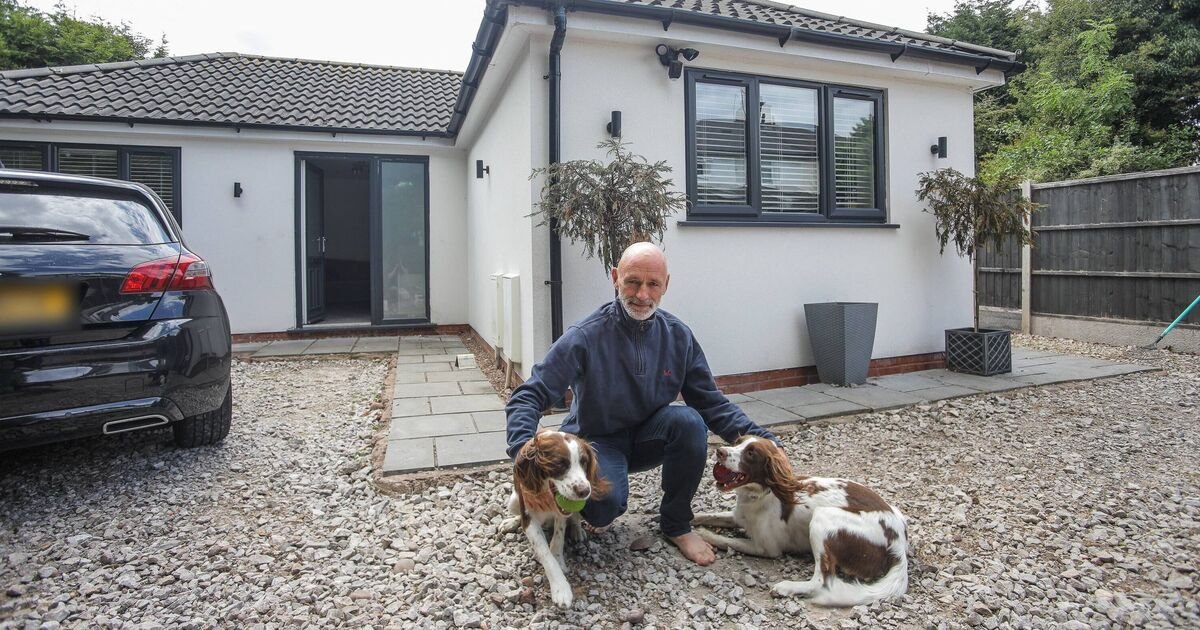
A court has instructed IT engineer Mark Jones, 55, to demolish a £180,000 bungalow he constructed in his backyard without obtaining the necessary planning permission. In March 2019, Jones replaced an old garage with a two-bedroom ‘granny flat’, connecting it to his main house’s electricity, water, and internet supply. The 83-square-metre brick annex, which features a kitchen diner, two bedrooms, a bathroom, and a storeroom, was completed six months later.
Jones did not apply for planning permission, assuming the structure was permissible due to its size and connection to the main house’s utilities. Initially, he intended for his ailing father, Tony, 71, to occupy the property in Walmley Ash Road, Sutton Coldfield, West Midlands.
However, following his father’s passing from bowel cancer, the bungalow was used by Jones’ adult daughter and her boyfriend during the Covid lockdowns. The arrangement was short-lived, as three neighbours lodged complaints, describing the bungalow as “over-intensive”, prompting Birmingham City Council to order its demolition in 2021. The neighbours’ concerns included issues with parking, privacy, and excessive light emanating from the new bungalow. Jones, who believed the structure complied with planning laws, submitted a retrospective planning application, which was rejected. A second application also failed, with the council determining that the property breached planning regulations.
Jones has now been instructed to dismantle the bungalow by the end of the month or risk facing potential further legal action. Mark, who settled into the bungalow post-divorce, faces the threat of homelessness should he be compelled to knock down his home. The father declared: “The bungalow was within the permitted development rights and could have habitable rooms.” He explained the plans: “It was meant for my father and reliant on the main house.”
Citing local precedence, Mark added: “There are several properties nearby with two story buildings in their gardens so I thought it was fine.” Talking about financials, he said: “It started at £60,000 but it didn’t have a kitchen so I added one on the plans.” After finishing the interior, Mark sought recourse with The Planning Inspectorate, only to have his hopes dashed when in February 2021, his bungalow was deemed “alien” to the local aesthetic.
Standing out with its white facade and personal outdoor space, the bungalow boasts a gravel driveway and patio area. Linked to the main property, a valued three-bed semi at roughly £355,000, the bungalow shares utilities with it. In frustration, Mark asserted: “There is no public interest in taking the bungalow down, so I don’t know why they’re making me.”
He questioned the decision, stating: “You look at other houses on the street and I can’t see why we wouldn’t get permission for it.” Highlighting local needs, he remarked: “For an area with a housing shortage, it’s ridiculous.” Clarifying his intentions, he said: “It was never meant to be a separate building, it was supposed to be part of the main house.”
He spoke of the lack of separatism: “It doesn’t have its own water, internet, council tax or waste.” Defending the setup, Mark insisted: “It is still part of the main house. I should’ve waited for planning permission but people can see why I haven’t.” Finally, he shared the urgency of his situation: “I was in a hurry to get my dad moved in.”
Upon examining Google maps and spotting multiple buildings in surrounding gardens, it’s obvious why Mark assumed his construction was permissible. Mark continued, “Loads of people have done this. If I tear it down I’ve got nowhere else to go so I’ll probably be on the streets.” He feels intimidated by the council, stating, “To me the council is bullying me. They want me to knock a property down that’s perfectly reasonable.”
Mark asserted that his bungalow wasn’t an eyesore or intrusive, mentioning, “From the street or a neighbour’s garden, you wouldn’t see anything. You can’t see into windows. There was a garage there before.” To pursue a resolution, Mark has filed a new permitted development certificate application with the council. However, even if it gets approved, Mark will have to dismantle the initial bungalow and rebuild it in compliance with the council’s regulations.
Regarding the situation, a Birmingham City Council representative clarified, “Mr Jones is currently in breach of the enforcement notice that was served to him in 2021, and we have given him ample time to comply with the notice by the end of June 2025. A decision will be made imminently on the lawful development certificate that Mr Jones has submitted, and a case officer will then be in contact with him to advise further.”