
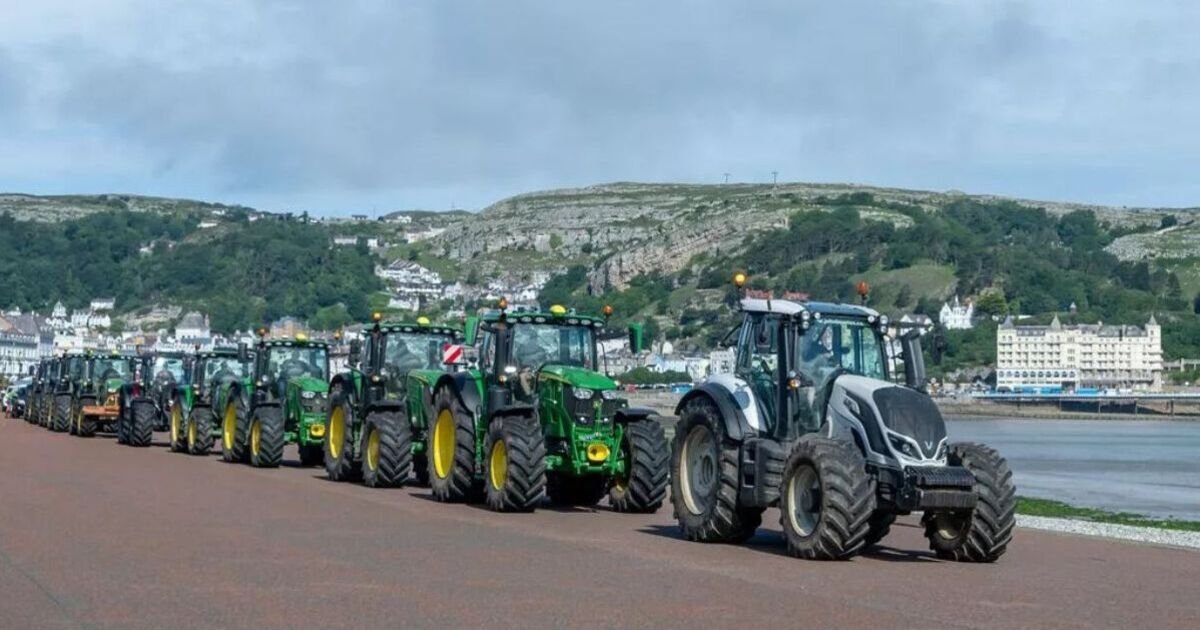

Furious farmers took to the streets to protest while Sir Keir Starmer gave a speech to Labour members in the Weslh town of Llandudno. The farmers say they are having to take extreme measures to keep their farms afloat and blame recent government policies and have staged a number of protests across the UK.
The latest protest saw farm vehicles and tractors lined up along the promenade in Llandudno, North Wales. It is the second protest to take place in the town, as well as other events in Cardiff Bay. The protest came as Starmer gave a speech at the Welsh Labour Party conference in Llandudno on Saturday. Voters will head to the polls next May to choose their representatives in Cardiff Bay.
As reported by Wales Online, Alan Hughes said farmers are producing food for the public “at a loss”. He farms on the Shropshire Powys border between England and Wales.
The beef and sheep farmer said: “At the moment we’re being forced to take second jobs to stay afloat to afford to produce food for the public at a loss. We can’t continue to do this.
“Supermarket prices are going through the roof but in the last month since the EU trade deal the price of beef has dropped by £1 a kilo, that’s a sixth. We’re pretty much on break even now.”
Mr Hughes works two other jobs to cover his bills. He blames both the UK and Welsh governments for the situation and said “their policies are driving us bust”.
One of the previous protests was organised by Swansea farmer Liam Payne. He said the situation hasn’t improved and there are now new issues facing farmers.
He explained: “Sixteen months ago we organised the Senedd protest, that was about TB testing, NVZ zones and TB. They’re all still here.
“Then the Westminster government came in and put the inheritance tax on us, and two weeks ago, Huw Irranca-Davies [the Welsh rural affairs minister] put bluetongue zone which is going to affect all breeding stock sales on the borders.”
According to the Welsh government, the restrictions will help keep the disease away for a period of time. However, it will not stay away forever.
Mr Payne added: “We ourselves go to Scotland to buy rams every year and we won’t be able to do that this year, and that means creating a smaller gene pool of breeding because we can only buy within Wales.”
