
Drying wet washing indoors during freezing winter weather can quickly turn into a battle against damp, rising energy bills and stubborn condensation. Without a tumble dryer to guzzle energy, heating your home efficiently is a battle when the Ofgem electricity price cap sits at 26.32p per kWh, rising to 32.69p per kWh from January 2027.
Many people have their own solution to drying clothes without a tumble dryer, including using a hot radiator or a heated airer. Others suggest draping a bed sheet over an airer to create a warm microclimate that traps heat and speeds up indoor drying. To settle the debate once and for all, I asked experts in the household appliances and energy industry for their advice. They all came back with exactly the same answer.
A single load of wet washing can release around two litres of water into the air. Left unchecked, that moisture settles on cold glass, walls and furniture, creating condensation and mould.
That’s why the experts point to the same rule: trap the moisture in one space and give it somewhere to go.
George Penny, home energy expert at The Solar Co, said: “The bathroom is usually the best choice, provided it has an extractor fan or a window that opens. It’s already designed to handle moisture, and the extractor fan can pull the damp air outside before it spreads through the rest of the house.” He adds that a utility room with an extractor fan or a spare bedroom with the door shut and a window cracked open are strong backups, while living rooms and bedrooms are best avoided.
Chris Michael, co-founder of Meaco, agreed on keeping the door closed: “If you use a dehumidifier, a smaller room with the door closed lets you concentrate drying in one area. If you don’t have one, choose a warm room with good ventilation, ideally with an extractor fan. Keep the internal door closed to limit the moisture to the room.”
Drying laundry quickly largely comes down to what you do before loading up the drying rack. Use the highest spin speed suitable for your fabrics to remove as much water as possible.
George suggests rolling heavy jumpers or towels inside a dry bath towel and pressing down firmly to squeeze out excess water.
Chris noted: “If you’re drying washing without a dehumidifier, opening a window helps some moisture escape. If you’re using a dehumidifier, close the windows and door so it can work on the air in that room.”
He warned that turning up the thermostat alone will not clear damp: “Heating alone does not remove the water released into the air. Combine warmth with ventilation or a dehumidifier. Simply turning up the thermostat leaves that moisture inside your home.”
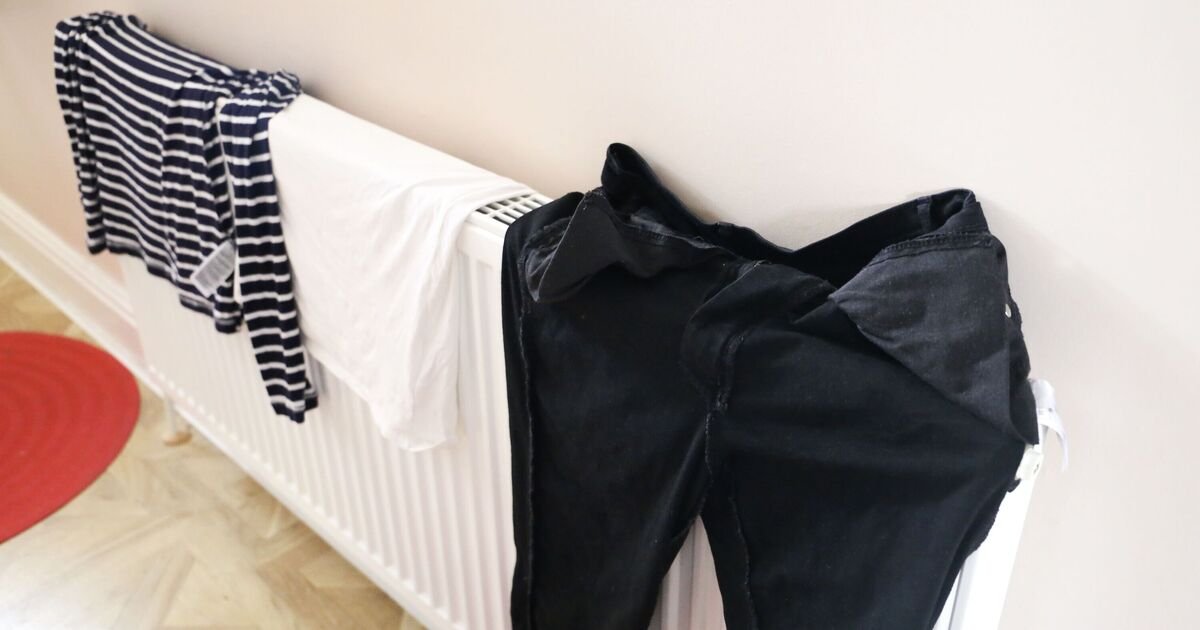
Can you dry laundry on a radiator?
Both Chris and Salah Sun, head of product marketing at Beko, advise against draping wet washing over radiators. George suggested targeted warmth near the airer, alongside ventilation, rather than heating the whole house just for laundry.
Drying times vary by fabric weight, temperature and airflow. George estimates four to six hours for lighter shirts and T-shirts and 12 to 24 hours for jeans and towels in a well-ventilated room with a fan and mild warmth, while cold, still rooms take longer.
In Meaco tests on 13 T-shirts in a utility room, a desiccant dehumidifier with a fan took one hour and 40 minutes, and a compressor model with a fan took just under two hours.
To prevent damp and mould, Chris recommends aiming for roughly 55% relative humidity in colder months and watching for persistent window condensation, musty smells or mould around frames and behind furniture.
Salah added that winter heating, combined with closed windows and damp washing, can cause condensation to seep into walls, carpets and furniture if left unchecked.
Ensure our latest lifestyle headlines always appear at the top of your Google Search by making us a Preferred Source. Click here to activate or add us as a Preferred Source in your Google search settings
