


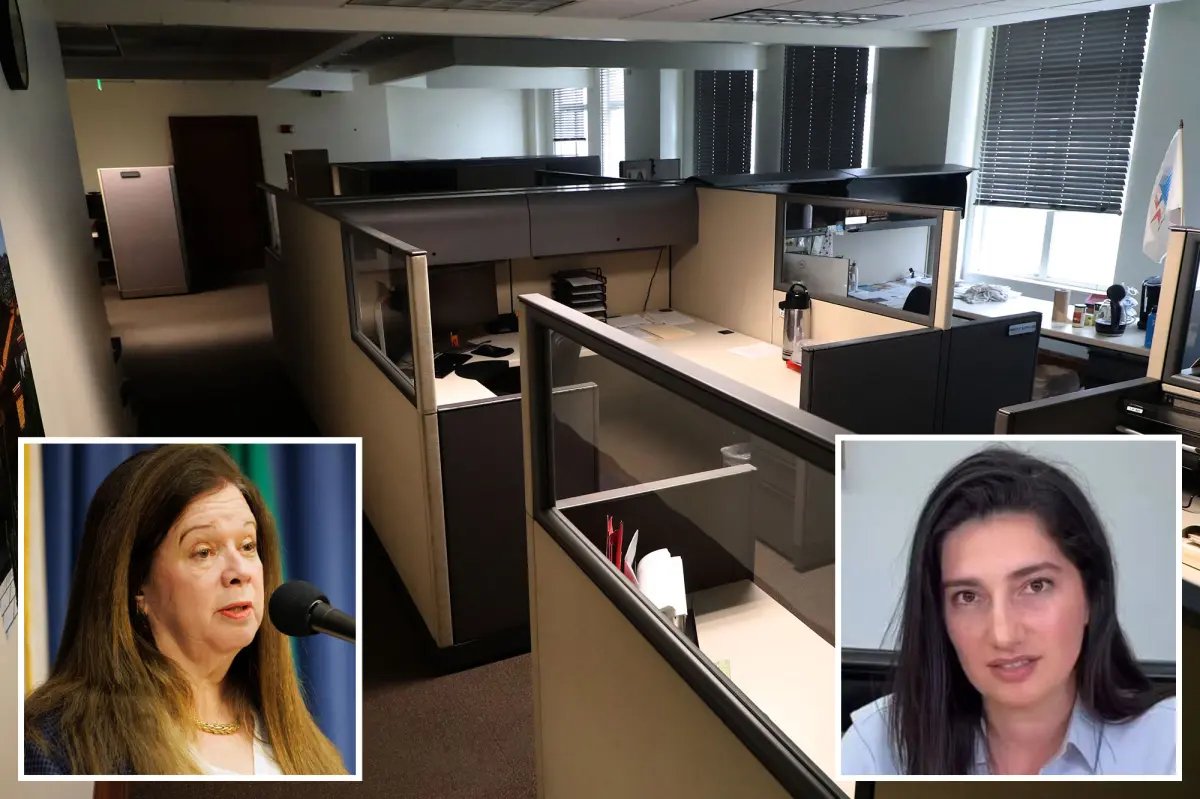

One of the contenders for Los Angeles city attorney is pushing a jaw-dropping plan: requiring government lawyers in the office just two days a month.
The proposal, reported by the LA Times, lands as frustration boils over across City Hall, where prior California Post reporting exposed closed doors and a hollowed-out downtown stripped of its daily workforce.
At the center of the fight: incumbent Hydee Feldstein Soto and challenger Marissa Roy.
Roy, a deputy state attorney general backed by the Democratic Socialists of America, told the city attorneys’ union she would slash in-office requirements to just two days per month, not including court appearances. The model mirrors the policy inside the office of Rob Bonta, where Roy currently works.
“There’s no reason why the city attorney’s office can’t have that same policy,” Roy said.
Feldstein Soto has pushed in the opposite direction.
Her office now requires most attorneys in person at least three days a week, with supervisors expected in four. The goal, she says, is oversight, training and responsiveness in a job that often requires real-time legal guidance for city leaders.
“It builds teamwork. It ensures cohesion,” she said, arguing younger attorneys in particular need hands-on supervision.
She has also raised concerns that looser remote policies could open the door for outside work, creating ethical and logistical complications for government lawyers tasked with representing the city.
The proposal lands in a city already struggling to keep the lights on, literally and figuratively. A California Post investigation found entire City Hall offices closed on Fridays, with no notice to the public.
Roughly 50 Angelenos were turned away in a single day after showing up to pay bills or seek help, only to find locked doors and empty counters. One small business owner drove across the city, paid for parking and took time off work, only to be told to come back another day.
The fallout has stretched beyond inconvenience.
Across the street, businesses that once depended on daily foot traffic from city workers have collapsed, with some reporting revenue plunges as much as 90 percent since the shift to remote work.
Even the basics are buckling. City workers tell the Post that ever since work-from-home took hold during COVID, routine services have slipped, with requests for things like street repairs are piling up and falling behind.
Roy has emerged as Feldstein Soto’s most formidable challenger, pulling in more than $450,000 in campaign contributions, while the incumbent has raised roughly $685,000.
While Roy is eyeing more remote work, other cities are slamming the brakes.
In August, thousands of employees in San Francisco will be required to be in the office at least four days a week, part of a push to bring life back to a downtown that’s been hollowed out since COVID.