


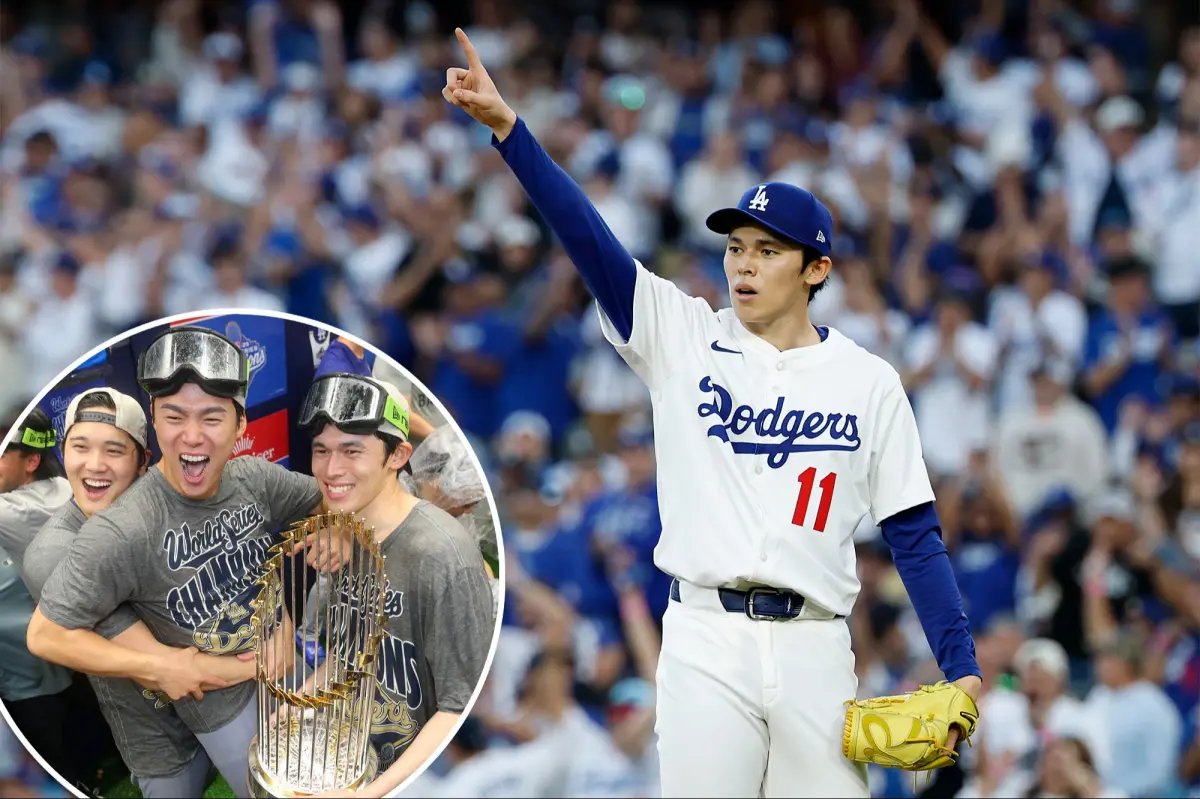

PHOENIX — No translation was required for Hyeseong Kim’s appraisal of Roki Sasaki’s new slider.
“Good,” Kim said in English.
Good enough for the Korean infielder to swing at the pitch and miss in a live batting practice session against Sasaki on Saturday.
Project Roki is underway at Camelback Ranch, the ninth-inning sensation of the Dodgers’ most recent World Series run working to solidify a place in the team’s rotation.
Sasaki is armed with two weapons that made him a dominant pitcher in Japan, as well as the country’s most anticipated baseball export since Shohei Ohtani: a 100-mph fastball and Wiffle-ball-like forkball.
Last year, more than 83% of pitches he threw were either fastballs or forkballs. Finding success as a major league starter will be borderline impossible with just two effective pitches, which is why the 24-year-old Sasaki is attempting to incorporate into his arsenal a slider or cutter, or maybe both.
Sasaki said he junked the slower variation of the slider he threw last season, which was not only hittable but also contributed to shoulder problems that sidelined him for four months. He is now experimenting with a faster version of the pitch he threw earlier in his career in Japan, with a spiral spin.
“I thought the slider I threw last year wasn’t very good,” Sasaki said in Japanese. “In reality, the results weren’t very good, either.”
Before he was placed on the injured list last year, Sasaki made eight starts in which he posted a 4.72 ERA.
The swing-and-miss by Kim on Saturday was a positive sign, but Sasaki said he still doesn’t have a clear vision for a pitch that will move away from right-handed hitters, whether it will be a slider or a cutter or something in between. Sasaki said he also plans to mix in a two-seamer.
By adding a slider or cutter and a two-seamer that travels in the opposite direction, Sasaki said, “I think it will bring my fastball and forkball to life.”
Said Dodgers general manager Brandon Gomes: “If he’s executing the fastball and split the way he’s capable of, with what he’s done in the past, it’s an amazing foundation. Anything on top of that is just going to make things more challenging for opposing hitters.”
Sasaki downplayed the magnitude of the changes he’s making, saying he started working on the new pitches last year. Whatever he ends up adding to his pitch mix, comfort will be a major priority.
“As much as possible, I don’t want it to affect my current pitching motion,” he said.
Sasaki showed why that was important to him as he pitched to Kim and minor-league catcher Seby Zavala. His fastball touched 98.6 mph.
Reflecting on his first season with the Dodgers last year, Sasaki said, “It wasn’t so much about coming to the major leagues and more about me stumbling.”
He believes that once he starts competing at this level without any physical impairments, he should be able to see the problems he has to remedy in order to excel.
“My goal is to continue pitching so that I can see those challenges,” Sasaki said.
Returning in the final week of the regular season as a reliever and enjoying success as a closer in the playoffs last year was helpful, Sasaki said.
“Rather than finish at the end of the spring (when I was placed on the injured list), it was obviously better to finish in a good way in the postseason,” he said. “It’s now easier to imagine something good. I was able to see something good, so in that sense, I think I’m able to pitch a little more relaxed.”
Sasaki is also drawing inspiration from a visit he made in the winter.
Back in Japan in December, Sasaki held a baseball clinic for 170 elementary school students in the coastal town of Suzu, which was devastated by an earthquake in 2024. He said he reached out to the city in the middle of last season to make arrangements. He ran with the children, watched them play catch and answered their questions. Before they left, he handed each of them an autographed baseball.
Sasaki could relate to the children, as his own life was shaped by a major earthquake. When he was 9, his childhood home in Rikuzentakata was swept into the ocean by a tsunami. He lost his father and a set of grandparents in the disaster.
“That was my first time participating in a baseball clinic,” Sasaki said. “It’s an experience you don’t usually have. I received different kinds of strength from the children.”
He’s now channeling that into a new arsenal, a new season and potentially a new identity as a pitcher.