


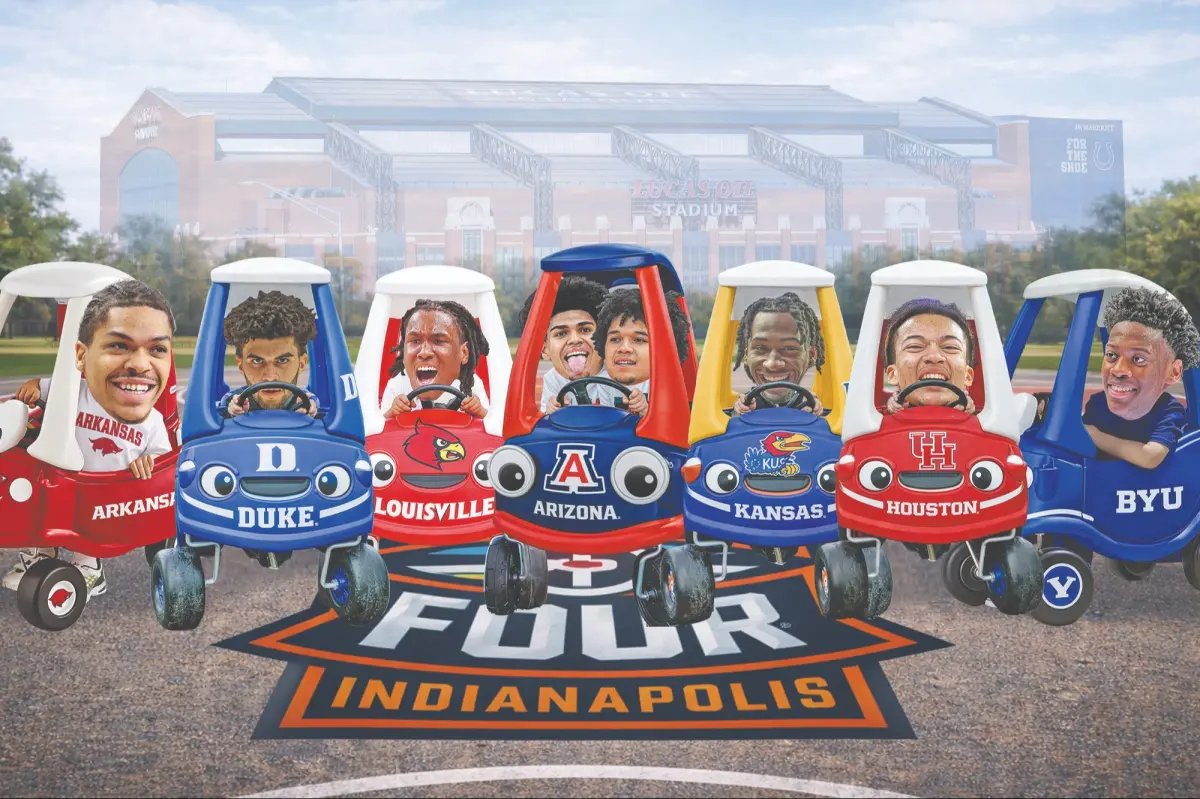

The road to Indianapolis for the Final Four could be fueled by college basketball stars barely old enough to have a driver’s license.
Arguably the greatest — and deepest — freshman class in the sport’s history is about to transition from dominating the regular season to testing its clutch gene under the pressures of the NCAA Tournament.
The one-and-done team-building strategy was ridiculed 20 years ago.
It then nearly went extinct as some veteran coaches preferred recruiting experience via the transfer portal and NIL checks.
Now, it is back in the spotlight thanks to No. 1 seeds and potential bracket-busters.
Perhaps no one faces greater expectations than Duke forward Cameron Boozer.
Not only is Boozer the favorite for National Player of the Year while trying to lead the No. 1 overall seed (East Region) to a championship, but he and his twin brother, Cayden, are trying to match their father’s 2001 title-winning legacy in Durham, N.C.
“I always want to be known as a winner,” Cameron said.
Cayden is stepping out of Cameron’s shadow and into the big shoes vacated by Duke point guard Caleb Foster, who is out for the season with a fractured foot.
Arizona’s dynamic duo doesn’t share DNA like the Boozers.
The Post has you covered with a printable NCAA bracket featuring the full 68-team March Madness 2026 field.
However, Brayden Burries and Koa Peat are key pieces for the balanced Big 12 champions, who are on a quest to get past the Sweet 16 for the first time since 2015.
The 2015 tournament is best remembered as one of the few times the freshman phenom strategy produced a national title.
Led by Jahlil Okafor, Justise Winslow, Tyus Jones and Grayson Allen, Duke won it all then — following the lead of 2012 Kentucky (Anthony Davis and Michael Kidd-Gilchrist) and 2003 Syracuse (Carmelo Anthony and Gerry McNamara).
There might not be a more enigmatic freshman this season than Kansas point guard Darryn Peterson, who seems to have put himself on a load-management plan by regularly pulling himself out late in games.
Kansas coach Bill Self, who has seemed exasperated himself with Peterson’s availability at times, recently shredded the narrative that his stud isn’t all-in and validated his untimely cramping, hamstring and sickness absences.
“He can put a team on his back for two or three weeks,” Self said, as if issuing a warning that the Jayhawks are a lively No. 5 seed in the East.
If Peterson isn’t the No. 1 pick in the NBA draft, it could be BYU forward AJ Dybantsa, who will try to make a mess of the West as the No. 6 seed.
The Cougars limped across the finish line in the Big 12 gauntlet, but not because Dybantsa is slowing down.
With senior guard Richie Saunders sidelined by a torn ACL, the nation’s leading scorer broke Kevin Durant’s conference tournament record by scoring 93 points over a three-game run, including one of his six games with at least 35 points.
John Calipari, the godfather of the one-and-done prospect, has his first premier freshman at Arkansas.
And SEC Player of the Year Darius Acuff Jr.’s season — who had a 30-point outburst to win the SEC Tournament final — doesn’t take a backseat to fellow Calipari guards Derrick Rose at Memphis or John Wall at Kentucky.
Could Acuff be the ingredient that keeps the No. 4 seed in the West out of some of the brick-laying droughts that kept Arkansas — a Sweet 16 party-crasher — from advancing further last March (and has undone many of Calipari’s best teams over the year)?
Or maybe one of the other elite freshmen has a March to remember.
What’s stopping Louisville sharpshooter Mikel Brown Jr., Illinois’ rapidly improving Keaton Wagler or Houston playmaker Kingston Flemings from taking over?
Perhaps the most compelling part of this freshman-loaded tournament is that it serves as an NBA draft appetizer.
Unlike in years past when top picks Ace Bailey and Dylan Harper (Rutgers), Ben Simmons (LSU) and Anthony Edwards (Georgia) couldn’t lift subpar supporting casts into the NCAA Tournament, almost all the best will be dancing.
Apologies to North Carolina’s human highlight reel Caleb Wilson (sidelined by a broken hand) and Stanford’s Ebuka Okorie, who brought a program in a 12-year NCAA Tournament drought onto a bubble that burst Sunday night.