


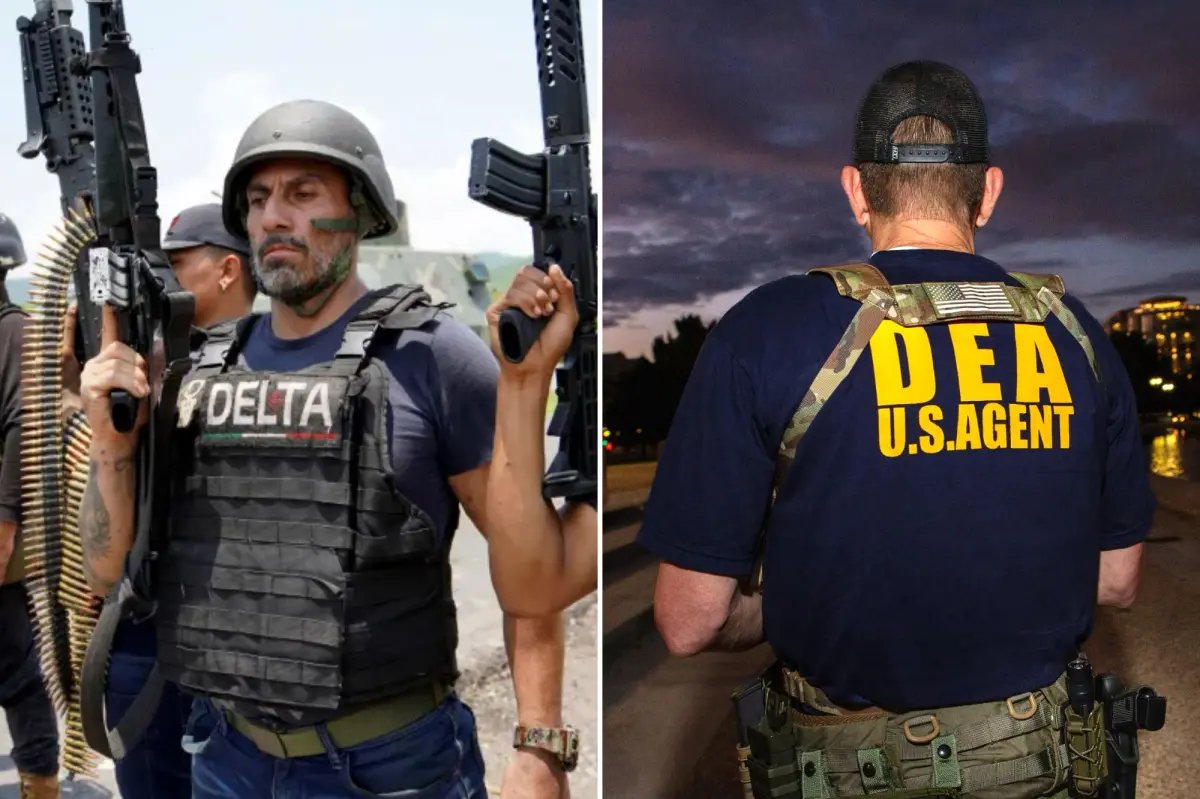

The CIA aided in the capture of Mexican drug lord El Mencho last week — but it was far from the only mission being undertaken by US forces in Latin America.
Joining President Donald Trump’s war on drugs and the cartels who manufacture them marks a huge turnaround for many of the administrations in the region, which has seen increased enforcement and co-operation with the US in Colombia, Bolivia and Ecuador, in particular.
One day after a closed-door White House meeting with President Trump on Feb. 3, left wing Colombian President Gustavo Petro ordered a strike against narco terrorists in his country, killing seven members of the National Liberation Army guerrilla group, which controls pivotal drug-producing regions.
“Colombia has ramped up counter narcotic activities after taking a very different approach for the first three years of the Petro administration,” Andres Martinez Fernandez, a Latin America policy expert, told The Post.
It is a huge turnaround from last October, when Trump sanctioned Petro over alleged drug-related issues.
Leaders across the region are thought to have been spurred into action, at least in part, by the arrest of Venezuelan president Nicolas Maduro from Caracas in a lightning strike US military operation in January.
Bolivia’s recently elected President, Rodrigo Paz, announced this week the country has welcomed the DEA back, resuming intelligence sharing, officer training, and operational coordination on drug trafficking, ending a 17-year-long diplomatic cold shoulder with the US.
“The [US] Drug Enforcement Agency is in Bolivia,” Interior Minister Marco Oviedo told local reporters on Feb. 23. “Just as the DEA is now present, we also have cooperation from European intelligence and police bodies.”
Paz is a centrist from the Christian Democratic Party, who replaced the long reign of the leftist Movement for Socialism (MAS) party.
Under their rule, Bolivia’s diplomatic relations with the US became deeply “poisoned” after ex-President Evo Morales expelled all DEA agents and the ambassador.
Morales pursued a “coca yes, cocaine no” policy that legally expanded coca cultivation —the plant used to make cocaine. As a result, Bolivia became the world’s third-largest cocaine producer, according to the United Nations.
“That whole Andean region [of Bolivia] is an area where there’s quite a bit of lawlessness where we’ve had a great deal of concern,” Daniel Gerstein, a retired US Army Colonel who worked in anti-narcotics in the region, told The Post.
“Morales poisoned his relationship with Washington. They’re trying to restore diplomatic relations.”
While Bolivian officials have said no foreign troops on the ground, that isn’t the case for nearby Ecuador.
In December, after unsuccessfully trying to lift a ban on foreign military bases, President Daniel Noboa begged the US Air Force for help in anti-narcotics efforts, framing it as essential for a “transnational war” against cartels.
Noboa, a center-right Trump ally, told local news at the time that the operation, “will allow us to identify and dismantle drug trafficking routes, and subdue those who thought they could take over the country.”
Ecuador, once one of Latin America’s safest countries, descended into chaos in recent years as a major cocaine transit hub for Colombian and Peruvian product heading to the US, with powerful gangs seizing control of prisons, ports, and entire neighborhoods.
2025 marked the nation’s deadliest year on record, with 9,000 homicides. In one gang turf war last March, 22 people were massacred — the worst violence the country had seen in decades.
The majority of drugs to flow from South America to the US pass through Mexico. Previous president Andres Manuel Lopez Obrador did little to co-operate with the US in busting narco-trafficking and was notoriously easy on the cartels who cause havoc across the region.
As recently as last August, now-President Claudia Scheinbaum kept similar policies, resolutely saying she was not working with the US on drug enforcement.
“[Trump] started talking about we’re going to fly drones over Mexico and take out drug [traffickers]. Scheinbaum made it crystal clear that Mexico had sovereign territory and they weren’t going to allow a bunch of helicopters or US drones flying over their territory,” said Gerstein, who also worked as an Under Secretary at Department of Homeland Security under President Obama.
But things have changed in the last six months, culminating with the death of the country’s most wanted cartel leader, Nemesio “El Mencho” Oseguera Cervantes.
“Mexico, with significant prompting of the United States, is taking more substantial action on narco trafficking in the past few months than it did over the preceding six years combined,” Fernandez added.
That mission was directed by Omar Garcia Harfuch, Mexico’s Secretary of Security, who has been instrumental in encouraging a better relationship with the US.
In March 2025, Harfuch met with FBI Director Kash Patel in Washington, DC.
The FBI posted on X that the meeting marked a “historic milestone” following the extradition of 29 wanted individuals to the US.
He has received training from the DEA and at the FBI headquarters in Quantico, Va., and is said to be completely on board with President Trump’s goal to end the trafficking of fentanyl into the US.
“[We are] expanding and enhancing our trusted partnership with Mexico through military-to-military engagements, operational coordination, intelligence and information sharing,” a rep for the Department of Defense’s Northern Command told The Post of the Mexican-led operation which received critical US intelligence support.
However, the FBI refused to comment on the meeting between Patel and Harfuch, who did not respond to requests for an interview.
Since Trump designated cartels as terrorist organizations last year, Mexico has sent 100 suspected cartel leaders to face justice in the US, mostly at Harfuch’s behest.
“President Trump promised to take on the cartels – and he has delivered by designating these criminal entities as Foreign Terrorist Organizations, destroying evil drug boats heading towards our country, arresting narco terrorist Nicolas Maduro, and more,” White House spokeswoman Anna Kelly told The Post.
“The President will always do everything in his power to protect our homeland from brutal terrorists who rape, maim, and kill American citizens.”