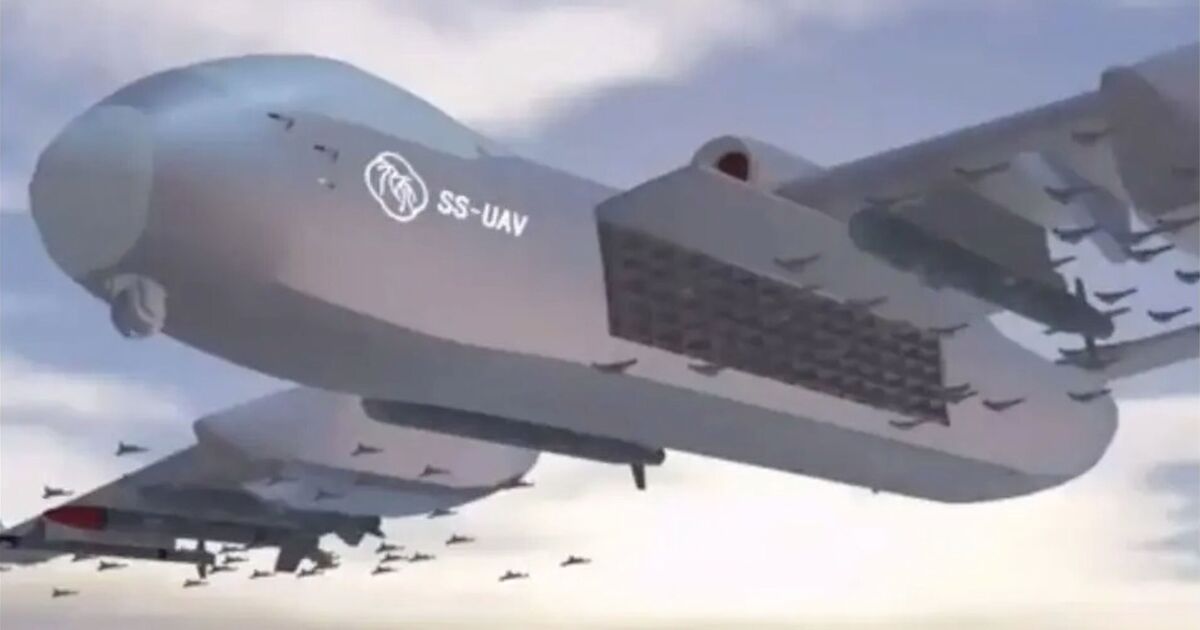

As diplomatic tensions rise around the world, China has unveiled a new type of weapons system that threatens to change the face of modern warfare. The Jiu Tian, or “High Sky,” is a massive “flying aircraft carrier” that can deliver an unstoppable swarm of drones to its target.
According to Chinese state media, the massive unmanned aircraft, first seen late last year, will fly its first operational mission this month.
With a range of more than 4,000 miles, the drone-carrying monster has eight external hardpoints to carry a six-ton payload of air-to-air, air-to-ground, or anti-ship missiles, as well as electronic-warfare or reconnaissance assets.
However the 82ft-wingspan aircraft’s main threat is its payload of 100 small suicide drones that can loiter over a target before crashing into it and detonating an explosive charge.
The drone swarm will use AI software to co-ordinate its attack and respond to any anti-aircraft defences more rapidly than any human operator can counter. General John Murray, head of the US Army’s Futures Command, said that he’s “just not sure any human can keep up” when faced with an attack from a drone swarm.
In January 2021, the European Parliament published a set of guidelines for using artificial intelligence. The clause concerning military AI reads: “The decision to select a target and take lethal action using an autonomous weapon system must always be made by a human exercising meaningful control and judgement.”
In the real world, though, those rules are unlikely to be followed. The Pentagon view is that artificial intelligences are less likely to make mistakes in the heat of battle, and they should be trusted to decide when to fire, and what to fire at.
Drone warfare has advanced dramatically since Russia’s attack on Ukraine in February 2022. The Institute for the Study of War has stated that both Russia and Ukraine have been focusing on developing drones with machine vision capabilities – allowing them to identify and autonomously attack their targets without human intervention.
By the beginning of this year small, cheap drones operated by specialist Ukrainian military units were accounting for up to 70% of the damage and destruction caused to Russian equipment in the war, according to UK-based think tank the Royal United Services Institute.
Russia’s military has developed a rival drone force and tasked electronic warfare specialists to upgrade its anti-drone technology. But Ukraine has responded by dispensing with wirelessly-operated drones and is instead deploying drones controlled via long fibre-optic cables instead.
Advances in autonomous weapons systems will soon remove the requirement for a human controller altogether.
Developments in Ukraine are being keenly followed by military leaders around the world. Taiwan, which has long feared invasion from neighbouring China, is investing in mass-produced drones and Israel’s famed Iron Dome air defence system is being upgraded to counter the threat of small, highly-manoeuvrable drones.
Late last year, a group of unidentified, and apparently unarmed, drones flying around Wright-Patterson Air Force Base near Dayton, Ohio, forced one of the largest US Air Force bases in the world to suspend all operations for around four hours. Several other NATO airbases were also affected. If that were to happen in a time of war, the consequences could be devastating.
The operational status of the Jiu Tian drone carrier highlights China’s strategic focus on swarm tactics.
In the US, the more low-tech Rapid Dragon concept, which calls for cruise missiles or drones to be deployed from transport aircraft and MBDA’s ship-launched Multi-Domain Orchestrated Swarm lag behind this dramatic development in drone warfare.
