


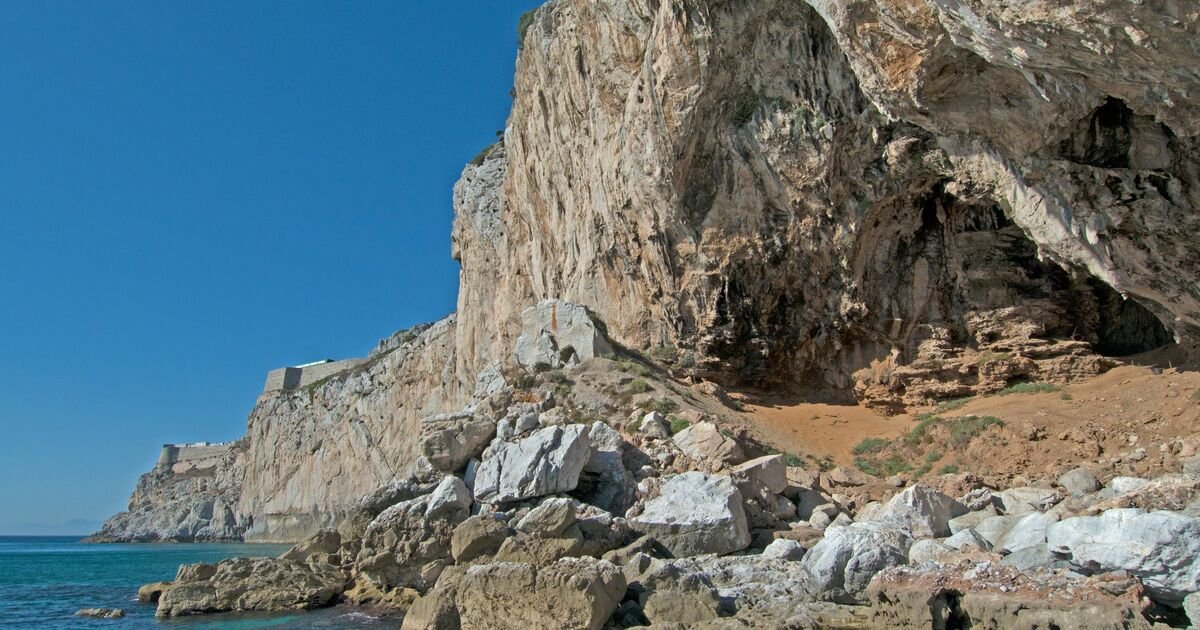
Until now scientists believed the ancient hominins went extinct on the island somewhere between 42,000 years ago. Although after exploring Gorham’s Cave recently, they are starting to question quite how long ago the Neanderthals lived.
It is now thought that they could have been living on the Rock as recently as 24,000 years ago. The scientists say this is “quite recent” and “changes human history”.
IFLScience writes: “It is typically held that these hominins went extinct around 40,000 years ago, but the artifacts in Gibraltar suggest some populations might have held on much longer.”
Gorham’s Cave was designated a UNESCO World Heritage Site in 2016 due to its historical significance. It was discovered in 1907 by Captain A. Gorham of the 2nd Battalion Royal Munster Fusiliers who was opening a fissure in the rocks at the time.
The cave is thought to have been forgotten for over 40 years, being rediscovered in 1940, with archaeological work carried out another four decades later. It is among four caves located in the steep limestone cliffs of eastern Gibraltar.
As well as Gorham’s Cave they consist of Vanguard Cave, Hyaena Cave, and Bennett’s Cave. The Neanderthals are thought to have occupied the area for around 100,000 years.
In its designation for Gorham’s Cave, UNESCO writes: “This exceptional testimony to the cultural traditions of the Neanderthals is seen notably in evidence of the hunting of birds and marine animals for food, the use of feathers for ornamentation and the presence of abstract rock engravings.”
It says scientific studies of the caves have “contributed substantially to debates about Neanderthal and human evolution”. Excavations in Gorham’s Cave have discovered a host of ancient artefacts including charcoal, bones, stone tools and burnt seeds.
Meanwhile underneath 39,000-year-old sediments, archaeologists discovered the “world’s oldest abstract art” in Gorham’s Cave during a 2012 expedition. The artwork consisted of a series of intersecting lines engraved into a ledge. It is located about 100m inside the cave on what is believed to have been used as a sleeping ledge.
In 2021 scientists discovered a new chamber in the nearby Vanguard Cave that – part of the wider Gorham’s Cave complex – lynx, hyaena and griffon vulture remains as well as what they believe is a large whelk.
Clive Finlayson, director and chief scientist at the Gibraltar National Museum, told CNN: “The whelk is at the back of that cave… it’s probably about 20 meters from the beach. Somebody took that whelk in there… over 40,000 years ago. So that’s already given me a hint that people have been in there, which is not perhaps too surprising. Those people, because of the age, can only be Neanderthals.”
He added: “How many times in your life are you going to find something that nobody’s been into for 40,000 years? It only comes once in your lifetime, I think.”