


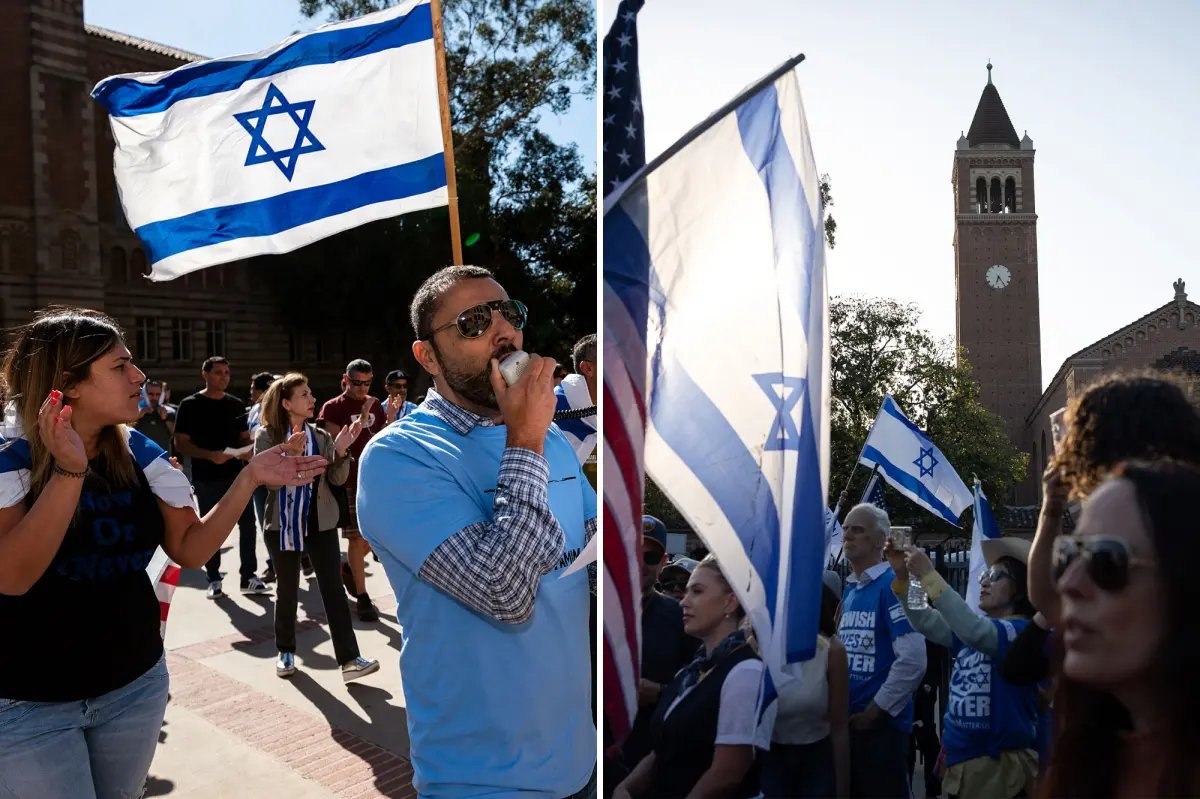
Dozens of student groups on college campuses across California have thrown their support behind the joint US-Israeli strikes on Iran — despite Gov. Gavin Newsom blasting the operation as “illegal” and “without justification.”
“We express our profound gratitude and support for the U.S. and Israeli service members operating under extraordinary conditions,” the letter, signed by 120 student groups, reads. “We stand in solidarity with these courageous men and women, and their families, as they work to degrade the structures of terrorism and safeguard the security of their nations.”


At least 26 of the student organizations are based in California, including many schools within the University of California public system, as well as the California State University system — the largest four-year public university system in the United States — and private schools.
“For 47 years, the ruling Iranian regime has prioritized regional destabilization and proxy warfare over the well-being and aspirations of its own citizens,” the organizations wrote.
Signatories include a diverse range of groups, from chapters of national organizations like Students Supporting Israel at UC Berkeley and San Diego State, to campus-specific advocacy clubs such as Bruins for Israel at UCLA, Tritons for Israel at UC San Diego, and Trojans for Israel at USC.
Participation also extends to cultural and heritage-focused groups, including the Persian Community Hillel at UCLA and UC San Diego, Mishelanu at UC Santa Barbara, and the Jewish Student Union at UC Santa Cruz. Prominent institutions across the state are well-represented, with additional support coming from groups at Stanford University, UC Davis, and several California State University campuses, including Northridge and Long Beach.
“President Trump and Prime Minister Netanyahu’s air campaign against the regime is necessary and long overdue. A democratic Iran is essential for the freedom and security of the free world,” Delilah Hirshland, a student at UCLA, told The Post. “I wholeheartedly support a free Iran,” she added.
The war began when a joint U.S.-Israeli operation killed Iranian Supreme Leader Ayatollah Ali Khamenei on February 28 in a targeted strike intended to topple the regime, according to U.S. and Israeli officials. The U.S. and Israel launched the war’s heaviest airstrikes on Iran Tuesday, moving the conflict into its third week. Earlier this month, President Trump said the U.S. has already inflicted serious damage and expects the fighting to end sooner than the four-week timeline he initially set.
The casualties of the war include a girls’ elementary school in Minab, Iran, allegedly hit by American missiles, killing dozens of children, along with U.S. service members who have also died in the conflict.
“We honor and remember the lives of the six brave U.S. service members who lost their lives in this war,” the student collective said in their statement. “We also acknowledge the significant impact of this war on the Gulf states and their citizens.”
Signatories outside of California include chapters at Ivy League and top-tier schools, such as Princeton’s B’Artzeinu, MIT Israel Alliance, Duke’s Israeli Public Affairs Committee, and Johns Hopkins’ Christians United for Israel, among others.
Many of these campuses, including NYU, University of Michigan, University of Texas, and UC Berkeley, were previously sites of major anti-Israel protests during the peak of Israel’s war in Gaza in 2024.
“A free Iran would make the world safer by ending a regime that supports terrorism and instability. It would allow the Iranian people to finally live with freedom and basic rights,” Maya Gerassi, a senior at San Diego State University, told The Post. “It would also reduce threats to Israel and the United States by weakening Iran’s network of terror proxies.”
The American public has largely opposed the U.S. war in Iran, according to several political analysts.
A Reuters/Ipsos poll found that only 27% of Americans support the conflict.
The New York Times reported Sunday that nearly 41% of Americans approve of U.S. intervention in Iran, a historic low compared with past conflicts — 97% during World War II, 92% during the war in Afghanistan, and 76% during the Iraq War.