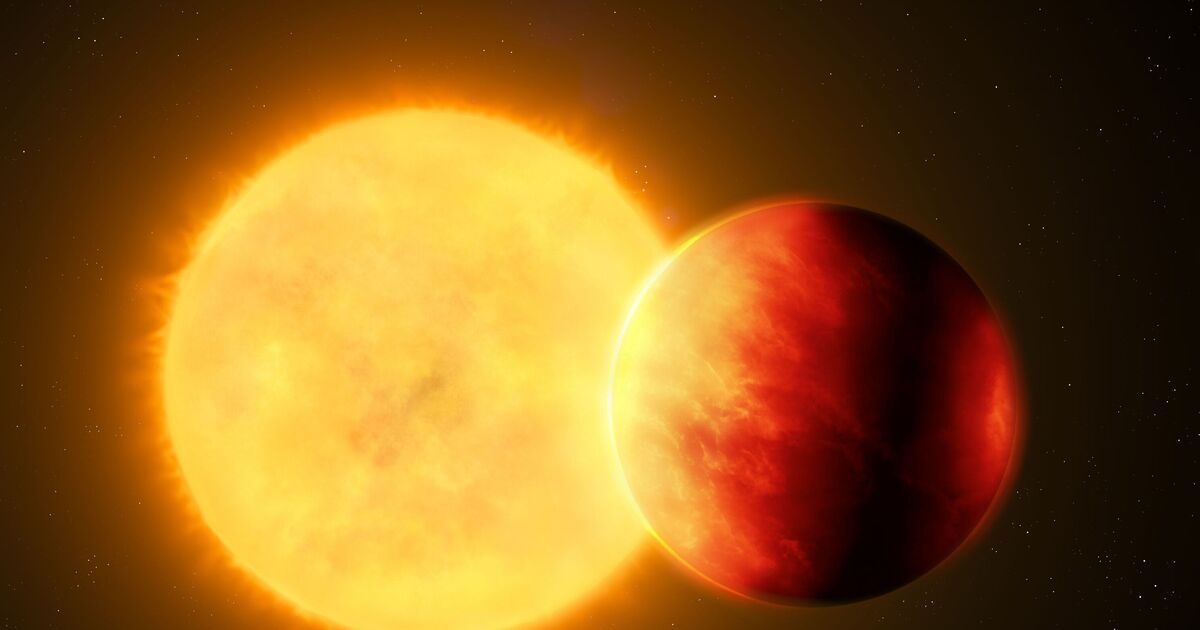

Astronomers have confirmed the discovery of a hellish alien world that’s likely being torn apart by its own star — and it’s unlike anything seen in our Solar System. The planet, named TOI-2431 b, lies 117 light-years away in the constellation Cetus and completes a full orbit in just 5 hours and 22 minutes. That makes it one of the shortest-period exoplanets ever discovered — and the shortest known orbit for any planet circling a K-type star.
TOI-2431 b is roughly 1.5 times the size of Earth and six times as massive, placing it firmly in the category of rocky “super-Earths”. But the extreme closeness to its host star means it’s almost certainly a lava world, with a surface temperature of more than 1,700C — hot enough to melt rock. Its dayside is likely a molten sea of silicates, while the planet’s nightside — assuming any temperature variation even exists — may be only slightly cooler. Any atmosphere it once had has probably been blasted away by stellar radiation.
Dr Kaya Han Taş, the study’s lead author from the University of Amsterdam, confirmed the discovery using a combination of data from NASA’s Transiting Exoplanet Survey Satellite (TESS), radial velocity measurements from NEID and HPF spectrographs, and speckle imaging with NESSI. The results were published on preprint server arXiv earlier this month.
The researchers wrote: “”We have confirmed the ultra-short period planet TOI-2431 b using a combination of photometric transit data from TESS, precise radial velocity observations with the NEID and HPF spectrographs, and ground-based speckle imaging with the NESSI instrument.”
TOI-2431 b is also a planet on borrowed time. It sits just 30% above the Roche limit — the theoretical boundary within which a planet can be torn apart by tidal forces.
Researchers estimate the planet’s orbit is slowly decaying and could spiral into its star within 31 million years — a blink of an eye in cosmic terms.
The extreme conditions and short lifespan make TOI-2431 b a rare and valuable target for future research.
The planet has a strong emission spectroscopy signal — suggesting it could be probed in more detail by instruments like the James Webb Space Telescope.
It may be a doomed world, but TOI-2431 b is offering scientists a unique window into how planetary systems evolve — and sometimes, how they end.
