


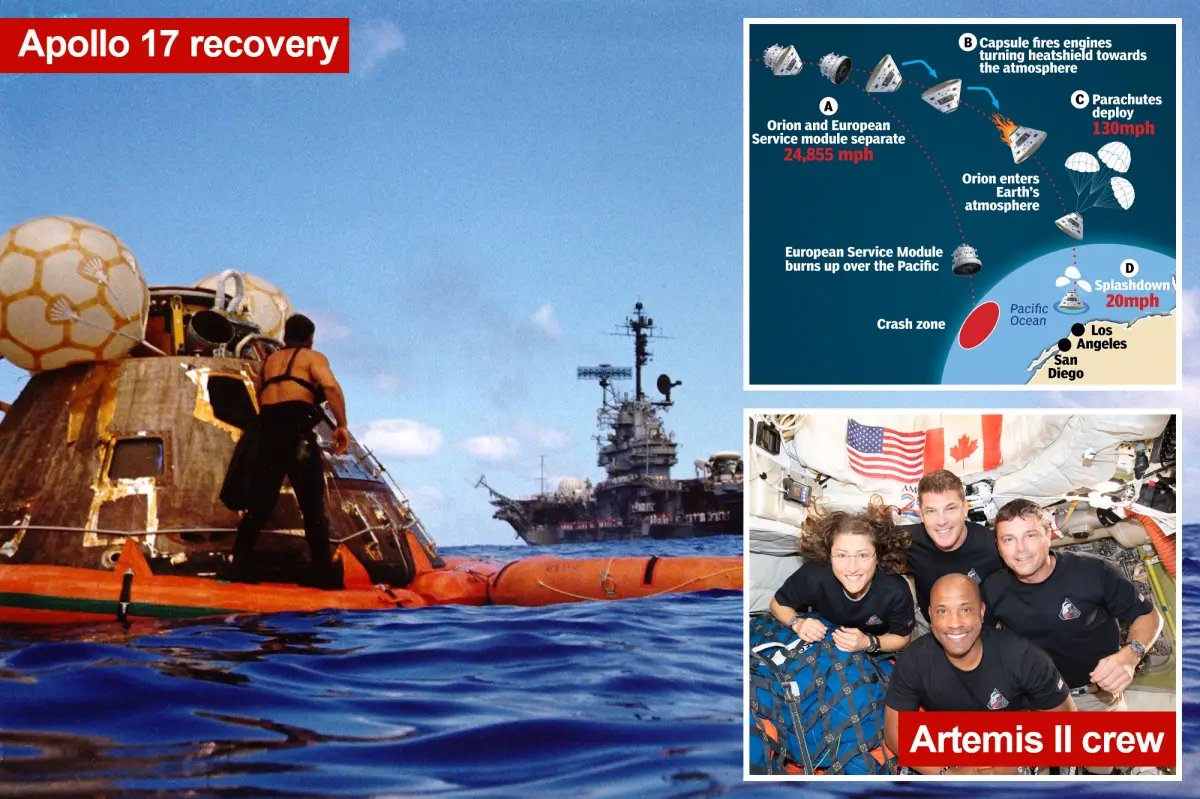

Artemis II’s long journey to the moon and back is expected to end with a glorious splashdown in the Pacific Ocean Friday evening.
The crew is scheduled to hit the water around 8:07 p.m. ET about 80 miles off the coast of San Diego, concluding a historic 685,000-mile flight that began 10 days ago on the Florida coast and marked the first manned flight to the moon in 54 years.
Friday’s splashdown is unlikely to be as dazzling a sight here on Earth as the April 1 launch was — but the astronauts will have a show from within their capsule as they soar through the atmosphere at nearly 25,000 mph on a tail of fire and the capsule heats to upward of 5,000 degrees Fahrenheit.
NASA said they’ll feel 3.9 Gs on the way back to terra firma — and hit a maximum velocity of 23,864 mph.
Parachutes will then deploy to slow the capsule, until it hits the water at around 17 mph, and the crew is snatched up by a waiting recovery ship.
A Navy transport dock ship, the USS John P. Murtha, will be in position with a crew of divers and helicopters to make sure Artemis II’s brave astronauts — Cmdr. Reid Wiseman, pilot Victor Glover, and specialists Jeremy Hensen and Christina Koch — are recovered safely from the capsule.
And safety will be at the forefront of everybody’s mind Friday evening — reentry takes about 14 minutes, but those short moments are packed with more opportunities for catastrophe than almost the entire mission combined.
Of primary concern is Artemis II’s heat shield — a 16.5-foot-wide layer of material along the bottom of the capsule that will face the Earth during reentry, which is designed to melt away at a controlled rate and protect the crew from the violent temperatures of the descent.
But the Artemis II shield has never been tested, and its contemporary on Artemis I was left pocked with dozens of alarming fractures when it returned to Earth on its uncrewed 2022 flight. Orion capsule builder Lockheed Martin was confident they had rectified the problem, however, and NASA gave Artemis II the go-ahead with an updated shield design.
Follow the latest on NASA’s Artemis II:
Even if the heat shield works flawlessly, it won’t mean a thing if the capsule isn’t properly maneuvered for reentry — if it enters at too steep an angle then the capsule could burn up and incinerate the crew, while if it the angle is too shallow, the capsule could miss its splashdown target and fall on land or other hazards.
And the most frightening outcome of a shallow entry would be the capsule skipping off the atmosphere like a stone to a pond and sending the crew hurdling off into space.
The Orion capsule is capable of keeping the crew alive for 11 days beyond its 10-day flight, though it remains unclear what capability it would have for reaching Earth again if it skipped away.
Manned spacecraft have returned to Earth dozens of times without problem since human spaceflight began in 1961, but disasters have happened.
Russian cosmonaut Vladimir Komarov died during reentry in 1967 when his parachutes failed to deploy on Soyuz 1, a flight which was marred by mismanagement from leadership and ordered to fly despite known problems.
Three more cosmonauts, Georgy Dobrovolsky, Viktor Patsayev and Vladislav Volkov, died in 1971 when their Soyuz capsule unexpectedly depressurized during reentry.
And the space shuttle Columbia exploded during its 2003 reentry, killing all seven crewmembers. That disaster was caused by a piece of debris which struck the shuttle’s wing during launch, with the damage allowing super-heated gases to enter and destroy the ship during reentry.
But Artemis II has spent the days ahead of splashdown ensuring all systems are go for a safe return.
The crew has fired its thrusters for trajectory corrections burns on the way home from the moon to make sure they enter Earth’s atmosphere precisely within the narrow window required for a safe return, and also tested out systems needed for reentry.
Mission Control in Houston has also been watching the capsule’s exterior cameras to make sure the craft has sustained no damage and is safe for splashdown, while the crew began preparing the cabin by stowing and securing gear on Thursday.
The astronauts’ last day in space will begin at 11:35 a.m. ET when they awaken, and further preparations will immediately begin.
They will don their spacesuits — which are bright orange for maximum visibility in the event of a rescue, and packed with a host of survival gear — and will strap themselves into their seats.
Reentry will be underway in full by 7:33 p.m., when the Orion crew capsule detaches from the service module — which houses the craft’s primary thrusters — and then positions itself to make sure the heat shield faces the planet during reentry.
It will then begin dropping into the atmosphere around 7:53 p.m. while about 76 miles from the Earth.
The ride down will be rocky for the crew, but they’ll be treated to a rare lightshow as a shroud of plasma and fire surrounds the capsule and streaks behind them. They will also lose contact with Mission Control for about six minutes while they’re surrounded by the plasma.
A pair of drogue parachutes will first deploy at 25,000 feet to slow the capsule down to around 300 mph, then at 9,500 feet a trio of parachutes will deploy to slow the capsule to 130 mph, and finally three 116-foot-wide main parachutes will unfurl and slow the capsule down to 17 mph before splash down.
Airbags will automatically inflate to make sure the capsule becomes upright, and the crew will wait for about an hour while the capsule is opened by a recovery team and they’re whisked away in a helicopter.
The chrome capsule will also have become a scalded black and brown because the reentry violence — but if everything goes well, the crew will be safe and sound and have completed the first steps toward walking on the moon again during 2028’s Artemis IV.