


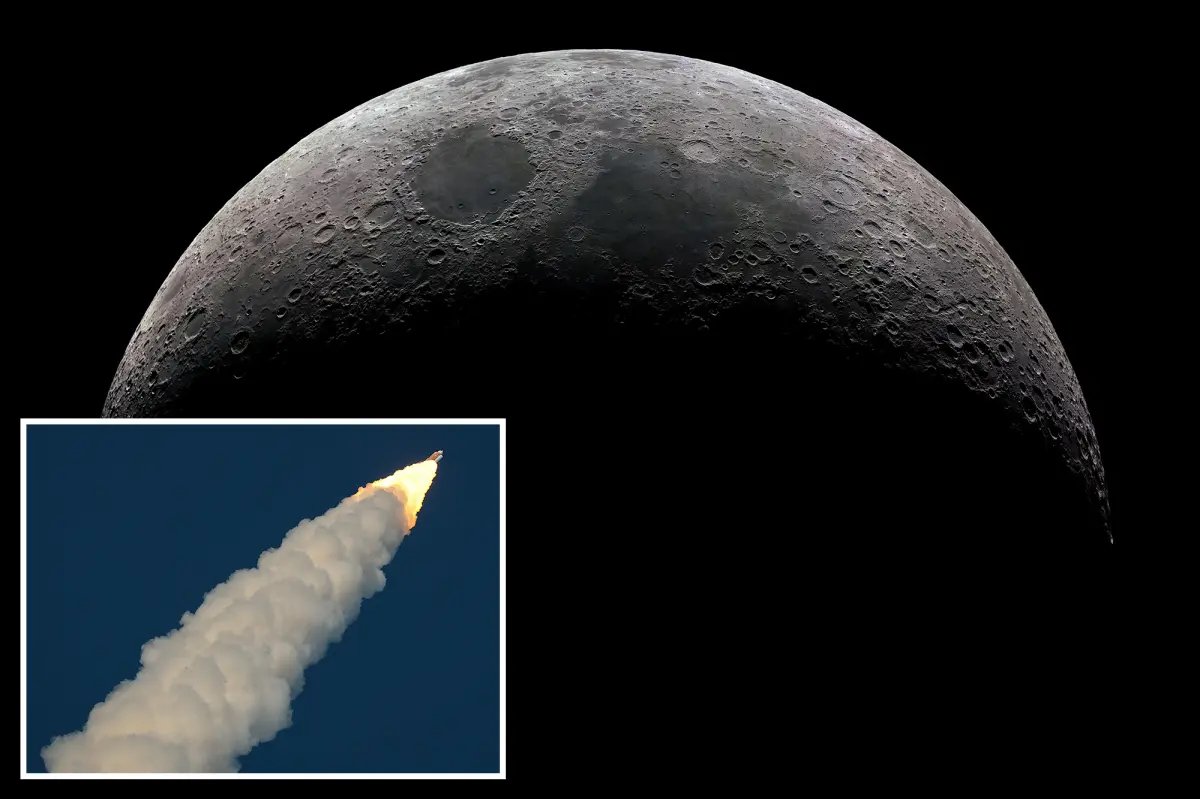

And now for the dangerous part.
Artemis II is officially flying to the moon after firing its thrusters and leaving Earth’s orbit at 7:49 p.m. — beginning an epic four-day journey that will take the crew where only 24 humans have gone before.
The Orion capsule flawlessly executed the nearly six-minute maneuver — known as the translunar ejection burn — Thursday night, just over a day after the historic mission launched from Florida’s Cape Canaveral.
Artemis II had been slowly circling the Earth in a large elliptical orbit since the launch, but the injection burn accelerated the capsule to about 22,000 mph and broke it free from orbit — launching it into the empty 250,000 mile vastness between the Earth and moon known as the cislunar space.
The mission’s four-person crew — Cmdr. Reid Wiseman, specialists Christina Koch and Jeremy Hansen, and pilot Victor Glover — will now buckle down for a four-day journey into deep space before arriving at the moon on Monday evening, if everything goes to plan.
Artemis II will be flying by Isaac Newton’s first law of motion — an object in motion stays in motion — for the duration of that trip, with the thrusters firing only for a series of minor adjustments to ensure its trajectory is correct.
Those correction burns will be vitally important, however. Even the smallest trajectory error could send the crew smashing into the moon or soaring off into endless space.
By Sunday — Day 5 — the capsule will have slowed down due to the drag of Earth’s gravity, but it will enter the lunar sphere of gravitational influence and begin to accelerate towards the moon.
AP
And Monday — Day 6 — will bring about the highly anticipated lunar flyby, when the crew will come within 4,000 miles of the moon and see its far side in sunlight for the first time with human eyes.
Exactly what time the flyby will begin is subject to change, but it would be around 4:30 p.m. based on the current flight plan.
Follow the latest on NASA’s Artemis launch:
Artemis II will make its closest approach to the lunar surface around 8 p.m. Monday — when the moon will appear out the capsule window to be about the size of a basketball held at arms length. That will be the closest any human has been to the moon since Apollo 17 left it behind in 1972.
Live looks at the flyby may be limited — and will cut out entirely for upwards of 50 minutes — as the moon blocks Artemis II’s communications with the Earth.
Monday could also break Apollo 13’s 1970 distance-from-earth record — 248,655 miles — with Artemis II expected to near 250,000 miles as it whips around the moon, meaning the crew members will travel further from Earth than any human in history.
Tuesday — Day 7 — will see the capsule heading back to Earth and leaving the moon’s gravitational sphere of influence.
Follow The Post’s live updates on the launch of NASA’s Artemis II mission to the moon
No translunar injection burn will be required for the trip home, because Artemis II will have utilized the moon’s gravity to slingshot itself around the satellite — and ride that momentum all the way home.
On Day 10 — Friday, April 10 — Artemis II will land back on Earth, with the capsule expected to begin descending through the atmosphere around 8 p.m.
Splashdown in the Pacific Ocean near San Diego will occur within minutes — currently expected 8:06 p.m. — with a press conference scheduled for 10:35 p.m. in Houston, though the astronauts may not attend that briefing in person.
The crew will have flown a staggering 685,000 miles in a massive figure-eight by the time the mission is completed.
Though the Artemis II objectives are mostly closely aligned with 1968’s Apollo 8 — which tested both the Saturn V rocket’s ability to send a crew to the moon, and the Apollo command module’s capabilities maneuvering to the moon and back — its actual flight path will most closely resemble Apollo 13.
That mission was intended to land on the moon, but after an oxygen tank exploded and power was lost the crew utilized the moon’s gravitational pull to slingshot themselves back to Earth — in exactly the same fashion Artemis II is preparing to do.
Artemis II’s mission so far has been without any major hitches, but a few minor speedbumps have arisen — notably in the bathroom department.
The capsule’s highly-anticipated hi-tech space toilet — complete with door for privacy — immediately malfunctioned after launch. And though it took hours, the problem was mercifully rectified.
All systems are a now “Go.”