
The history of where humans derived from has been a topic that has compelled experts for years.
While the modern day human is usually linked to homo sapiens, scientists have discovered another human relative that had been previously unknown.
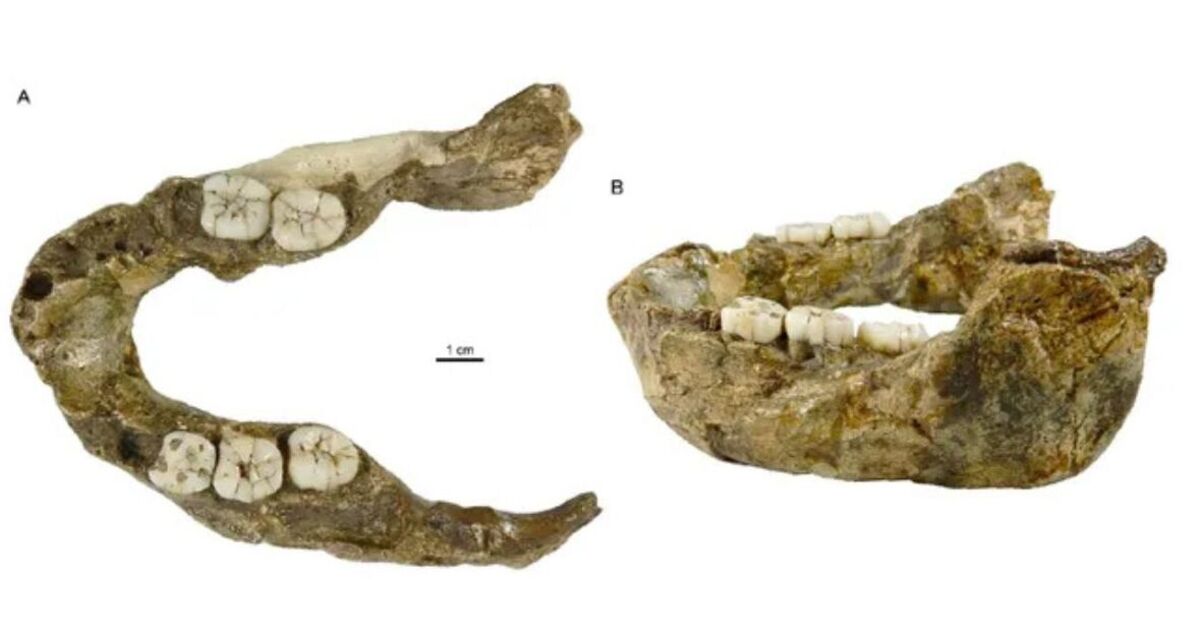
A new study found that a 1.4 million-year-old jaw belonged to the genus Paranthropus from southern Africa. The exctinct spieces is nicknamed “nutcracker man” because of its huge jaws and molars.
However, the recently discovered nutcracker man has a smaller jawbone and teeth, which suggests that they weren’t so apt after all.
When the Paranthropus roamed the earth, there were also other species alive and closer related to humans than chimps. Our genus, Homo came about arround 2.8 million years ago, while our species, Homo sapiens go back at least 300,000 years ago.
This means that early Homo species would have been alive at the same time as the Paranthroupus. Scientists previously knew about three Paranthropus species including P.aethiopicus, P.boisei and P. robustus.
They lived between one million and 2.7 million years ago, reports Live Science.
The new study revealed that the ancient jaw named SK 15 was originally unearthed in 1949 in a South African cave known as Swartkrans. Other Paranthropus fossils and early Homo specimens were also discovered at the site.
Paleoanthropologist at the University of Bordeaux, Clement Zanolli, who is the lead author of the study, told Live Science: “Swartkrans is thus a key site to uncover the extent of hominin diversity and understand the potential interactions among various hominin species.”
It was first thought that SK 15 belonged to the never seen before Telanthropus capensis species but since the 1960s it was believed that it came from the early human species known as Homo ergaster.
The researchers carried out X-ray scans of the jaw as well as other fossils to create virtual 3D models of the specimens to get a better understanding of their internal and external structures.
To their surpsied they discovered that SK 15 was likely not H. ergaster but actually the previously unknown Parathropus, which the lead author revealed was “the first time since the 1970s that a new species of Paranthropus was identified.”
The external structure of the jaw does resemble H. ergaster however, it looks “a bit weird for Homo,” says Clement Zanolli.
He continued by comparing the two structures highlighting that SK 15 jaw was much thicker compared to Homo jaws and the Parathropus molars were quite long and rectangular in comparison to the more rounded molars found on Homo.
Going deeper, the scientists found that the internal structure of the teeth, specifically the portion of the dentine below the enamel in the crown of the teeth, did not match any known Homo specimen.
Therefore, based on the jaw shape, the sizes and shapes of both the crowns and roots of the teeth, it was concluded that SK 15 most likely belonged to Parathropus but the structure still looked different to any known Parathropus specimen.
The jaw and teeth were significantly smaller and so the findings suggest that SK 15 does not belong to any of the three known Parathropus species and it therefore belongs to a newly discovered one, which they named P. capensis.
At least two Parathropus species, P. robustus and P. capensis were living at the same time in southern Africa around 1.4 million years ago.
Though it might be difficult for the scientists to currently determine the evolutionary end of the P. capensis, Clement Zanolli said that their might have been a species of Paranthropus “that survived much longer than we currently know.”
