


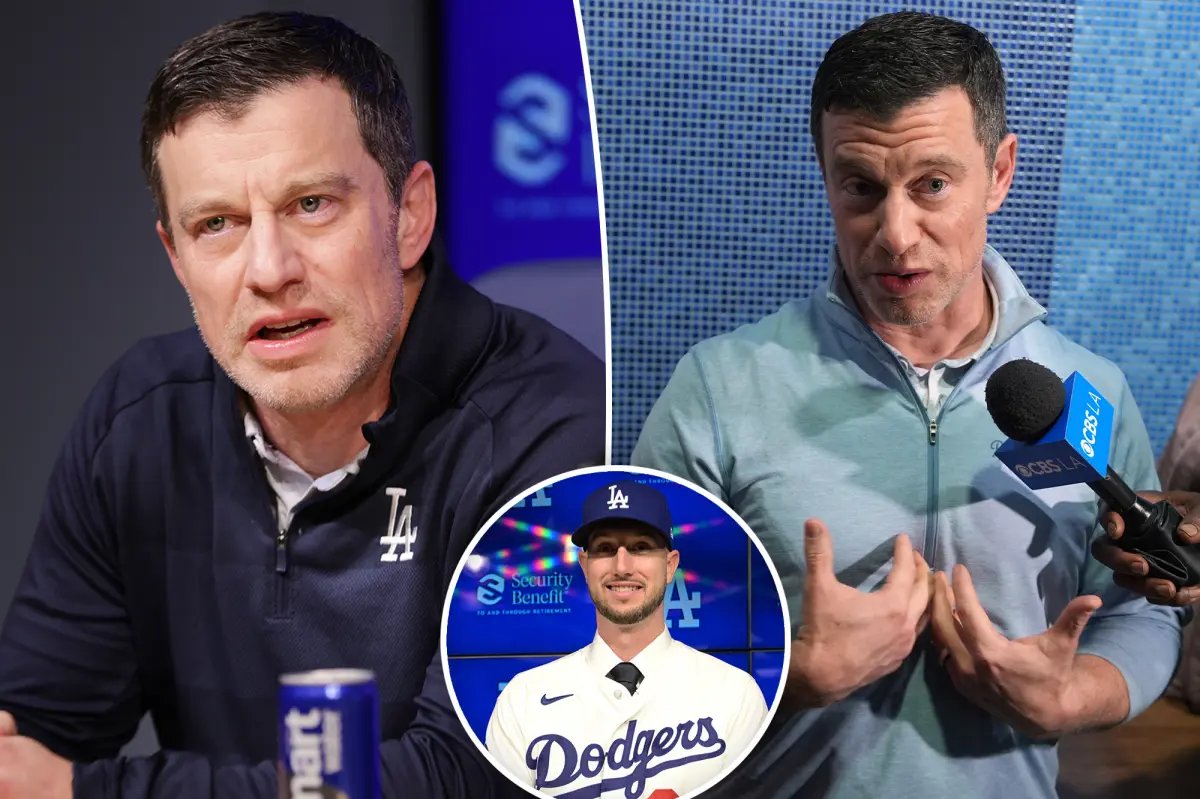

The first time Andrew Friedman reached the World Series as a general manager, his upstart 2008 Tampa Bay Rays team had a payroll of $43 million, the second-smallest in the majors that year.
When last year’s Friedman-built Dodgers squad won its second-consecutive World Series title, the club’s star-studded roster cost almost 10 times that amount, with a record-setting $415 million payroll that incurred another $169 million in luxury tax penalties on top of it all.
Looking back at that juxtaposition now, Friedman can’t help but chuckle.
“(When I got to the Dodgers), I didn’t even know what the CBT really was, or how it exactly worked,” he said. “And even to think back to where we were then, to where we are now, is comical.”
Indeed, such has been the transformation of not only the Dodgers in recent years, but also their longtime president of baseball operations.
Once the posterboy for small-market success, sustainable spending, and an analytically-driven approach that was supposed to help negate the traditional financial disparities within the salary cap-less sport, Friedman has a new reputation now:
Architect of a villainous Dodgers dynasty widely criticized as being “bad for baseball.”
“I’ve heard that over the last couple years,” Friedman deadpanned last month, when asked about public outcries over the Dodgers’ near-limitless spending. “For us, all we’re consumed with is the partnership that we have with our fans … That’s our only focus.”
For much of his 20-year front office career, of course, Friedman operated differently.
In Tampa Bay, he built a consistent winner on shoestring budgets, pioneering a value-based operation to work around the club’s financial limitations. Even early in his Dodgers tenure, he practiced fiscal constraint when constructing his teams, occasionally dipping under the luxury tax threshold while avoiding many big-money free-agent signings.
That all changed when the Dodgers signed Shohei Ohtani two offseasons ago –– turning the team into a revenue-generating machine with resources unmatched by any other club in baseball.
Download The California Post App, follow us on social, and subscribe to our newsletters
California Post News: Facebook, Instagram, TikTok, X, YouTube, WhatsApp, LinkedIn
California Post Sports Facebook, Instagram, TikTok, YouTube, X
California Post Opinion
California Post Newsletters: Sign up here!
California Post App: Download here!
Home delivery: Sign up here!
Page Six Hollywood: Sign up here!
Since then, Friedman has embraced his new financial reality, completing one star signing after another, including additions of Edwin Diaz and Kyle Tucker this winter that have pushed the team’s 2026 payroll back over the $400 million mark.
“The moment that we signed Shohei, it was important to back that up and continue to show our commitment to winning and reinvesting in the team,” Friedman said in a recent interview with The California Post. “How that has played out, in conjunction with having Shohei, I think has increased (our willingness to spend) and made it an even more aggressive plan than we initially thought. But again, we didn’t sit down and say, ‘OK, now it can be X instead of Y.’ It was more like, let’s be more aggressive. And as we’ve done that, aggressiveness has beget more aggressiveness.”
Friedman didn’t always envision, or even seek, this kind of opportunity. During his time in Tampa Bay, “I thought I was going to be with the Rays forever,” he said.
Coming to the Dodgers in 2014, however, represented what he described as a “perfect situation” –– in large part because it meant “throwing myself in the deep end and activating a totally different part of my brain.”
A decade later, it has led more of Friedman’s offseason focus to now be on pursuing top free agents with eye-popping financial proposals, rather than more marginal maneuvers with payroll management in mind.
And while the Dodgers “are doing some things that probably aren’t sustainable, or we probably wouldn’t do for 10, 15, 20 years,” he acknowledged, the opportunity to capitalize on this current window has warranted such a drastic change in spending habits.
“(We are) appreciating this moment in time and the talent we have on our roster,” he said, “and not being flippant about the fact that it will always be like this.”
When asked if such unprecedented resources has made his job any less stressful, Friedman paused to consider his career path.
“Whatever the rules are, whatever the unique challenges of your market and situation are, my focus has always been on just doing the best that we can to put the best team on the field and give us the best chance to win a championship,” he said. “So while it’s been very different in my two experiences, the pressure you feel, the work you put in, feels very similar. Because the constraints are given to you, and then you do your best within them to do the best you can.”
Still, the fact that the constraints are so much less now has led to a marked shift –– turning the man who once represented the antithesis to the Dodgers’ current style of spending, the face of a deep-pocketed dynasty sparing no expense in its hunts for more championships.
“I think it speaks to the success that we’ve been able to enjoy organizationally,” Friedman said. “And our mindset is to pump that back into our team on the field.”