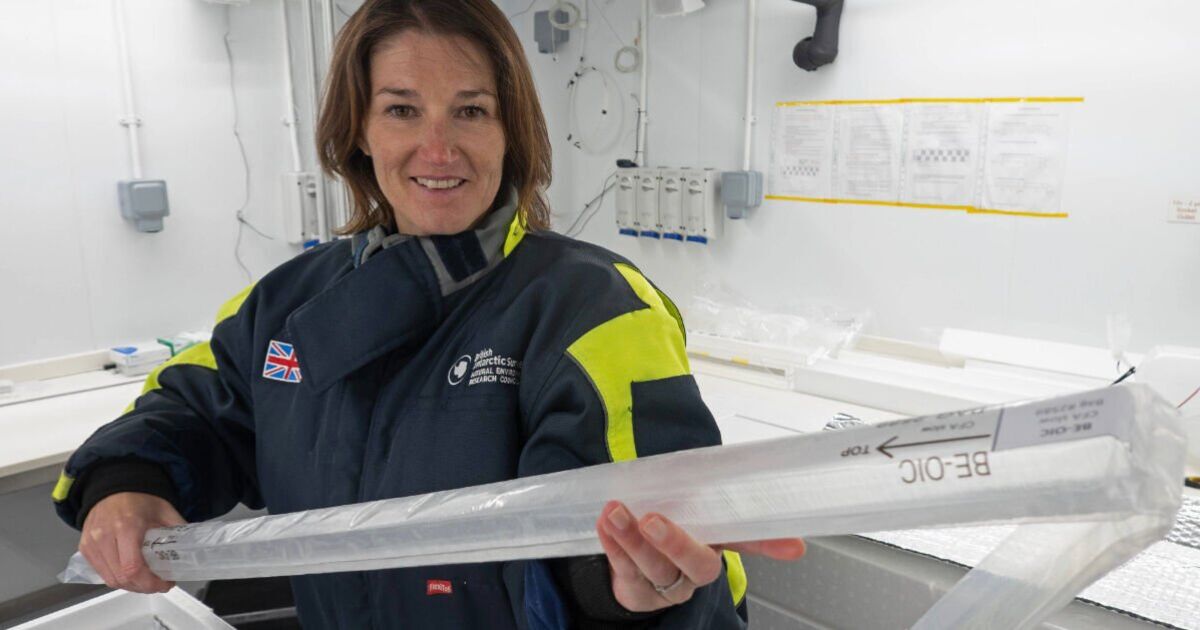

Icicles hang in the corner of the -25C laboratory where scientists are preparing to unravel the secrets of the oldest ice core ever collected from Antarctica. Precious rods thought to be up to 1.5 million years old sit in polystyrene chill boxes, under a network of whirring fans that maintain the precise temperature.
Their arrival at British Antarctic Survey’s Cambridge headquarters last week was a moment decades in the making. After carefully selecting a site using radar analysis, Europe’s top ice engineers drilled down 2.8km over four summers to extract this continuous climate record in 4.5m sticks. The cores were transported by land, air and sea to Italy, then Germany, where they were further divided.
Scientists at BAS will now use their 190m share to study the chemical elements, particles and isotopes in the ice, which acts like a time capsule revealing the atmospheric composition many thousands of years ago.
It is hoped the work will help them better understand the natural processes that drive climate change, improving predictions about what will happen in years to come.
Climate scientist Dr Liz Thomas explained: “We know that humans are influencing the climate right now, and climate change is happening, but underlying that is always going to be this natural variability. We need to be able to understand that to make sure that the predictions going into the future are better.
“It’s effectively almost a crystal ball. We’ve got a chance of looking back in time and seeing when the Earth was in this similar condition and understand how quickly things changed. And, ultimately, as humans, we want to know what will happen next.”
After years of radar and topography analysis to choose the perfect spot, digging began in 2020 and continued for five years, with one season off during the pandemic.
Ice core drilling engineer James Veale spent many hours in -40C conditions, wrapped in multiple layers and eating far more calories than usual to stay warm.
Mr Veale said: “Every two hours when we pulled out our next bit of ice, we knew we were getting closer and closer to the oldest ice that’s going to give us the information we desperately need.”
The engineer said it was “amazing” to see the ice finally reach BAS’s labs and made those tough weeks “all worth it”.
So, once you have extracted ancient ice, how do you discover its secrets? You melt it. In the cold lab, the ice cores will be fed into a melting device that produces a steady stream of water which is fed through a pipe into the room next door.
The temperature is still chilly but more bearable there, where banks of instruments and machines are waiting to collect a wealth of data.
Staff will work from 7am until 10pm for seven weeks to complete the data collection by October. Other analysis will also look for microbes in the ice, including single-celled algae called marine diatoms.
Dr Thomas said: “The period that we’re really interested in with this particular ice core goes back to a time when we think the ice sheets were much smaller than they are now.
“So this is a time when we can go back in history and look at when there were potentially smaller ice sheets, because they had melted away because it was warmer, so sea levels would have been higher. We can use that information to better understand how we may be changing in the future.”
The pressure is high. Dr Thomas added: “This is one shot, if we don’t get the information we needed from it we haven’t got the option of going back again.”
Scientists will spend months interpreting the data and hope to present their first findings towards the end of next year.
The oldest ice core project has brought together researchers from 10 European countries and 12 institutions. It builds on the previous extraction of the EPICA dome C ice core 20 years ago, which provided a continuous record dating back 800,000 years.
Dominic Hodgson, BAS’s acting director of science, said: “For the past 20 years, 800,000 years has been where the story ends. Now, with the ice core that arrived in BAS just last week, we can extend the story back to 1.4 or 1.5 million years. That spans a very important climate transition.”
