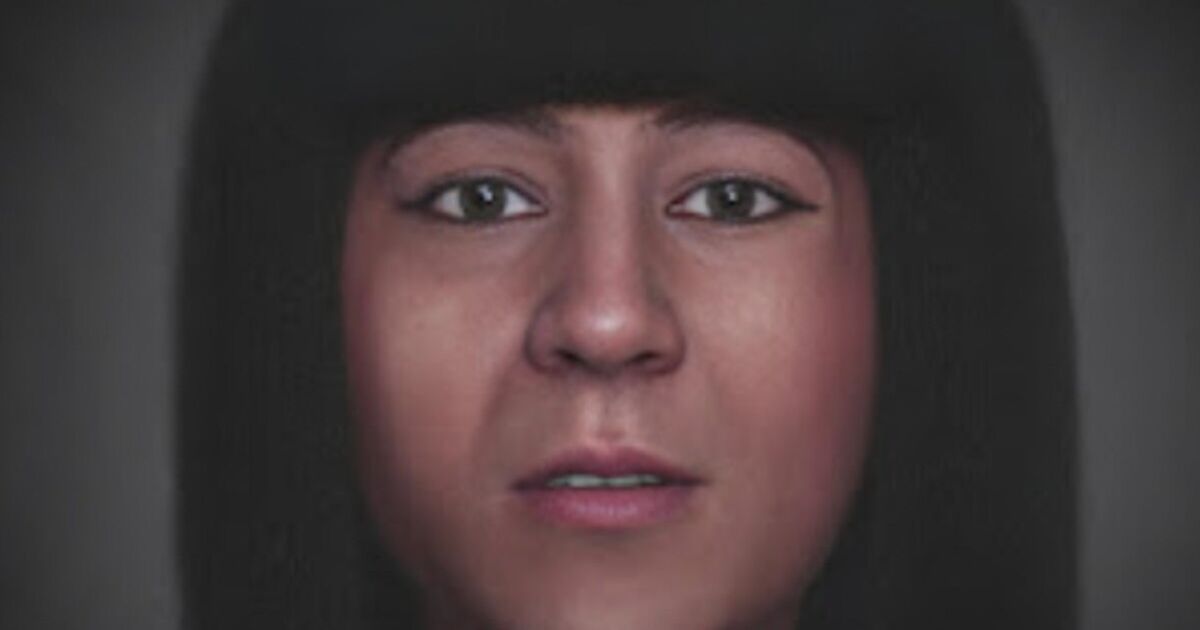

The “dignified” and “gentle” face of an ancient Egyptian priestess has been revealed for the first time in 2,800 years. Meresamun had a role of “high religious prestige” in the inner sanctum of the temple at Karnak, before her untimely death in mysterious circumstances.
She was said to be able to calm the gods with her beautiful voice and singing, which she would perform during religious rituals. She died at around the age of 30 and was buried in an elaborately decorated casket that has never been opened. It bears her name, her role as a singer, and the inscription “she lives for Amun” (an Egyptian god).
The coffin containing her mummified form was purchased in 1920 by American archaeologist James Henry Breasted.
Thanks to new research using CT scans, her face has now been revealed for the first time since the Iron Age.
Cicero Moraes, lead author of the study, used scan data from the mummy’s skull to recreate Meresamun’s likeness.
“She looks elegant,” he said. “The reconstruction presents a harmonious and serene face, with features that suggest dignity and gentleness.
“While any aesthetic interpretation involves a degree of speculation, the goal was to maintain a respectful image aligned with the deceased’s social role.”
Meresamun is believed to have come from an elite Thebes’ family and was probably trained for her role by her mother – often several generations of women from a single family worked as temple singers.
To recreate her face, Mr Moraes combined different techniques. First, soft tissue thickness markers were applied to a virtual recreation of Meresamun’s skull, guided by data from living donors, revealing the likely shape of her face.
Then a technique called anatomical deformation was used, in which a virtual model of a donor’s face and skull is warped until it matches the subject’s dimensions.
The resulting faces were then combined to give a objective reconstruction in greyscale, to which subjective elements like skin tone, and eye and hair colour were added.
Mr Moraes, a Brazilian graphics expert prolific in the field of forensic facial reconstructions, has previously worked with police to recreate and identify the faces of crime victims.
Based on his experiences, he’s confident that his recreation of Meresamun offers a good likeness.
He added he had found no evident signs of disease or an identifiable cause of her death.
Mr Moraes published his study in the journal OrtogOnLineMag.
It comes after UK archaeologists have undiscovered a 2,400 year-old Egyptian metropolis who worshipped a cobra goddess – thanks to state-of-the-art satellite imagery.
