
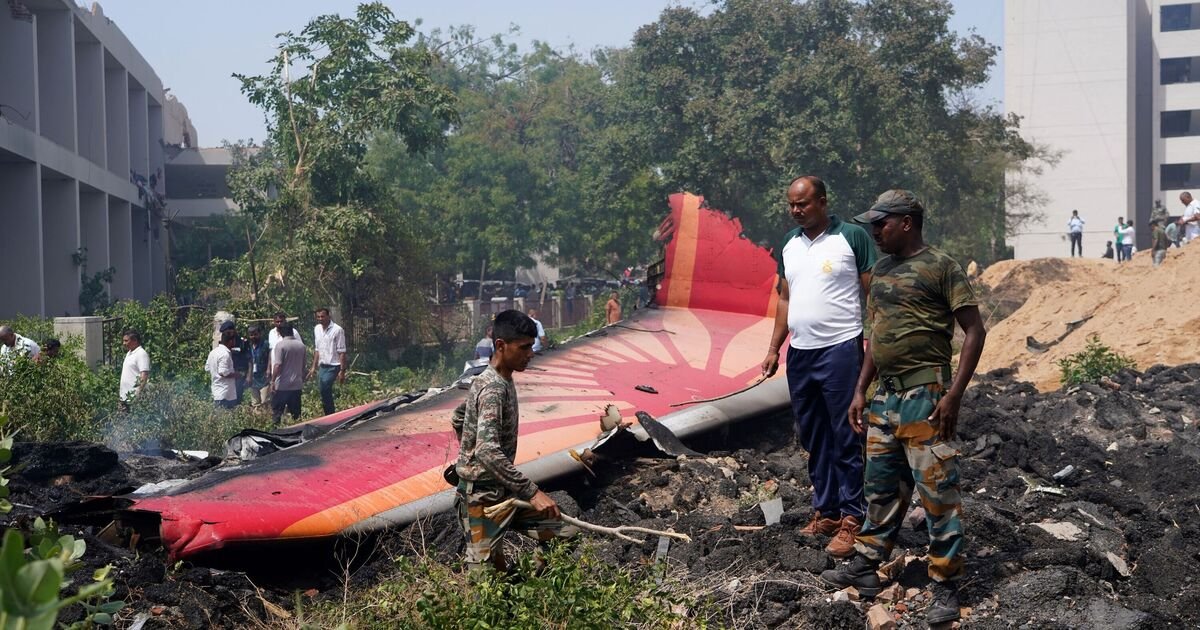


Only one person survived the crash. (Image: Getty)
Theories are swirling regarding the cause of yesterday’s Air India crash, which killed all but one passenger after the aircraft hit a hostel shortly after takeoff. The flight from Ahmedabad, Gujarat, India, was bound for London Gatwick Airport. Officials said 242 passengers and crew were on the aircraft, including 53 British nationals, 169 Indian nationals, one Canadian national and seven Portuguese nationals. There was only one survivor – 40-year-old Vishwash Kumar Ramesh.
The Brit was seated in 11A, right by an emergency exit, and managed to escape the wreckage. He told DD News: “I still can’t believe how I survived. For a moment, I felt like I was going to die too… But when I opened my eyes and looked around, I realised I was alive. At first, I thought I was dead… Later, I realised I was still alive and saw an opening in the fuselage. I saw people dying in front of my eyes – the air hostesses, and two people I saw near me… I walked out of the rubble.”
READ MORE: Indian PM meets sole survivor of Air India plane crash as 200 bodies recovered

The plane crashed shortly after takeoff. (Image: Getty)
Engine failure/mechanical issues
As investigators comb through the wreckage, they’ll be searching for signs of a failure, possibly power-related, that left the pilots unable to control their aircraft in the crucial seconds after takeoff.
Philip Baum, visiting professor of aviation security at Coventry University, told The Independent that it “seems likely” the accident was caused by system or multiple systems failures.
Questions have been raised about whether the plane had its Ram Air Turbine (RAT) deployed, an emergency back-up turbine that kicks in when main engines fail to generate power for essential systems.
Double engine failures are almost unheard of, with the most notable example being the 2009 “Miracle on the Hudson”.
One senior aviator confided to the BBC that dual engine failure might also be caused by fuel contamination or clogging, noting how critical the fuel system is for aircraft engines, with blockages potentially causing fuel starvation and engine shutdown.

A British man was the only survivor of the crash. (Image: Getty)
Bird strike
The Boeing 787, a twin-engined aircraft, is designed to manage takeoff on just one engine, even during the case of a bird strike at lift-off.
Still, Ahmedabad Airport’ has a concerning reputation for bird strikes. A study from 2018 highlighted that the airport faced “a high potential of bird-aircraft collision hazards”.
Shocking official figures for 2023 positioned Ahmedabad airport as having the second-highest number of bird strikes in India, with its 81 instances, trailing only behind Delhi’s 169, despite handling merely a quarter of the flights.
According to the Civil Aviation Ministry, 462 bird strikes were documented within Gujarat state over five years, most of which occurred at Ahmedabad airport.
Salil Colge, a Mumbai-born aviation management lecturer at University College Birmingham, told The Telegraph: “Historically, there have been reports of several bird strikes in this area in the past, and that could be one of the possibilities.”

There are many theories on what caused the crash. (Image: Getty)
Pilot error
It’s understood that the co-pilot, Clive Kundar, who had over 1,000 hours of flying experience, made a mayday call shortly after takeoff. He was accompanied by a trained instructor with more than 8,000 hours of experience, Captain Sumeet Sabharwal.
Radar tracking indicated that the pilots did not use the full length of the runway for take-off, instead joining at an intersection around halfway. Estimates suggested that the pilots used slightly less than 2,000 metres of the runway.
Experts told The Telegraph that on a hot day, with the plane almost fully loaded and carrying enough fuel for a nine-hour flight, the recommended runway length would likely be around 2,500 metres as a minimum.
Due to lower air density on a hot day, planes achieve less lift, meaning they need to go faster to achieve the same lift as on a cooler day. Flight AI171 took off in the early afternoon sunshine of Gujarat, with temperatures reaching 40°C.
A plane struggling with insufficient speed or lift could collide with a low obstacle or fail to take off properly.
Plane flaps
Aviation specialists have hinted that recent video footage capturing the final moments of the flight indicated the wing flaps were not correctly positioned.
Wing flaps are pivotal in making an aircraft aerodynamic for liftoff, but some said they were fully retracted. The aircraft’s wheels also remained down despite usually being stowed immediately after takeoff on a 787.
The wheels may have got stuck, leading the pilots to perhaps retract the flaps in an attempt to reduce drag and sustain lift off. Another reason could be a technical glitch with the flaps, preventing them from responding to pilot controls.
Former pilot Marco Chan spoke to BBC Verify, explaining the shared footage was too blurry to determine whether the flaps were outstretched, but he noted such a fault would be “highly unusual”.
He said: “The flaps are set by pilots themselves, before takeoff, and there are several checklists and procedures to verify the setting. That would point to potential human error if flaps aren’t set correctly.”
