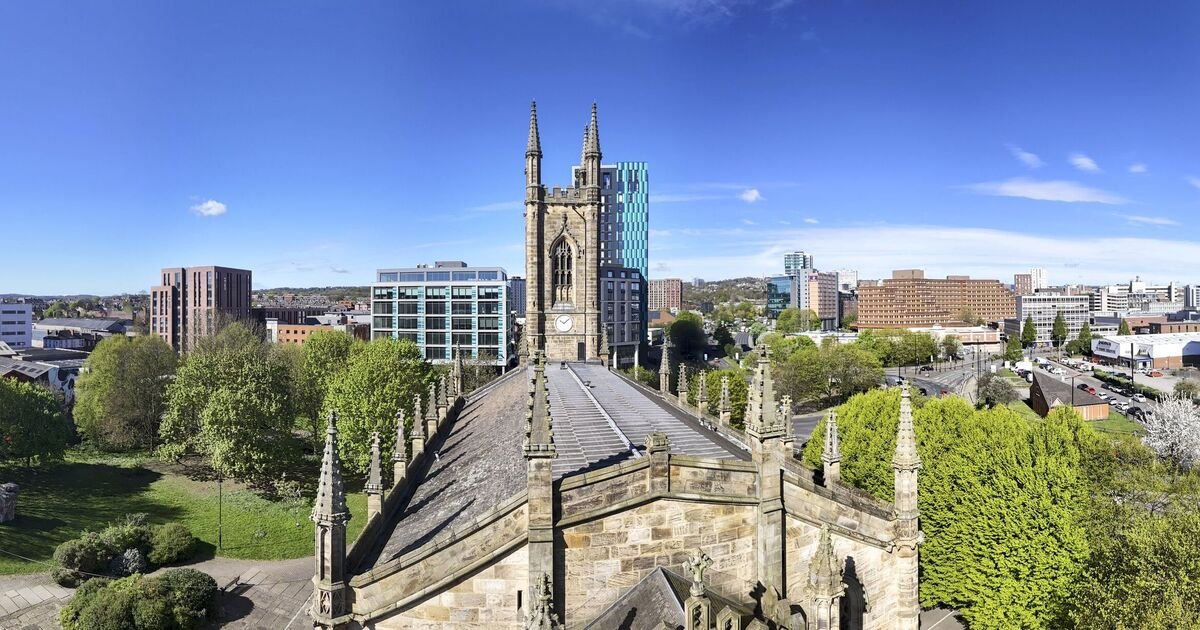

Despite its heavy industrial past giving it the nickname “the steel city” this Yorkshire city actually has more trees than humans! The factories and blast furnaces of its industrial heyday have given way to a much prettier skyline. This once mighty powerhouse of Victorian industry and hot metal has now given over 61% of its land to parks, woodland and green spaces and is today recognised as the greenest city in the UK.
“There’s been a bit of a misconception about Sheffield for a while – our out of date nickname ‘The Steel City’ doesn’t really help, because it give the impression of being the antithesis of green and sustainable” says welcometosheffield.co.uk Nowadays though it is known as “The Outdoor City” due to its proximity to the Peak District, offering opportunities for walking, climbing, and cycling. Sheffield is a hilly place, where neighbourhoods roll over seven gentle peaks that surround the city centre set in the middle of a valley. It’s also at the centre of five water sources – the River Don, the Sheaf, Rivelin, Loxley and Porter Brook. It was all this fast-flowing water propelled waterwheels that powered hundreds of mills and Sheffield became the birthplace of small steel items like cutlery and knife blades. Additionally, a third of Sheffield is within the Peak District National Park.
Today, with around 4.5 million trees across the city, Sheffield’s tree population far outstrips its human one of just more than 550,000, with more trees per person than any other city in Europe – or seven trees per person and nearly one-fifth of the city’s surface is covered by trees.
The tree situation in the city first came to a head in 2012 when council contractors began to fell a number of healthy trees to make way for new saplings which understandably confused and upset local residents. Eventually some six years later an agreement was struck between local campaigners and the city council and a new green initiative was born – Sheffield Street Trees Partnership.
A study conducted by NatWest in 2021 named Sheffield the greenest city in the UK, based on metrics like green space and tree density and in 2022 Sheffield was recognised as one of the international Tree Cities of the World.
Sheffield also boasts over 250 parks, gardens, and woodlands. As well as the tree planting initiative Sheffield has implemented various other projects to further ‘green’ the city, such as the “Grey to Green” scheme, promoting urban greening. Sheffield is also recognized for its commitment to sustainability and green energy production.
And while it has more trees than any other European city, it is pipped at the post by the Norweigan capital Oslo for the amount of green spaces. Oslo is made up of 72% of green spaces.
Sheffield City Council’s wesbite says: “Sheffield has taken big steps towards our goal of becoming a net-zero carbon city by 2050 and we have won several awards for our Grey to Green Scheme – the largest planned retrofitted sustainable urban drainage scheme in the UK which converted former dual carriageway into greenspace and seating, a cycle route and generous footways while also improving the area’s resilience to flooding.”
For visitors to the city, Sheffield has a diverse culinary scene, with many independent eateries and microbreweries. The city was even named the UK’s foodie capital by Accor. It aslo has a lively nightlife scene, with a range of bars and clubs.
For history buffs Sheffield has some interesting heritage sites, including two cathedrals (Anglican and Catholic) and Manor Lodge, a Tudor house famous for being the location where Mary, Queen of Scots, was held prisoner for a time.
Sheffield City Walking Tours are run by Marcus Newton who says: “My private 90 minute tour takes you on a journey through 900years of Sheffield’s history. On your private tour you will see many of Sheffield’s key attractions, such as the twin Cathedrals and the Town and City Halls.” www.sheffieldtours.com
