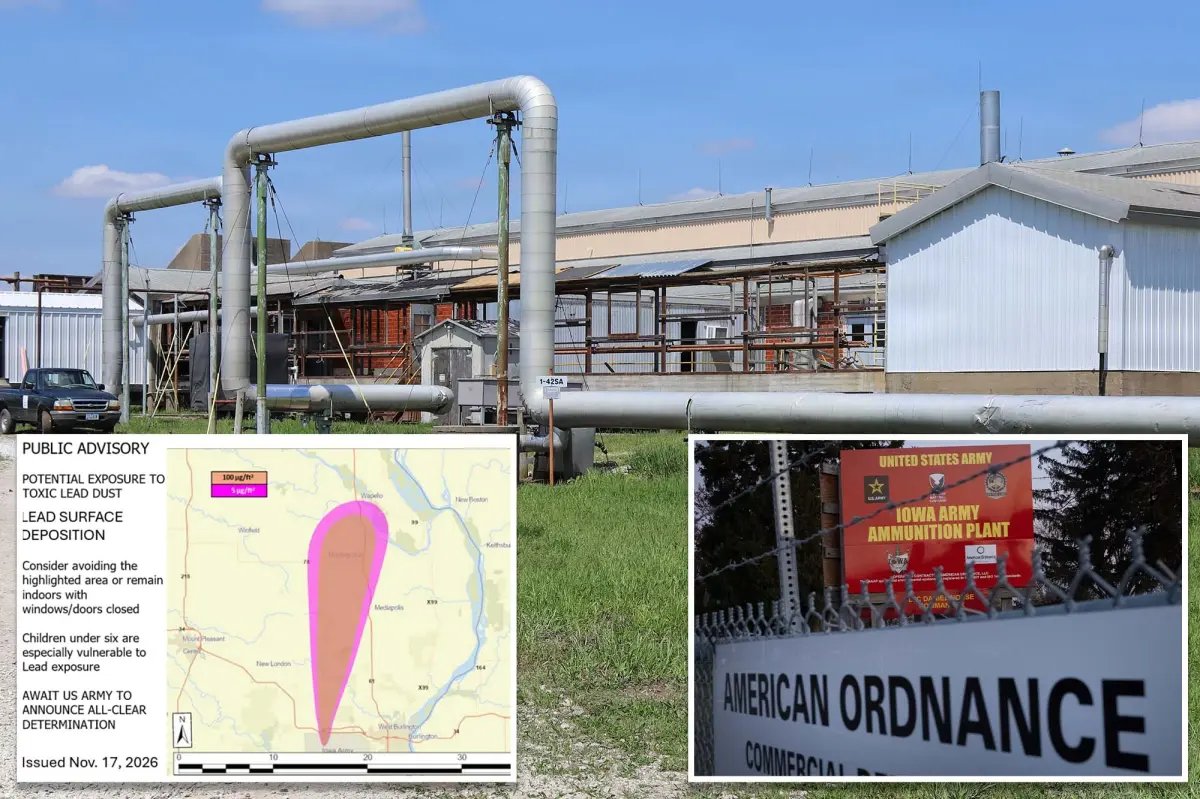


The U.S. Army decided to delay Friday’s detonation of several tons of bomb-making chemicals in southeast Iowa after an outpouring of public concern that a cloud of lead dust could cause environmental contamination and health problems.
The plan is now to carry it out on Monday.
Iowa Gov. Kim Reynolds, who was among those who called for the detonation to be delayed as the clock ticked down Thursday, spoke directly with Acting Secretary of the Army Adam Telle, her office said. Environmental groups filed a lawsuit earlier in the day, seeking emergency court action to halt the plan.
Planning for the detonation at the Iowa Army Ammunition Plant began after staff earlier this year found several dozen barrels containing lead azide that had degraded, “creating a highly unstable and dangerous situation,” according to an emergency permit approved last week by the U.S. Environmental Protection Agency. Moving or relocating it posed an unacceptable risk of accidental detonation, a possibility that increases in cold weather.
“This will delay the detonation until the latest possible moment prior to a forecasted temperature drop, which would risk further destabilization of the material,” Telle said in a post on X announcing the delay.
As officials prepared for the detonation, they had recommended that some residents in nearby Middletown vacate the area. The Army had shared details during a public meeting in Middletown in October, but a public advisory Sunday was the first time many other communities — some as far away as 100 miles (160 kilometers) — were notified that they could be affected.
The EPA permit approved last week required the Army to model how the detonated material could disperse in the air and on the ground.
“Public communication is essential to public trust,” Telle said.
Schools planned to shutter for the day
Nearly 400 people live in Middletown — about 160 miles (257 kilometers) southeast of Des Moines — but thousands more in surrounding areas could be affected. The Army’s decision to delay came Thursday evening, but many schools and businesses throughout the region were already set to close Friday.
That includes schools in Danville a few miles away. School Superintendent Pat Wallace said his initial intention was to keep schools open, but there were enough uncertainties that made canceling “the most responsible decision.”
“I am not suggesting that the detonation will result in unsafe conditions,” he wrote. “The reality is that we simply do not know exactly what conditions will look like Friday afternoon.”
In Mediapolis, less than 20 miles (32 kilometers) away, schools and the public library were set to close Friday and the local fire department planned to hose down playgrounds that could be covered in lead particles.
Vibrations from the two planned blasts were expected to be quick, but they could break old windows in the Middletown area. The resulting dust is expected to linger for no more than one hour, depending on wind speed, officials said.
According to the Army, extensive modeling predicted that the potential level of lead particles in the air may be elevated, but still well below the level at which the EPA would require protective action.
While the Army recommends cleaning cars, windowsills and outdoor surfaces, residents have taken to social media to voice concern and question whether that will be enough.
Long-term storage leaves chemicals vulnerable
Middletown residents learned in March that the Army needed to dispose of several dozen barrels containing lead azide after the ammunition plant paused operations as part of a review and the degraded material was discovered.
“The safety of our people and our neighbors is non‑negotiable,” Lt. Col. Daniel Nosse, commander of the plant, said at the time, acknowledging the volatility of the chemical compound used in munitions production.
The Army said it put together a panel of experts in munitions chemistry, engineering and environmental safety to come up with the detonation plan.
Moving or relocating the barrels posed an unacceptable risk of accidental detonation, officials said. Justine Barati, public affairs specialist at the Army Sustainment Command, said that possibility increases in cold weather.
Experts urge residents to take precautions
Patrick O’Shaughnessy, a professor at the University of Iowa’s Department of Occupational and Environmental Health, said it’s still unknown how much contamination will end up in the atmosphere and on surfaces.
Lead is a neurological toxicant that can harm the brain, nervous system and other organs.
With high doses over a short period, people can be subject to lead poisoning and begin to feel sick, said Andrew Whelton, an environmental engineering professor at Purdue University who has helped communities recover from chemical disasters.
Long-term exposure to low doses can lead to neurological development problems, especially in young children, O’Shaughnessy added.
Iowa State’s Des Moines County Extension field office was busy fielding calls Thursday from concerned residents who have been “deathly afraid” for their animals and vegetable gardens, said staff member Morgan Hoenig.
“We ran out of soil test kits yesterday,” she said.
Environmental groups sued Thursday in an effort to stop the detonation, arguing that the EPA failed to require the Army to consider safer alternatives and that the Army failed to give adequate notice of its plans.
According to EPA documents, alternatives such as neutralizing and decomposing the drums’ contents with other chemicals were considered. But officials said handling the drums would increase the probability of an accidental, fatal detonation.
