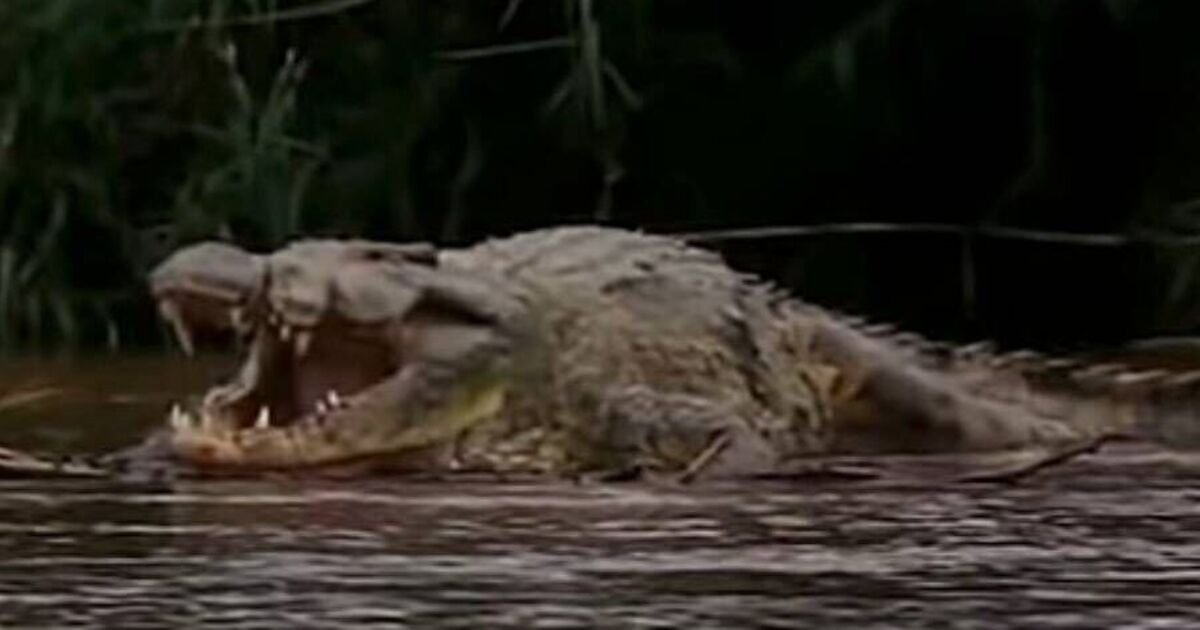


Gustave was a massive 20 feet long (Image: MagellanTV)
For years a colossal killer crocodile has instilled fear amongst a local community after embarking on a deadly rampage which is rumoured to have claimed the lives of up to 300 people.
Man-eating Nile crocodile Gustave, as he was christened by Patrice Faye, a herpetologist who has tracked the creature since the 1990s, has been preying upon those residing along the Ruzizi River in Burundi, Africa, since the late 1990s.
Gustave, estimated to measure at least 20 feet in length and tip the scales at 143 stone, has terrorised all those dwelling near the river, with anxiety reaching its height in 2004.
He was initially sighted in the late 1990s bearing three bullet wound scars and a badly damaged shoulder blade, though the origins of these injuries remain unknown.
Gustave is believed to be over 60 years old and has undergone extensive study since his killing spree began, with scientists suggesting he targeted human prey due to his enormous size, rendering the nimble creatures typically hunted by crocodiles in the area, such as fish, antelope and zebra, inadequate for his needs, reports the Daily Star.

The croc was thought too big to eat its usual prey (Image: Magellan TV)
Experts believe the enormous crocodile was consequently compelled to target far larger animals including hippos, buffalos and humans, accounting for his substantial tally of recorded human fatalities.
While many contend the actual number of victims is closer to 60 rather than 300, disturbingly, he also abandoned his victims’ bodies unconsumed – raising concerns he was targeting humans purely for sport. Determined to bring some stability to the region, Faye, accompanied by several fellow scientists, embarked upon an expedition to capture the killer crocodile in 2004.
For two years they employed several techniques to ensnare Gustave – and on each occasion he succeeded in evading them.

Gustave was feared to have eaten 300 people (Image: Magellan TV)
They built an enormous trap cage, measuring nearly 30 feet in length, and eventually located the colossal creature. The team positioned bait within the trap and fitted a camera enabling them to record the instant they secured the monster.
Yet Gustave refused the bait… and avoided the trap. Undaunted, the team subsequently constructed three additional massive traps along particular riverbanks where the immense crocodile had been sighted.
The traps did succeed in capturing several smaller crocodiles but Gustave once more remained at large. With only one week remaining before the team of scientists knew they would be compelled to depart the country due to political instability, they attempted one final bold capture.
They positioned a live goat inside a substantial bait cage with the objective of securing Gustave permanently. Calamity struck when a thunderstorm erupted in the vicinity and damaged the infrared camera within the cage so it failed to capture any footage.
Alarmingly, when the team inspected the bait cage the following day, it was discovered partially submerged in water and the goat had vanished. It remained unclear whether the goat managed to flee in the rising waters or if the cage itself had malfunctioned.
Five years afterwards, Gustave made a horrifying return when he was sighted once more in the Ruzizi river close to Lake Tanganyika in 2009.

The traps caught smaller crocodiles – but not Gustave (Image: AFP via Getty Images)
Yet by 2019, reports emerged suggesting the enormous crocodile had at last met his end – though nobody has witnessed any proof and his remains have never been discovered.
Nile crocodiles typically have a lifespan ranging from 70 to 100 years.
