
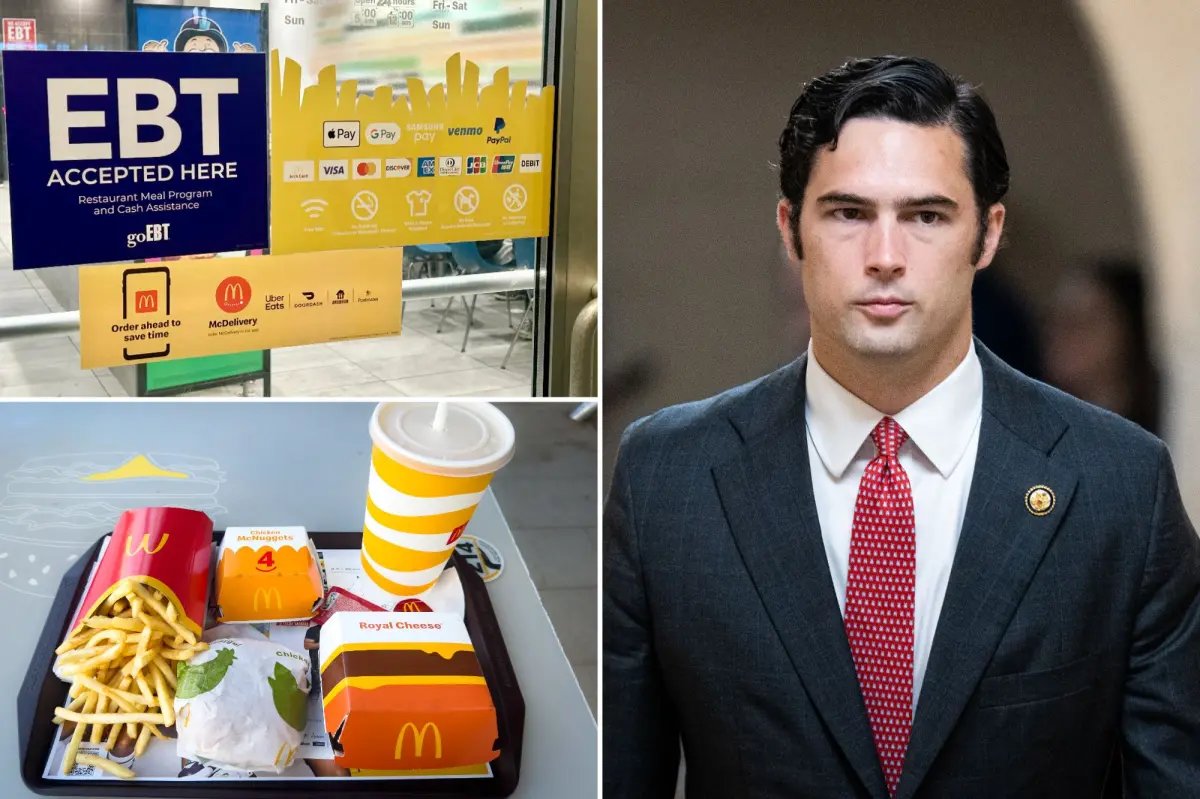


More than half a billion dollars in SNAP benefits went to restaurants over a two-year period — and California alone accounted for nearly all of the spending outside the other eight states combined.
Freshman Rep. Brandon Gill unveiled legislation Thursday to eliminate the Restaurant Meals Program, which allows certain SNAP recipients to use their benefits for hot meals at approved restaurants.
The numbers are likely to fuel the debate: From June 2023 through May 2025, more than $524 million in SNAP benefits were redeemed at participating restaurants across nine states, according to data provided to Gill and Iowa Sen. Joni Ernst.
California accounted for approximately $475 million.
Gill says taxpayers should not be footing the restaurant tab through a program he believes has strayed from SNAP’s intended purpose.
“SNAP is supposed to help struggling Americans put nutritious food on the table, not stick taxpayers with the bill for fast food,” Gill told The Post in a statement.
Getty Images
The gap between California and the other states is enormous. Arizona ranked second with $41.4 million, followed by New York at $3.6 million.
Michigan accounted for $1.3 million, Rhode Island for $995,900, Massachusetts for $649,000, Illinois for $497,000, Virginia for $308,500 and Maryland for $8,600.
California’s spending comes as its CalFresh program serves more than 5 million people.
Roughly 13% of Californians rely on EBT benefits to purchase food.
Los Angeles County alone has more than 1.5 million EBT users, while children represent roughly 40% of statewide CalFresh enrollment.
The Restaurant Meals Program is currently operating in nine states: Arizona, California, Illinois, Maryland, Massachusetts, Michigan, New York, Rhode Island and Virginia.
California has expanded the program statewide, with participating restaurants in heavily populated areas including Los Angeles, San Diego and the San Francisco Bay Area.
Thousands of approved restaurants accept benefits, including Subway, KFC, Taco Bell, Pizza Hut, McDonald’s and Burger King, along with independent restaurants.
But the program does not allow every SNAP recipient to simply walk into a participating restaurant and swipe an EBT card.
Every member of an eligible household must be elderly, disabled or homeless, or be the spouse of someone who qualifies.
EBT cards are coded to identify eligible recipients and are automatically declined at participating restaurants when the cardholder does not qualify.
Gill’s legislation would scrap the restaurant component while keeping provisions that allow qualifying public and nonprofit organizations to provide meals, including home-delivered meals for some elderly and disabled recipients.
The USDA describes the Restaurant Meals Program as an accommodation for people who may be unable to prepare meals themselves or who lack permanent housing where food can be stored and cooked.
Gill’s latest move follows a July effort involving Ernst and other Republican lawmakers, who asked Agriculture Secretary Brooke Rollins and Health and Human Services Secretary Robert F. Kennedy Jr. to review the program.
The lawmakers argued that the program had expanded well beyond its original limited accommodation and had become increasingly dominated by major fast-food and quick-service chains.
Gill is also pointing to the Trump administration’s broader effort under its Make America Healthy Again initiative to restrict SNAP purchases of products such as soda and candy.
“More than half a billion dollars in SNAP benefits have gone to restaurants through this loophole in just two years while the Trump administration is working to get junk food out of the program.”
