


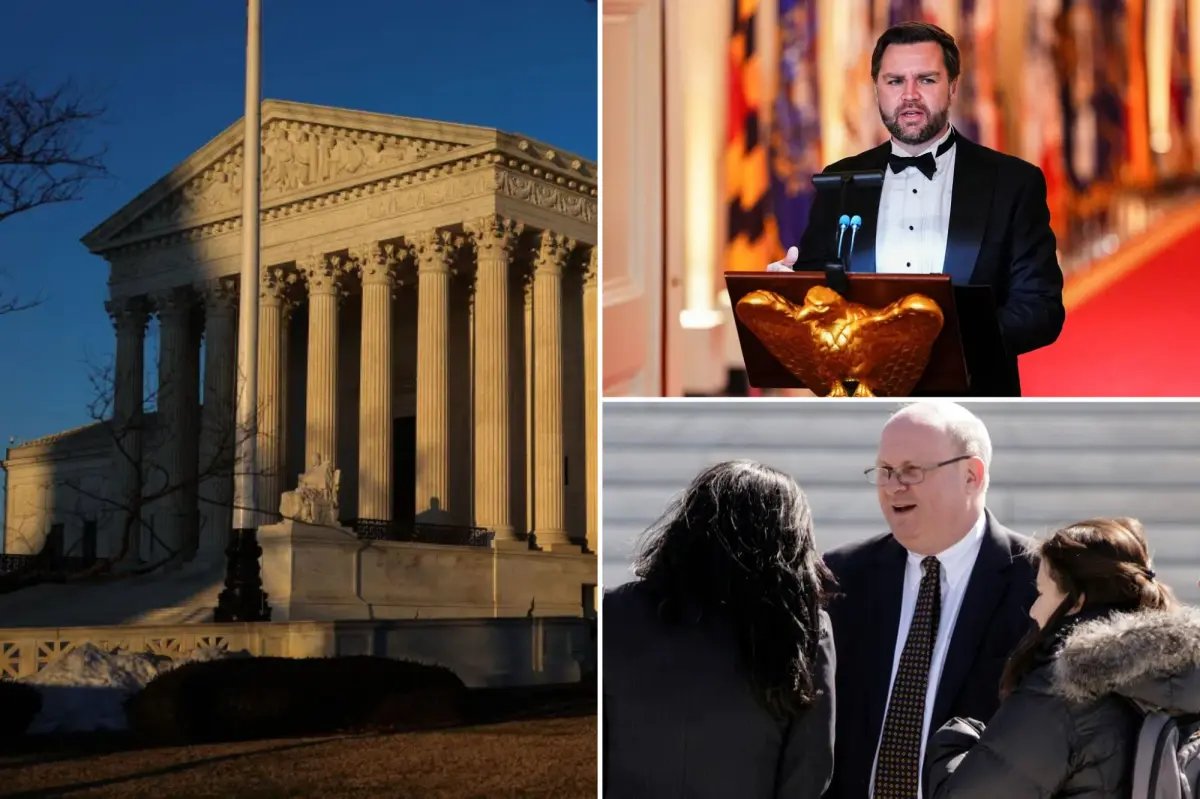

WASHINGTON — The Supreme Court ruled that federal limits on coordinated spending between political parties and their preferred candidates are unconstitutional, a decision with sweeping implications for this year’s midterm elections and beyond.
The National Republican Senatorial Committee (NRSC) had mounted a First Amendment challenge in 2022 to the Federal Election Campaign Act of 1971, arguing that it unconstitutionally capped so-called “coordinated funding expenditures,” which are mainly used for campaign advertising.
The high court had upheld the expenditure limits in the 2001 case of FEC v. Colorado Republican Federal Campaign Committee, but the NRSC argued that events since that ruling — including the rise of Super PACs, changes in campaign finance law, and the court’s own decision in 2010’s Citizens United v. FEC — had made the 2001 decision obsolete.
The decision is one of the most consequential campaign finance-related cases to come before the court since Citizens United, which struck down limits on political spending by corporations.
Proponents of nixing the coordinated funding limits had argued they weakened the power of the parties by making them subject to restrictions that did not apply to super PACs.
“Republicans have achieved a major victory with coordinated spending limits being struck down, and they are in the driver’s seat because of their massive cash advantage,” Sean Cooksey, managing director at BGR Group and former Chairman of the Federal Election Commission, told The Post.
“The GOP can now work with its candidates to buy more ads at cheaper prices to maintain their majorities this fall,” Cooksey, a former counsel to Vance, added.
As of 2025, the limits, which the FEC adjusts for inflation each year and depend in part on the voting age population of each state, ranged from $127,200 to $3,946,100 for Senate candidates; $127,200 for House candidates in Alaska, Delaware, North Dakota, South Dakota, Vermont and Wyoming; and $63,600 in all other states.
The GOP’s official campaign arms have massive cash advantages over their Democratic counterparts across the board that will now be far more impactful with coordinated spending limits gone.
For example, the Republican National Committee has over $125 million cash on hand, compared to the Democratic National Committee’s measly $14.8 million, according to the latest FEC filings.
Thanks to the Supreme Court’s ruling, Republicans will be able to put that massive cash advantage to work supercharging candidates such as incumbent Maine Sen. Susan Collins (R) in critical contests.
Liberal Justice Elena Kagan had raised concerns during December’s oral arguments that eliminating coordination rules would be an end-run around restrictions on how much money donors can funnel to campaigns.
“The super PAC can’t be coordinated. And these party expenditures can be coordinated so they’re more helpful to the candidate,” she said at the time. “They effectively function as contributions to the candidate. There can be coordination to the max.”
While the official GOP congressional campaign arms sought to quash the restrictions on coordination with candidates, their Democratic counterparts largely opposed the effort.
Marc Elias, a longtime election attorney for Democrats, had argued before the Supreme Court last year that those restrictions protect the parties by allowing them to build up critical infrastructure and preventing them from devolving into glorified campaign slush funds.