


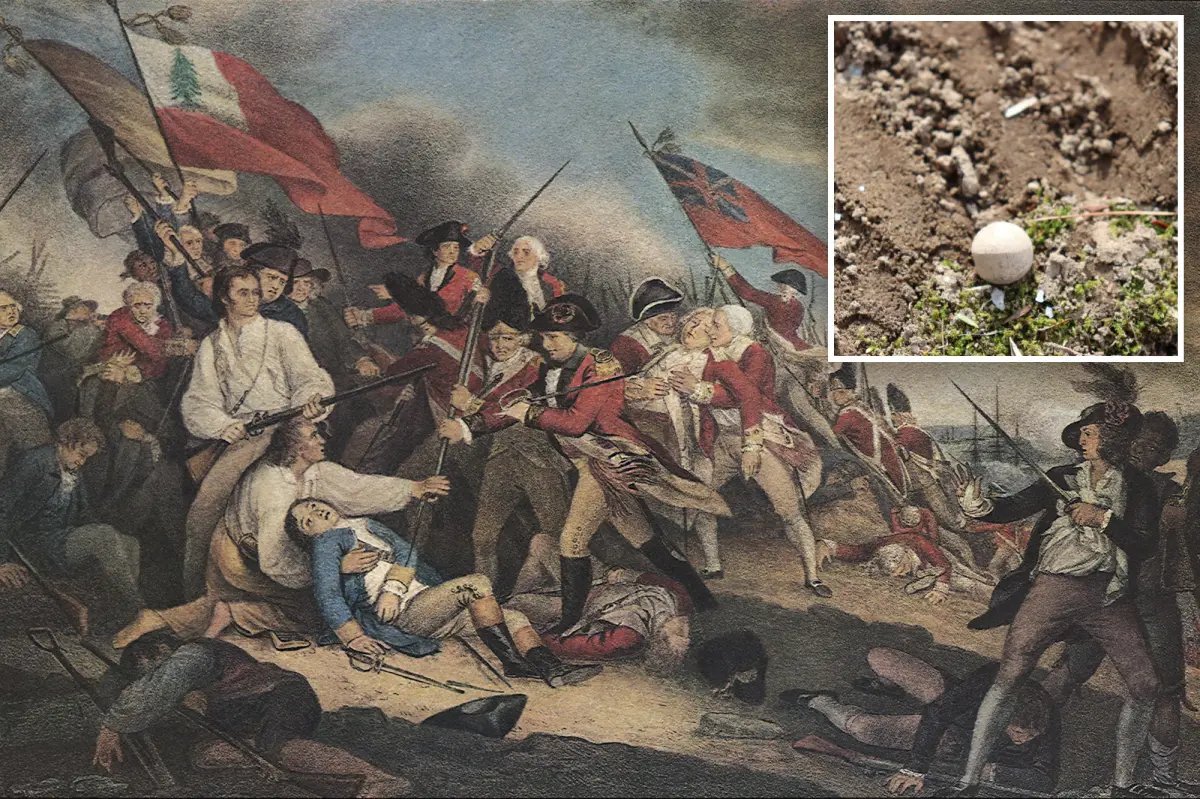

Even though it’s been nearly 250 years since the Continental Congress declared independence from Britain, the study of the American Revolution is far from over.
For decades, archaeologists have dug at Revolutionary War battlefields across the country, yielding fascinating artifacts.
From southern sites to northern battlefields, these places are still sharing secrets — and shedding new light on our country’s founding.
As America celebrates its 250th, below are a few Revolutionary War battlefields that are still revealing new discoveries.
1. Bunker Hill
One of the earliest military engagements of the Revolutionary War, the Battle of Bunker Hill was fought in Charlestown, Massachusetts, just outside downtown Boston.
On June 17, 1775, the British decisively defeated American forces and seized the Charlestown Peninsula after a retreat.
Archaeologists, who began digging at the site in June, have been actively making new discoveries about the battle site.
Among their findings is a redoubt, a dirt fort colonial soldiers built by hand overnight.
“We know that the fortification was up here, but nobody has been able to identify where specifically,” Lauryn Sharp, project archaeologist for the City of Boston, told Fox News earlier in June.
“We’re learning new things about the battle that we didn’t know before.”
“Even with the monument being built, there wasn’t any evidence of where the actual redoubt was, so … we are adding this information back into the story.”
Some artifacts have also emerged, including munitions.
“We found two English gun flints, a French gun flint and then two musket balls,” Joel Bohy, a historian and material culture specialist in Concord, Massachusetts, told Fox News.
“This project has been extremely successful, and we’re learning new things about the battle that we didn’t know before.”
2. Camden Battlefield
American Veterans Archaeological Recovery (AVAR), a veteran-led archaeological organization, excavated Camden Battlefield in Camden, South Carolina, last year – and they weren’t just looking for old artifacts.
AVAR founder Stephen Humphreys told Fox News Digital that archaeologists-in-training used GPS receivers to collect spatial data about movements of the battle, which was fought in August 1780.
“[We’re] using intensive metal detector surveys to plot exactly where the different forces were during the battle,” he said at the time. “We’re getting spatial data for every musket ball that’s found on the site.”
Humphreys said the battle was a devastating loss for the colonies. “It’s an extremely significant battle for the South … and for the North as well.”
3. Minute Man National Historical Park
In 2024, archaeologists unearthed remnants of the battle that ushered the “shot heard round the world” at Minute Man National Historical Park, the site of the Battle of Concord and Lexington.
Five musket balls believed to have been fired by colonial militia members were uncovered near an area where British soldiers formed.
It was “incredible” that the lead musket balls survived so long, park ranger and historic weapons specialist Jarrad Fuoss told Fox News Digital at the time.
“It is also a poignant reminder that we are all stewards of this battlefield and are here to preserve and protect our shared history,” he said.
“We weren’t looking for them,” Fuoss noted. “We were just trying to make sure there was nothing going to be damaged.”
Honorable mention: Colonial Williamsburg
While it was not the site of a Revolutionary War battle, archaeologists found remnants of soldiers’ barracks at Colonial Williamsburg in 2024.
The barracks used by American forces were likely built between 1776 and 1777.
Jack Gary, executive director of archeology at the Colonial Williamsburg Foundation, told Fox News Digital that the barracks could once accommodate 2,000 soldiers and up to 100 horses.
They were destroyed by British troops who were on their way to Yorktown in 1781.
Historical documentation shows that “in August 1776, just a month after the signing of the Declaration of Independence, the Commonwealth of Virginia ordered the construction of those barracks,” Gary said.
“After the Cornwallis troops moved through, they could see the barracks on fire in the distance,” he added.