



The champions avoided the first round but had to work to do so.
It was expected that Knicks president Leon Rose would trade the No. 24 pick in Tuesday’s first round of the NBA draft to avoid taking on first-round salary.
And that’s what happened, though it required a few moves to get it done.
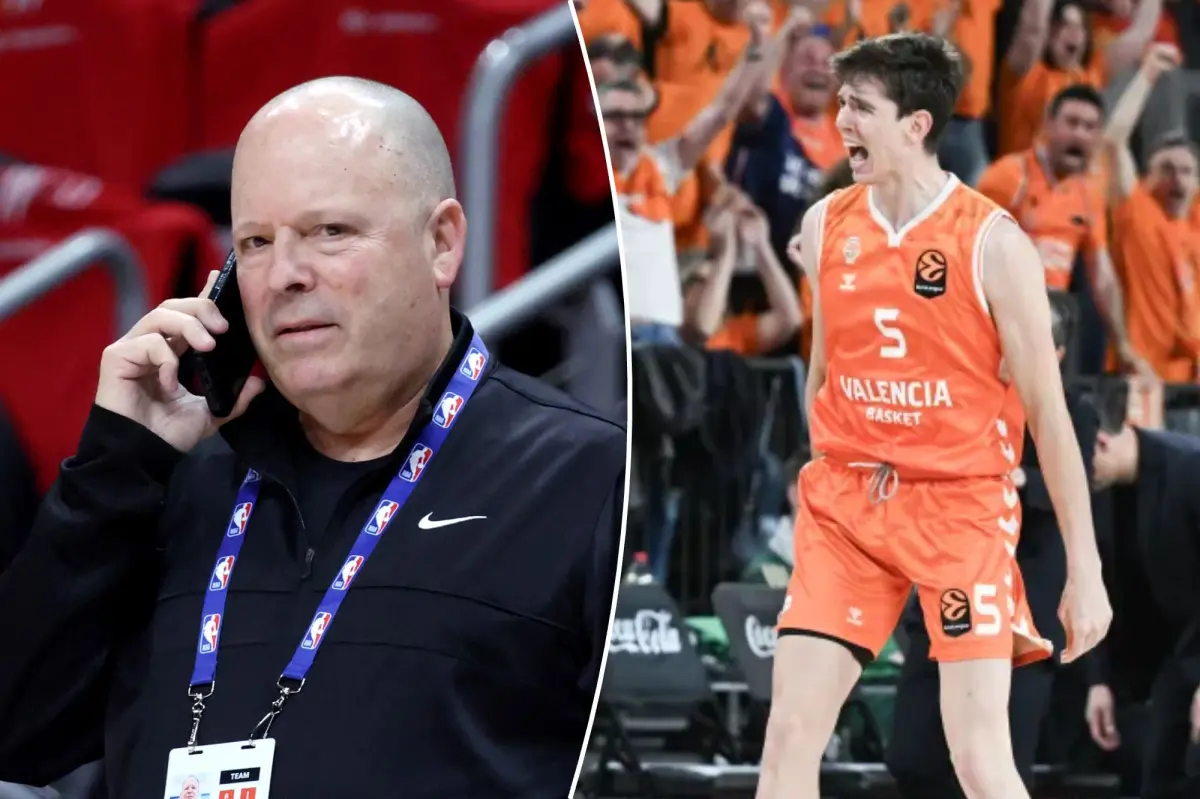
The Knicks initially traded the No. 24 pick to the Lakers and moved one slot later, to No. 25, in exchange for cash considerations. The Knicks picked Spanish youngster Sergio De Larrea at that pick, and it seemed like a potential stash option that would allow them to come out of the night with talent for the future but avoid adding salary for next season.
But after the first round was completed, the Knicks sent De Larrea to the Mavericks in exchange for No. 30 pick Koa Peat and two second-round picks. Then they made one more move, sending Peat to the Suns for three second-rounders and cash.
So after a series of three trades, Rose moved the Knicks out of the first round and left with five additional second-rounders and cash. And they accomplished their goal of avoiding any first-round salary without having to attach any capital to get rid of that No. 24 pick, which some thought they might have to.
The No. 47 pick is one of the second-rounders the Knicks got from the Suns. So now the Knicks have Nos. 31, 47 and 55 on Wednesday to either add cheaper talent or continue dealing for future picks.
Second-round picks usually sign for much less than first-rounders and, unlike first-round picks, don’t automatically sign guaranteed contracts.
The No. 24 pick — who ended up being Cameron Carr — is slotted to make roughly $3.5 million for his rookie season. If the Knicks envisioned that pick as someone who would be a reserve — like their ninth, 10th or 11th man — it didn’t make sense to have to pay that much. They can find players on veteran minimum deals to fill those roles.
The Knicks have limited space to stay under the second apron — which owner James Dolan recently said he wishes to avoid, though it’s to be determined if that desire becomes reality. They are already bringing back Mohamed Diawara on a multiyear deal worth $10 million, The Post’s Stefan Bondy confirmed.
And they have multiple free agents of their own to make decisions on — namely Mitchell Robinson, Landry Shamet and Jordan Clarkson along with less important ones like Ariel Hukporti and Jeremy Sochan. Jose Alvarado has a $4.5 million player option, too.
Not counting Diawara — since his annual salary is not yet known — the Knicks will be roughly $16.5 million under the second apron if Alvarado opts in. So, figure a few million lower than that once Diawara’s deal is made official.
That number would have been around $13 million under the second apron if they stayed at No. 24, made that pick and signed that player. Alvarado’s decision could change that as well.
Tuesday’s decision continued the trend of the Knicks trading away their first-round picks. Pacôme Dadiet — whom they picked at No. 25 in 2024 — remains the only first-round pick they made and kept since 2020.
St. John’s star Zuby Ejiofor went right before the Knicks — at No. 23 to the Hawks — to prevent any chance for him to stay in the city in which he is so popular. UConn center Tarris Reed Jr. — who could have been a potential replacement for Robinson as a backup center if he leaves in free agency — was available and went at No. 26 to the Spurs.
But finances were front of mind for the Knicks. Their intention was clear.
The end result Tuesday was what was largely expected. It just took a series of complicated maneuvers to get there.