


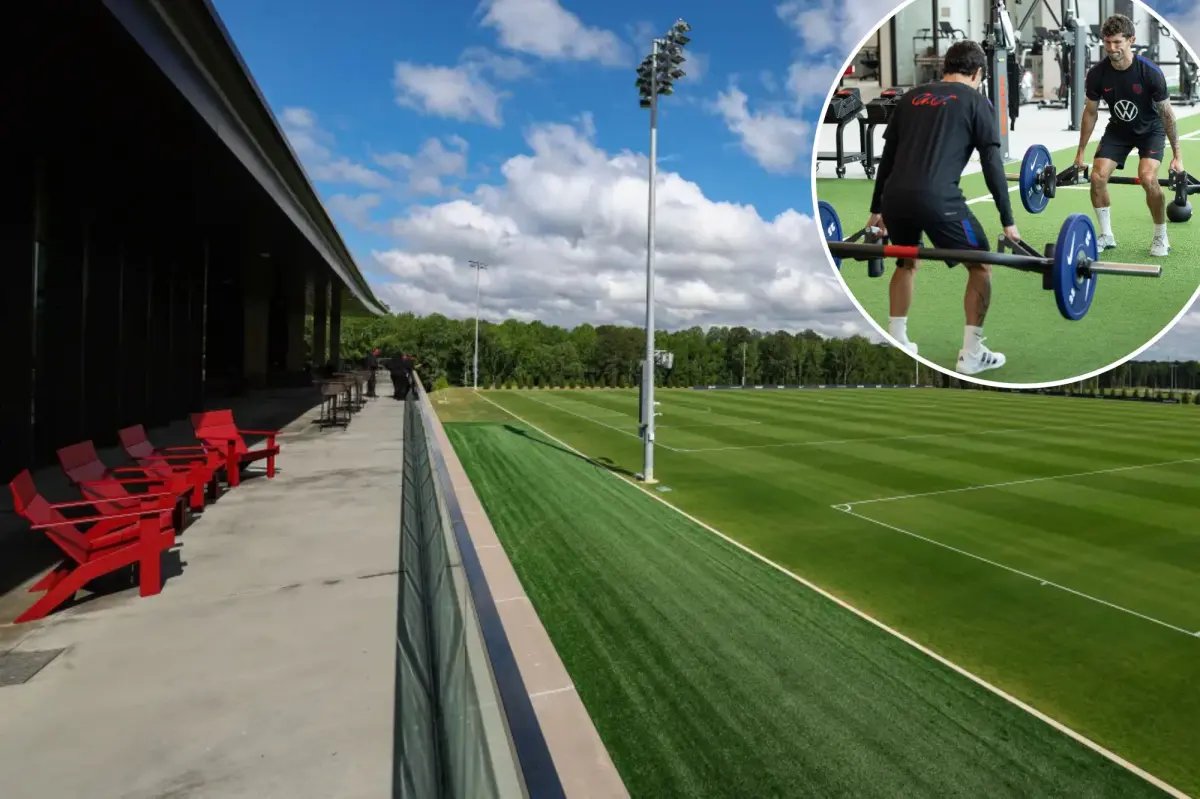
FAYETTEVILLE, Ga. — U.S. Soccer Federation employees lined the walkway of the National Training Center on Thursday afternoon, giving the men’s national team a sendoff as it departed its first camp at the forever home the federation has always craved.
To be pedantic, it would be wrong to call this camp the grand opening for the facility that sits some 20 minutes south of Atlanta’s airport, an area that straddles the line between suburban and rural. But it was certainly the grand unveiling.
Funded in large measure by Atlanta Falcons owner Arthur Blank, whose name is on the building, Chick-fil-A chairman Dan Cathy, billionaire businesswoman Michele Kang and a series of USSF sponsors, the building is as impressive a soccer facility as there is in the United States, and arguably the world.
Envisioned as a home not just for the men’s national team, but for every one of 27 national teams run by U.S. Soccer — men’s, women’s, youth, beach, adaptive sport — as well as the business side of the federation’s operations, the 200-acre site includes 17 outdoor surfaces, 13 natural grass fields, two indoor surfaces and a shiny new building that, among other things, includes 23,000 square feet of glass.
All this on land that, until ground was broken in 2024, was a vacant cow pasture.
“Our previous sporting director [Matt Crocker] had a lot of connections with [England’s] FA and so we did look at St. George’s Park [England’s national training ground] closely,” Tom Norton, the facility’s general manager, told The Post. “We also look at the places we’ve been, whether that be the location out in Carson, what we’ve got in Kansas City as well. All of those were inspiration, and then we also looked at things like Augusta National and Wimbledon as we talked about the inspiration for the look and the feel on the grounds.”
The federation purposely didn’t take the players here when they held camp up the road at Atlanta United’s training ground in March so that they would see it for the first time in the run-up to the World Cup. And throughout their time here, players took every opportunity to rave about it.
“I feel like [it’s] what the national team has needed for a really, really long time,” Tyler Adams said.
“I think we all expected it to be nice, but when we first got here, it sort of blew our socks off,” Gio Reyna said.
“It’s the best facility I’ve ever been to in my life,” Sebastian Berhalter said.
“This facility,” Christian Pulisic said, “is insane.”
Until now, there’s been no such thing as a home base for U.S. Soccer. Even at the senior level, the men’s and women’s teams were nomadic, pitching their tents in different cities and different MLS training facilities all over the country. Ditto for youth, beach and adaptive teams, though with — as you can imagine — less investment in general.

When a power chair team, the first to see the facility, walked in, tears were shed.
“Prior, they were here for a camp in Fayetteville in a church,” Norton said. “Everyone was dropping their kids at after care and going to training. They’ve never had a spot that they can charge their chairs, change, take showers, train together.
“Same thing with the beach soccer team. The beach soccer team has never had a home like that. They stepped their feet out there, they were like, ‘Can we walk out on the sand?’”
They were walking, they were crying, they were FaceTiming their teammates.”

There are other benefits U.S. Soccer hopes to gain from having everything under one roof. The youth teams that trained in Fayetteville this week got to be around the senior men’s team. Mauricio Pochettino got to attend training for the U19s, who helped send off the senior team in turn.
The federation hopes coaches who never got the chance to interact before can now work out of the same building and exchange ideas, resulting in long-term growth.
There’s a symbolism to the setup, too. As a result of the landscape, the practice fields are terraced. The senior teams will train on the upper fields, the youth teams further down the hill.
so they’ll always be looking up at the next goal.
“Whether it be the senior men and women, the disabled teams all gave their feedback and it’s been cool seeing them in the building saying, ‘Oh we talked about that,’ and seeing it come to life,” Norton said. “We talked to everyone and we’re not just about athletes.
“We talked about the ecosystem which, for us, the ecosystem are the people that make soccer what it is in the U.S. We have all of our state associations here right now. They want to host meetings with you, all of that. We want everything for soccer happening under this roof.”