

Some teachers are making less than their students are paying in tuition at tony New York City private schools.
A Post investigation revealed that, at some of the city’s best private K-12 schools, a full-time teacher can make more than $17,000 less than their own students’ parents pay for them to attend kindergarten.
Meanwhile, the schools sit on massive endowments and often pay their heads of school more than $1 million.
“I was very stressed about money when I lived in New York,” Blythe Grossberg, a former teacher at the ritzy Upper West Side all-boys school Collegiate, told The Post. “It was almost impossible to live on my salary in New York. Like, there was absolutely no way it could be done.”
At Collegiate, a lower school substitute teacher could make no more than $50 an hour and as little as $25 — less than Mayor Zohran Mamdani was paying emergency snow shovelers this winter. Tuition is $68,900.
Grossberg, a Harvard-educated learning specialist with a doctorate, says she started at $55,000 when she worked at elite NYC prep schools including Collegiate and Packer Collegiate Institute from 2005 to 2018 — hardly enough to get by in the city, especially because she has a son with autism who requires services.
“I basically was tutoring around the clock just to pay the mortgage slash rent slash expenses,” she recalled. “[My colleagues] were always either tutoring or working in summer school. They had all kinds of side gigs.”
But not everyone. Grossberg realized that many of her colleagues could get by, thanks to their own privilege.
“I think the dirty little secret, at least in my experience, is that a lot of the teachers also went to private school, so some of them have trust funds, basically,” she said. “And then, it’s helpful if they have a very rich spouse.”
For those without a rich spouse or family money, the salaries can be rough — and totally incongruous with the wealth that fills NYC private schools.
At Riverdale Country School in the Bronx, students pay $59,000. Yet they could be taught by a lower school associate teacher of Spanish, music, or art making only $52,000 to $60,000 a year.
Meanwhile, the head of school was raking in $1 million, between $983,000 base pay and $192,000 in other payments, in 2023, according to tax filings.
At the all-girls Nightingale-Bamford School on the Upper East Side, a kindergarten associate teacher could make as little as $54,000 and only as much as $60,000, according to a recent job posting.
Tuition is $71,600 for the very kindergartners they teach. Their head of school also pulled in more than $1 million in salary and other compensation in the 2024 school year.
Many private school teachers make less than their public school counterparts. Starting salary without teaching experience in public schools is $68,900 with a bachelor’s degree and $77,500 with a master’s degree.
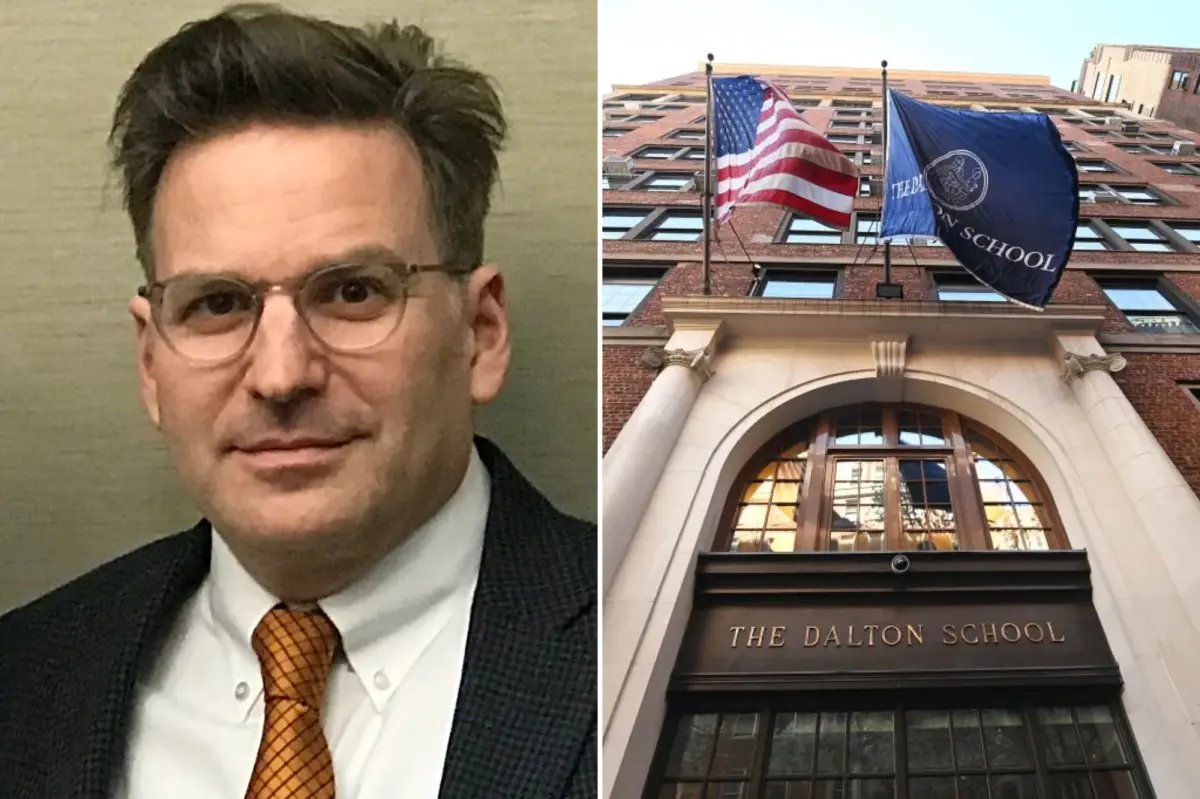
That minimum starting salary is pushing the maximum of some private school job listings. At Dalton, prospective first- and second-grade associate teachers are being offered between $66,000 and $69,000. Tuition at the Upper East Side school is $67,500, and the head of school makes more than $1 million, according to tax filings.
Emily Glickman has spent 27 years advising families on admissions to New York City private schools. She says there’s a total disconnect between what families assume their teachers are making and reality.
“There’s definitely a perception gap between what families are paying and what teachers are earning,” she said. “Families assume tuition is going to teachers — but a significant portion supports the broader institutional structure.”
Grossberg saw this firsthand while teaching middle and high school students at Collegiate.
“Some of the students ask me, like, ‘Dr. Grossberg, where are you going this summer?’ And I was kind of like, you know, ‘To my apartment in Brooklyn to vacuum,’” the teacher recalled. She’s the author of a book about her experience teaching in private schools called “I Left My Homework in the Hamptons.”
Glickman says parents “assume that their $70,000 tuition means private school teachers are being paid at a completely different level from public school teachers.”
At Brearley, an all-girls Upper East Side school, a lower school associate teaching job was recently listed for $63,700, while tuition is $66,800.
Ethical Culture Fieldston, a “progressive” K-12 school that describes itself as “cooperative [and] student-centered” was recently ripped by Town and Country for advertising a role for associate teachers with a $60,200 salary, compared with a $68,200 tuition price tag.
A spokesperson for the school told The Post the median teachers earn is higer, at $137,000. Fieldston’s top earner is their CEO, who made $949,000, in 2024, according to publicly available filings.
The Post reached out to Brearley, Dalton, Collegiate, Nightingale-Bamford, Riverdale, and Grace Church School but received no reply.
Paul Rossi, a former high school math teacher at the Grace Church School from 2012 to 2021, said that private school teachers might start approaching public school salaries, but it takes a long time to catch up.
“For teachers with more than 20 years experience at the ‘elite’ privates in New York, salaries may approach that of public teachers,” he said, noting that’s in part due to the strength of public school unions.
At Grace Church School, a Lower School and Early Childhood associate teacher can expect to make only $60,000 to $62,000, while tuition was $68,500 for the 2025-2026 school year.
Rossi points out private school teachers are usually making a conscious choice to accept less pay.
“It can be a source of frustration, but it’s more like a tradeoff,” he said. “Public school teachers who move to private schools often frame the decision as getting less pay for a more desirable work environment. You might take as much as 20k less per year but you escape the bureaucracy and terrible discipline issues.”
He added, “Generally most private school teachers just accept getting lower pay than public as a ‘fact of life.’ For most of them, I think they see the higher pay in public school like a form of ‘hazard pay.’ The difference between drilling a regular oil well and an offshore one.”
