


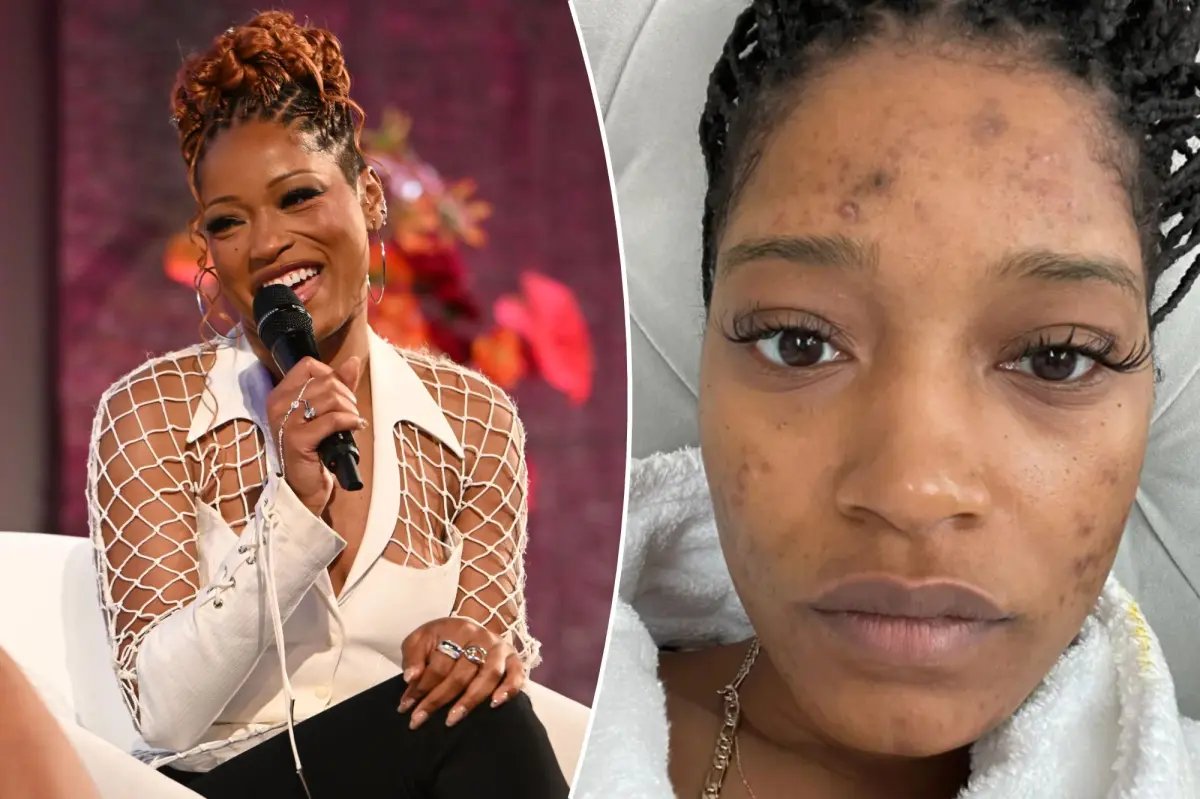

Keke Palmer is opening up about a health battle that left her dealing with what she describes as “unbearable” and “crippling” adult acne — and a frustrating, long search for answers.
“Everybody was on that glass skin and I’m over here with cracked glass,” the Emmy Award winning actress said Monday during a panel at the third annual Women’s Health Lab in New York City. “It hurt emotionally in a way that you can’t describe.”
The 32-year-old told host Gayle King that she spent years cycling through doctors and treatments trying to figure out what was behind her symptoms, which also included sprouting a “beard.”
Standard interventions, including two rounds of Accutane — a powerful acne medication often used as a last resort because of its intense side effects — didn’t clear her skin.
Lifestyle guidance, like changing her diet and staying better hydrated, also brought no relief.
“It is a very heavy thing on your mental health because [I felt like] if I do it right, I should have the results. I’m eating right. I’m doing the things. I’m exercising. I’m drinking water. Why is my body betraying me?” the podcaster and television host said.
Those questions eventually pushed the “One of Them Days” star to dig deeper on her own.
“I remember just reaching a point where I said, ‘I got to solve this. I’ve got to fix this,” she said. “This isn’t just acne; my body is telling me something more is going on.”
After researching possible causes and taking a closer look at hormone health and her family history, Palmer went back to her doctors and asked if she might be dealing with what was then referred to as polycystic ovary syndrome, or PCOS.
The long-term hormonal and metabolic condition affects an estimated 170 million women around the world. It can cause a wide range of symptoms, including acne, excessive hair growth, weight changes, infertility and irregular periods.
But when Palmer first raised the possibility with her doctors, she said she was dismissed — told she couldn’t have the condition because she didn’t have cysts on her ovaries.
“I was telling doctors, y’all are wrong,” she recalled.
Frustrated but still pushing for answers, Palmer turned to an endocrinologist, a doctor who specializes in hormone-related conditions.
Testing later confirmed she had the disorder, her testosterone levels “extraordinarily high” and her androgens “all out of whack.”
Her experience isn’t unusual. Experts say confusion around the condition has fueled widespread misdiagnoses and long delays in treatment for women like Palmer.
It’s one of the reasons PCOS was recently renamed polyendocrine metabolic ovarian syndrome (PMOS), a term doctors say more accurately reflects the disorder’s complexity and could ultimately improve diagnosis and care.
“For years, this complex, long-term hormonal and metabolic disorder has been reduced to a gynecological disease that was thought to just affect people who had cysts on their ovaries,” Dr. Iman Saleh, an OB/GYN and director of obesity medicine at South Shore University Hospital, previously told The Post.
“If you didn’t have a cyst or the ovary was not enlarged,” she added, “people had a misdiagnosis or spent years not getting diagnosed.”
Palmer herself is supportive of the updated terminology.
“This, to me, feels more fitting,” she said on the panel.
Since getting diagnosed, the “I Love Boosters” actress said she’s been able to get her acne under control through a combination of medication, diet changes and lifestyle adjustments.
“Not to be TMI — but this is a place to do it — but I started getting really good with my cycle, meaning really measuring the time, really on that sitting-by-the-moon vibe, really just getting into the body,” she said on the panel.
Still, Palmer is clear that this isn’t something that simply goes away. It’s a lifelong condition she’ll continue to manage — but one she now understands.
“I’m always going to have hormone dysfunction,” she said. “Getting that diagnosis helped me understand, well, sometimes you need more help, girl, and there’s nothing wrong with you going and doctors getting more help.”