



They can’t give it away for free.
Mayor Zohran Mamdani’s administration failed to convince more families to apply to the city’s free pre-K and 3-K programs — and even reported a slight dip compared to last year — despite an aggressive months-long social media campaign and advertising blitz, new data shows.
About 590 fewer students applied to the city’s free 3-K programs this year, marking a 1.4% dip compared to 2025, while pre-K applications only increased by a measly .3%, or 172 applications, according to a Post review of Department of Education data.
Mamdani has made universal childcare a key platform of his mayoral campaign and administration, with Gov. Kathy Hochul pitching in $73 million in state funding for his 2,000-seat 2-K pilot program, or about $36,500 per tot.
Meanwhile, Hizzoner launched an outreach campaign to boost the city’s existing free preschool programs for 3- and 4-year-olds, but the same percentage of eligible families applied this year compared to last, the data shows.
Only half of all tots eligible for 3-K applied to the program in both 2025 and 2026 — even though demand has surged citywide for spots and overall seat capacity jumped to roughly 84%, from 81% between 2023-24, according to an Independent Budget Office analysis.
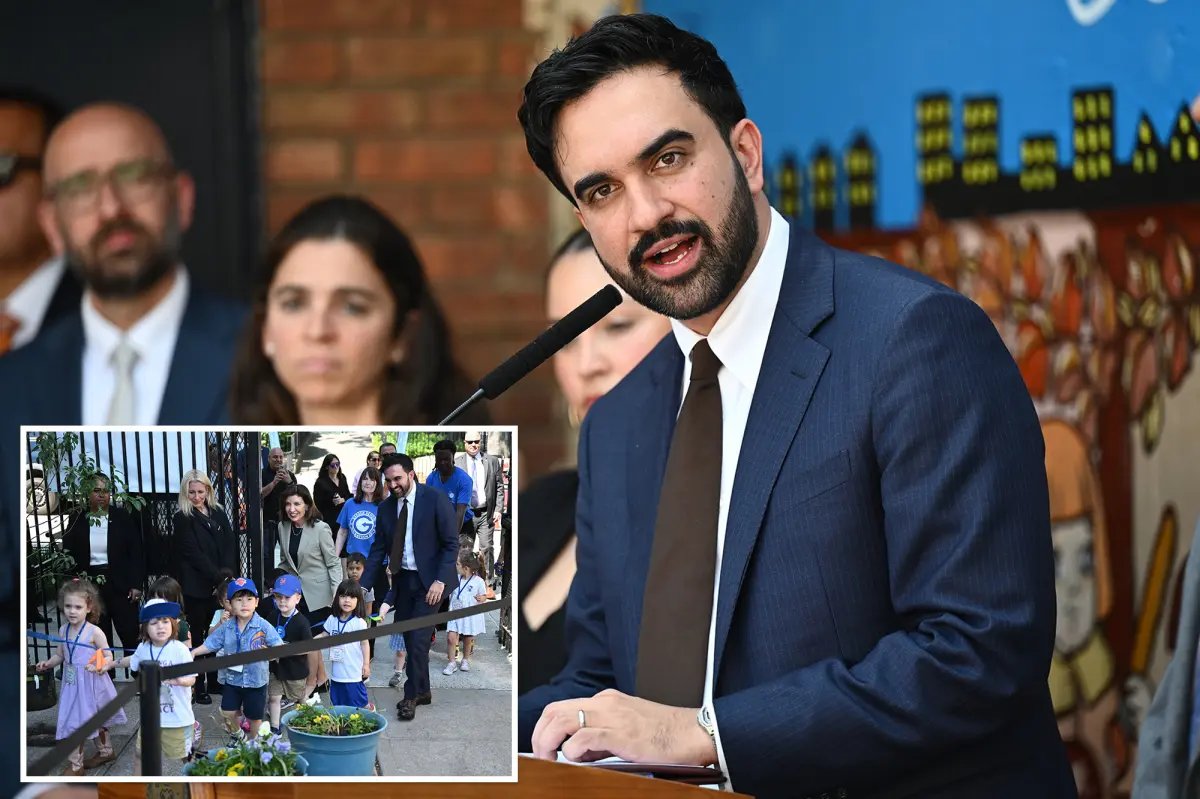
Speaking at a news conference Tuesday, the mayor blamed his predecessor Eric Adams for bequeathing him a broken universal childcare system with a “bare bones” outreach team.
“Despite the incredible efforts of the City Council, we saw that there was sustained disinvestment in the outreach around universal childcare, especially as it pertained to 3-K and pre-K,” Mamdani said.
“What we’ve also seen is decreased immigration into our city, increased fear and suspicion of enrolling and using city services, especially from immigrant communities,” he added, in attempting to explain his admin’s struggle to increase applications.
“We knew we had to invest in a sustained outreach this year and have it also be part of multi-year outreach so that we can start to win the trust back of those families,” he said.
The mayor also blamed “years of confusion over what was actually available,” alluding to anecdotes citywide of students receiving offers for preschool spots in neighborhoods miles away from their homes.
As of Tuesday, the city had made nearly 100,000 offers for pre-K and 3-K — with fewer families receiving placements to programs not listed on their applications, from 15 to 12%, “helping ensure more families received offers they could realistically accept,” City Hall said.
The mayor’s office touted also touted a significant decrease to the average distance between a child’s home and 3- and 4-year-old program placement in 2026.
Last year, the average school commute was 1.1 miles for pre-K students and 1.97 miles for 3-K families. This year, those figures dropped to .9 and 1.12 miles, respectively.
Fewer than 200 families received out-of-borough offers this year — compared with 720 families in 2025 — and all placements were within three miles from home, the city said.
“Frankly, the announcements that we’ve made today of how much closer these centers will be — how many more families will have their top choice or their top three choices — that’s how you start to wind people back to being a part of the system,” Mamdani said.
“It’s not going to be the ad that you see on a LinkNYC kiosk or in the back of a taxicab,” he argued.
“It’s going to be a comment you see from a parent on a Facebook group, that [says], ‘Actually, this year, I got that program.’ That’s how we’re going to start to win people in the years to come.”
The news comes as the city faces a population decrease, with the number of eligible 3-K students in the city plummeting 1.23% since 2025 — and officials are blaming affordability struggles on the exodus. Last year, New York City lost 114,000 more residents to other US cities than it gained.
At the same time, Mamdani has aggressively expanded the number of early childhood education seats available after a Post investigation revealed dozens of city-run preschools were built, but never opened, under previous mayoral administrations.
This week alone, Mamdani announced a 2,000-seat addition to the city’s universal 3-K programs across the five boroughs, effectively doubling the city’s earlier expansion program.
But some parents have left the system entirely — and shell out tens of thousands of dollars for private child care due to far-away placements or difficult commutes on public transit.
“The bus doesn’t come,” Brooklyn mom Jessica Setton lamented to The Post last week. “Unless you’re under a mile [away] from the schools, one child will always be late.”