



WASHINGTON — President Trump’s bashing of migrants from “s—hole countries” and other fiery immigration rhetoric came back to haunt him during the Supreme Court’s oral arguments Wednesday.
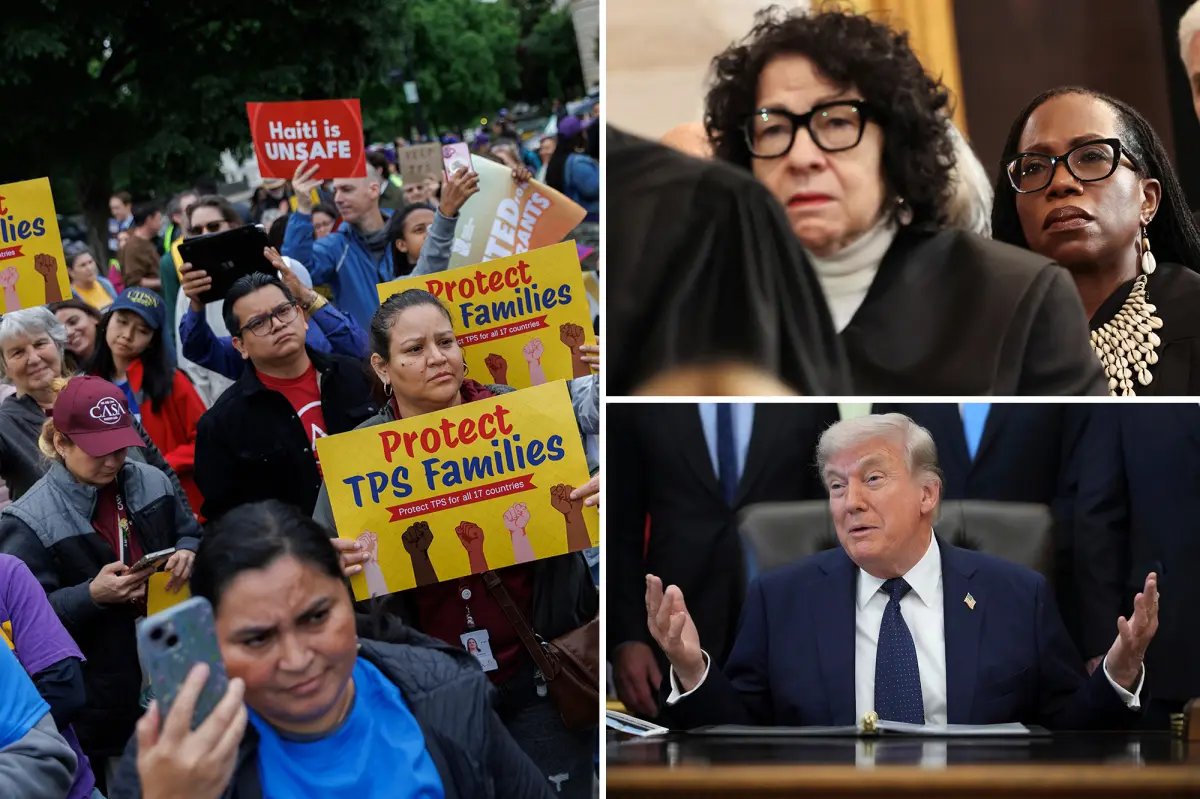
While considering a case over the Trump administration’s bid to yank temporary protected status (TPS) for thousands of Syrian and Haitian migrants, Democrat-appointed justices latched onto his hot rhetoric to imply the White House was being racist.
“Now we have a president saying at one point that Haiti is a ‘filthy, dirty and disgusting s—hole country,’” liberal Justice Sonia Sotomayor said. “I’m quoting him.”
“He declared illegal immigrants, which he associated with TPS, as poisoning the blood of America,” she went on. “I don’t see how that one statement is not … showing that a discriminatory purpose may have played a part in this decision.”
Solicitor General John Sauer countered that Trump’s statements, when taken in context, were referencing non-racial issues such as poverty, crime, welfare, and drugs.
But fellow liberal Justice Ketanji Brown Jackson seemed unconvinced.
“What about ‘Poisoning the blood‘ of Americans?” she asked. “What about ‘bad genes?’”
“So the position of the United States is that we have to have an actual racial epithet that we aren’t allowed to look at all the contexts to include the president’s insistence that immigrants from certain countries largely, if not almost exclusively, countries with African immigrants, black African immigrants, are not allowed,” she shot back.
Trump, in a rally in 2025, said he didn’t want immigrants from “s—hole countries” and defended a “permanent pause on Third World migration, including from hellholes like Afghanistan, Haiti, Somalia and many other countries.”
“Why is it we only take people from shithole countries, right?
Why can’t we have some people from Norway, Sweden, just a few? Let us have a few from Denmark,” Trump said in Pennsylvania in December, recalling a conversation with lawmakers.
At issue before the high court was a stay application against former Secretary of Homeland Security Kristi Noem’s decision last September to take away TPS for over 6,000 Syrians and 350,000 Haitians living in the US.
The move came in response to Trump’s January 2025 executive order calling on his DHS secretary to curtail TPS designations.
Over 1.3 million nationals across 17 countries were protected by TPS as of March of last year. Statutory law allows administrations to “designate” countries whose migrants deserve temporary protection.
Under TPS, which has been in effect since 1990, eligible migrants get temporary status in the US and can seek work authorization for over a year and a half.
The Supreme Court heard a consolidated case of two different lawsuits from a group of Syrians and Haitians who both argued that the decision was made based on racial animus rather than geopolitical factors.
Democrat-appointed justices did the bulk of the questioning on all sides during oral arguments on Wednesday and signaled opposition to the Trump administration’s actions.
Republican-appointed justices were comparatively less aggressive, with Chief Justice John Roberts and Justice Amy Coney Barrett, who has two adopted Haitian children, doing little to tip their hand as to where they were leaning.
“It’s not the Assad regime anymore, though?” conservative Justice Brett Kavanaugh noted. “The whole thing was the Assad regime after 53 years of complete oppression and brutal treatment. It’s gone.”
Ahilan Arulanantham, an attorney for the Syrian nationals, acknowledged the dramatic change in Syria that took place over the past year and a half, but contended that the country is still dangerous and migrants from there deserve protection.
Geoffrey Pipoly, the lawyer for the Haitian plaintiffs, argued that yanking TPS for Haitians was “preordained, driven by the president’s tests for Haiti, no matter what criterion given for the determination.” He ripped the DHS review of TPS as a “sham.”
“Isn’t it the case that TPS was terminated for quite a list of countries?” Republican appointed Justice Samuel Alito pointed out. “You say they’re all nonwhite, and that’s the distinguishing characteristic?”
Pipoly acknowledged that the State Department may have programs that consider Syrians white, but argued that the Trump administration was still being discriminatory in its decision to roll back TPS.
Meanwhile, Sauer argued that the statute behind TPS gave the administration the authority to determine whether to yank TPS status, thereby precluding judicial review of that decision.
“I had a hypothetical to pull out an Ouija board. The secretary says, ‘You know how I’m going to figure this out,’” Jackson pressed Sauer. “Your view would be that no judicial review of that claim.”
The US solicitor general countered that “any exception” to his assertion that TPS determination isn’t subject to judicial review “that the court would craft here would be something that a truck could be driven through.”
The Supreme Court previously gave the Trump administration the go-ahead to yank TPS from 600,000 Venezuelans in the US.
A decision in the consolidated Mullin, Sec. of Homeland Security v. Doe and Trump, President of the United States. v. Miot cases is expected by the end of June.