


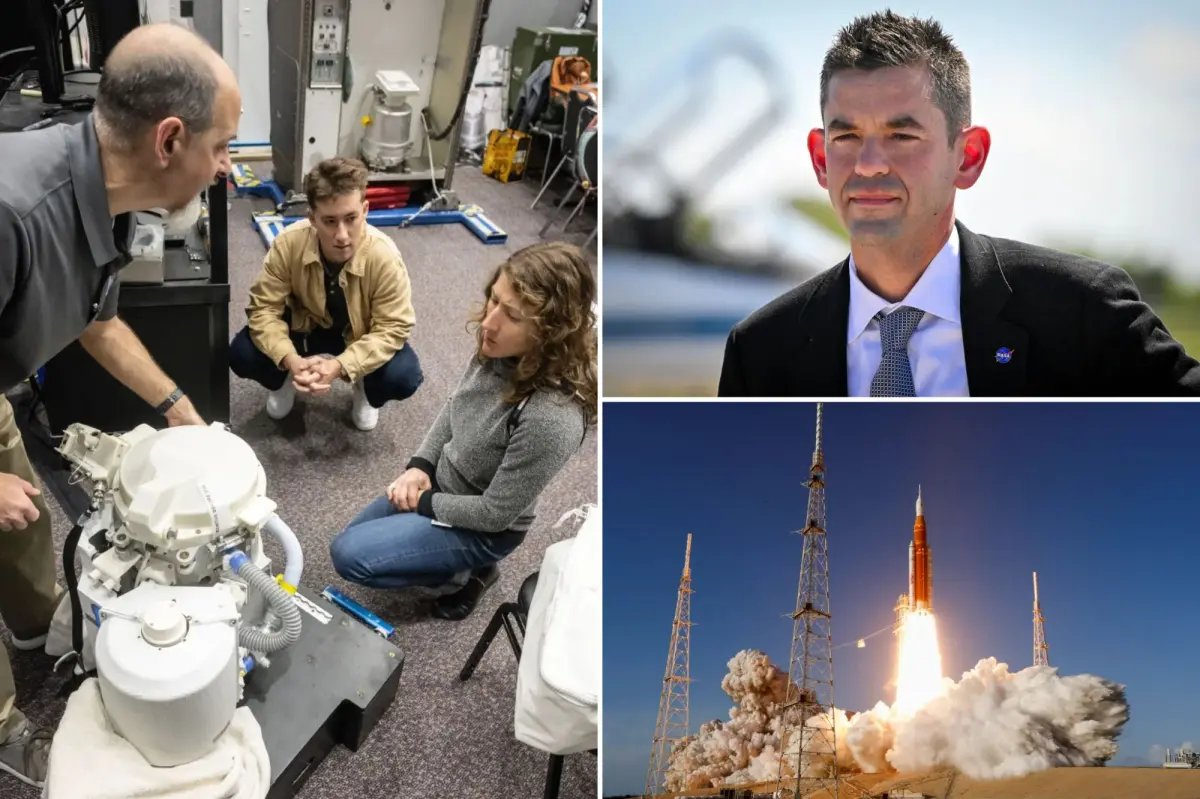

NASA’s No. 1 guy Sunday poo-poohed critics of the Artemis II mission’s $23 million toilet — saying the astronauts know they’re lucky to even have the crappy alternative.
“Throughout the history of human spaceflight, the toilet working is almost a bonus capability,” agency administrator Jared Isaacman told CNN’s “State of the Union” when asked about the suction-based titanium throne’s less-than-stellar debut aboard the Orion spacecraft.
“I will say we build in a lot of back-ups. So there’s different vent lines, for example, for urine,” Isaacman said.
“Even when we have an issue with some freezing on the primary [option], the secondary has been working. So, believe me, the astronauts, they’re OK right now, and they were well-prepared for the situation,” he said.
Still, “this is something that we can do — a lot of extraordinary things in space right now — but nailing this capability is one that we need to certainly work on,” Isaacman said.
The sophisticated toilet system uses suction technology to get feces into a canister that will travel back to Earth, while urine gets flushed out into outer space. Astronauts’ waste previously went into plastic bags through a suction system.
Shortly after the Orion’s launch, its four astronauts reported that the eight-figure loo was jammed because of a problem with its pump.
The astronauts could use it for No. 2 but not No. 1 because the urine line became frozen..
Then Saturday, they reported a mystery burning smell while using the lunar loo. The smell appeared to be coming from orange insulation on the toilet’s hygiene bay door.
The toilet was eventually cleared for use again.
Developing the Upper Waste Management System took six years and is the second most expensive space toilet developed. The 1992 Space Shuttle Endeavour’s Waste Collection System cost about $30 million, or just shy of $70 million in 2026 in inflation-adjusted dollars.
There are at least 10 other sophisticated space toilets that have been in use, including four on the International Space Station.
Isaacman, a billionaire who founded Draken International, which has the world’s largest private air force, was on the first all-civilian spacecraft flight in September 2021.
He became the first private citizen to do a spacewalk in 2024.
The NASA boss, who took the reins of the agency in December, meanwhile revealed he believes aliens exist.
“I have been to space twice. I didn’t encounter any aliens up there yet,” he said. “I have not seen anything to suggest that we have been visited by any intelligent life forms out there.
“But when you think about it, we got 2 trillion galaxies out there. Who knows how many star systems within each of it? I would say the odds that we will find something at some point to suggest that we are not alone are pretty high.
“Our job here is to go out and try and unlock the secrets of the universe,” the NASA chief said.
“And one of those questions is, ‘Are we alone?’ So I would say that is inherent in every one of our scientific endeavors, our exploration endeavors.”