


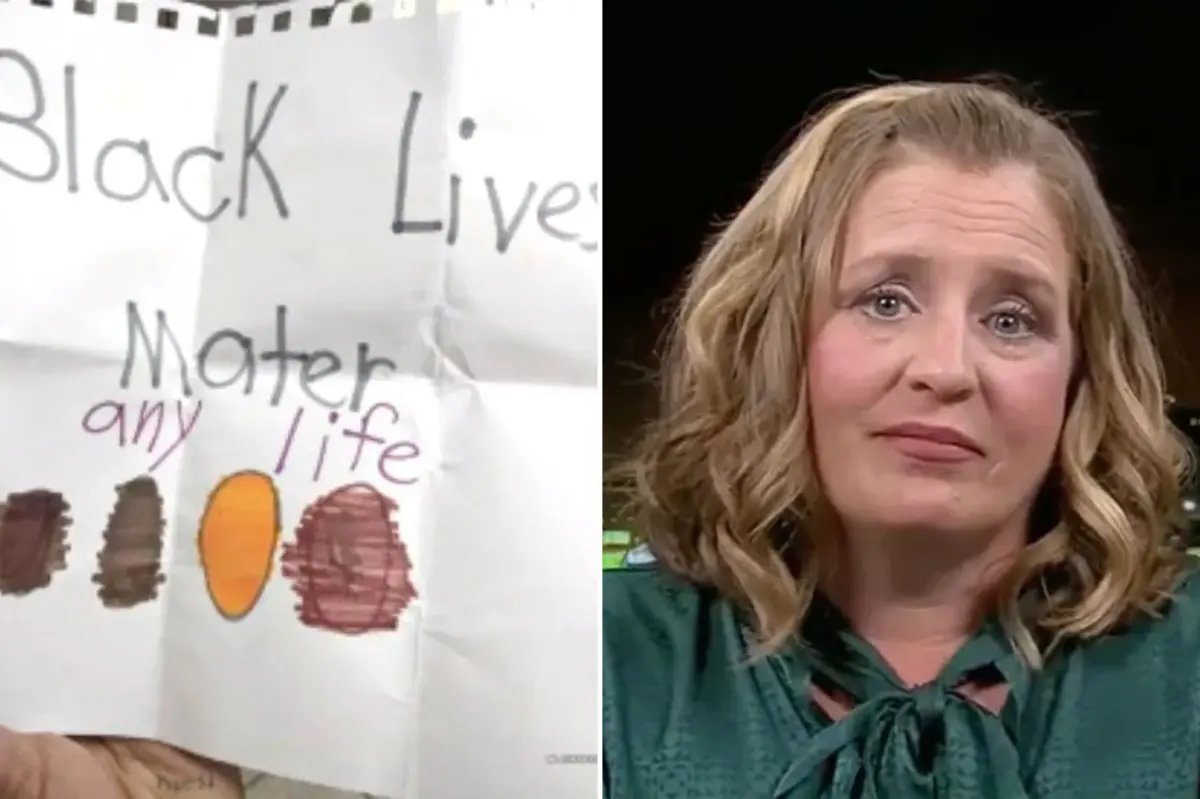
A California appeals court backed a white girl who was punished by her school and called racist for writing “any life” drawing innocent thumbprints of her friends under “Black Lives Matter” picture at school.
The girl, identified as “B.B.” in court documents, in 2021 drew the picture and gave it to a black classmate, “M.C.,” after listening to a story about the Rev. Martin Luther King Jr. in class.
Under a ”Black Lives Matter” illustration, M.C. poignantly wrote ”any life” and marked the paper with four drawings of her friends with different skin color thumb prints.

But when M.C. took the picture home, her mom raised concerns with the B.B.’s mom, Chelsea Boyle, and the school.
Jesus Becerra, the principal of Viejo Elementary School, in Mission Viejo, told the girl her drawing was racist, forced her to apologize to M.C., and banned her from recess for two weeks.
Boyle later filed suit against the school, alleging B.B.’s First Amendment rights were violated.
The lower court disagreed, concluding the drawing was not protected speech and interfered with the black student’s right to be let alone.
But the appeals court overruled the decision based on the landmark 1969 ruling in Tinker v. Des Moines Independent Community School District case, which established high school students had the right to protest the Vietnam War.
“This case presents an important issue: to what extent is elementary students’ speech protected by the First Amendment?” the three-judge panel wrote in a per curiam opinion.
“We hold that elementary students’ speech is protected by the First Amendment, the age of the students is a relevant factor under Tinker, and schools may restrict students’ speech only when the restriction is reasonably necessary to protect the safety and well-being of its students,” the judges found.
”Because the Tinker analysis raises genuine issues of material fact, we vacate the grant of summary judgment and remand,” they added.
The lower court judge, U.S. District Judge David Carter, a Bill Clinton appointee, argued that age was a factor in his decision.
“Thus, the downsides of regulating speech there is not as significant as it is in high schools, where students are approaching voting age and controversial speech could spark conducive conversation,” Carter wrote.

But the higher court said age is a relevant but “non-dispositive” factor.
“Disagreeing with the district court’s determination that the drawing was not protected by the First Amendment, the panel held that elementary students’ speech is protected by the First Amendment, Tinker applies in the elementary student speech context, and elementary students’ young age is a relevant, but non-dispositive, factor,” the panel wrote.
Boyle celebrated the higher court’s decision.
“This isn’t just a win for my daughter. It strengthens constitutional protections for students across the country,” she wrote in an Instagram post.
“Turns out…The Constitution doesn’t have an age limit,” she added.
Her attorneys followed suit.
“Today’s ruling affirms what should be obvious: Students don’t lose their constitutional rights just because they’re young,” Caleb Trotter, senior attorney at Pacific Legal Foundation, said in a release published online. “The Constitution protects every student’s right to free expression. No child should be punished for expressing a well-intentioned message to a friend.”
The case will now go back to the U.S. District Court for the Central District of California, per Courthouse News.