


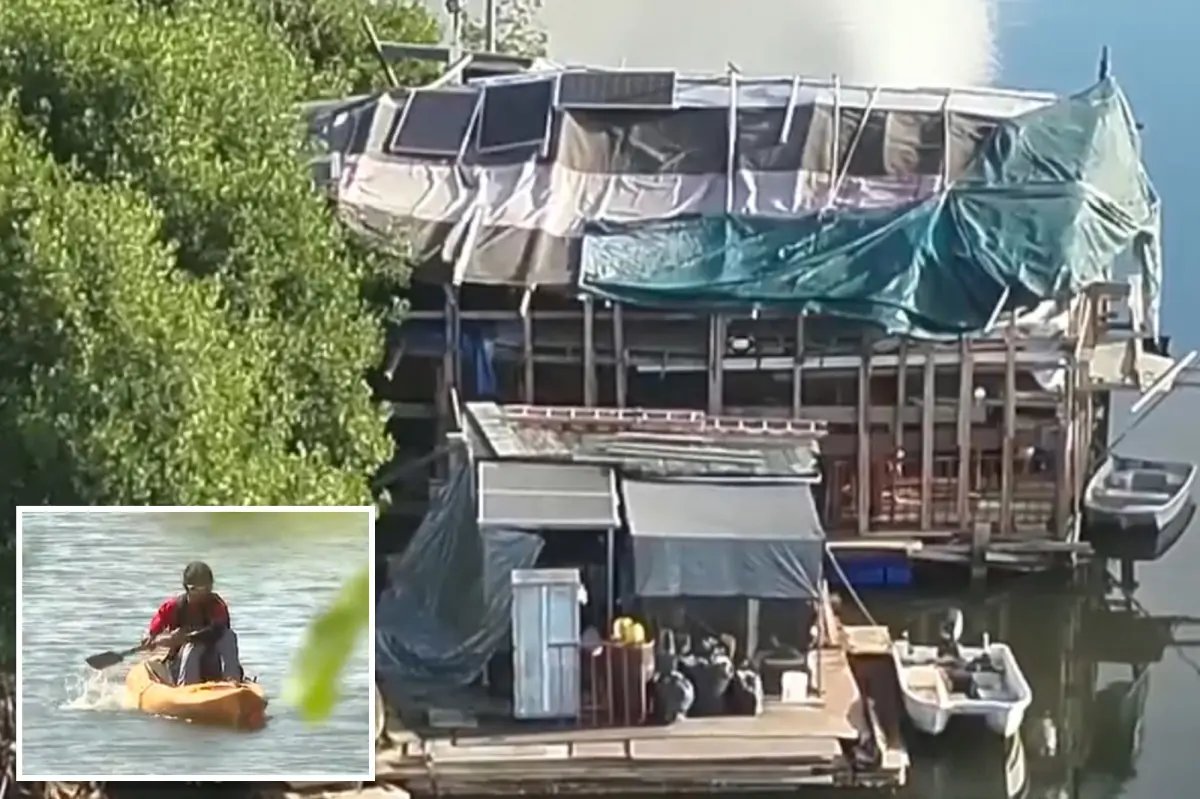

A neighborhood in Hawaii’s capital city has been plagued by a sprawling waterfront homeless shanty town that includes a makeshift houseboat used to avoid encampment sweeps.
The two-story floating structure, the center of an ever-growing homeless community along Keehi Stream, is surrounded by smaller outposts housing vagrants who kayak to and from the shelter.
It is even retrofitted with recycled solar panels so it can independently store electricity — but still poses an increasing threat to both locals and its homeless residents.
Laura Thielen, executive director of housing nonprofit Partners in Care, told Hawaii News Now that the skittish squatters are unlikely to immediately accept any charity from the city or state.
“They’re just like regular communities. They want to help govern themselves, but if we expect them to go far away, they’re more than likely not going to do it,” Thielen said.
Honolulu’s director of homeless solutions Roy Miyahira is intent on helping the group live with more relative security — without using force to flush them out of the encampment.
“Now we recognize where they are, where we think we can deliver some help to them, have more of a suitable type of place to live, and away from any type of danger,” he told the outlet.
Hawaii’s Department of Land and Natural Resources homeless coordinator Pua Aiu told the outlet that the encampment used to be on the south side of Keehi Stream. It’s unclear how long the encampment was overlooked, but Aiu said the department discovered it during a survey in June 2024.
The state conducted a sweep of the southern shoreline with the intent of clearing the houseboat, but the two-story structure had “moved across the stream” to the city’s jurisdiction, Aiu said.
The dense greenery surrounding the stream and the city-state jurisdiction debacle has turned the waterway into a hotspot for the homeless.
One site, situated under the Nimitz Highway viaduct, was cleared out in October 2017, resulting in a mass displacement after a majority of the squatters declined housing and relocation offers.
The mayor’s office confirmed to the outlet that they first reached out to the current residents at the Keehi Stream encampment in February, and are hoping to have them all relocated elsewhere by the end of April.
Aiu told the outlet that the three-month cleanup in the summer of 2024 cost just over $1 million. The laborious process required them to first cut back the fast-growing foliage with hand tools before they dismantled the structures.
There are an estimated 6,000 homeless people scattered around Honolulu. Most major encampments are settled around Keehi Stream and Diamond Head, a volcano in a state park.