


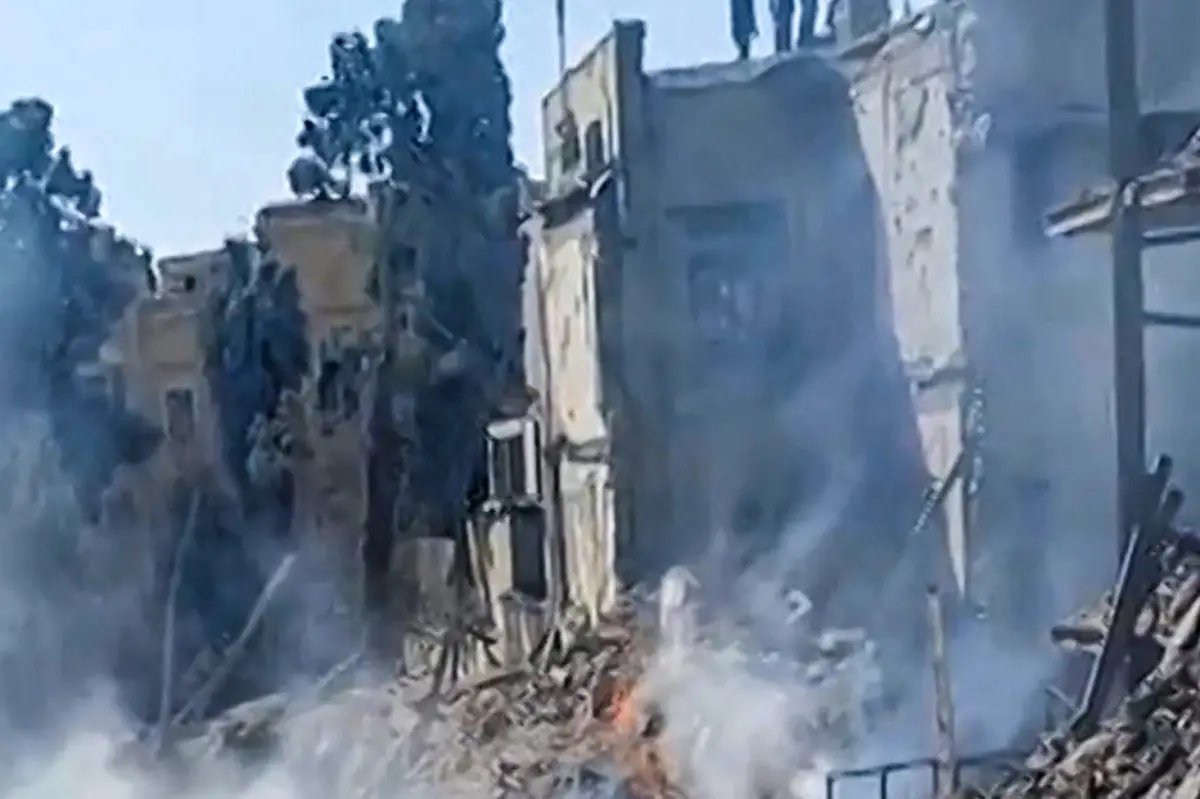

The massive scale of the joint US and Israeli strikes against Iran signals the goal of Operation Epic Fury is regime change rather than a pinpoint “decapitation,” experts told The Post.
Withering joint strikes and carried out by the US and Israeli Defense Forces pummeled Iranian missile launchers. There was a huge explosion at the site of Supreme Leader Ali Khamenei’s compound. Another strike targeted Iranian President Masoud Pezeshkian, the Times of Israel reported.
There were airstrikes reported in Isfahan, where the US hit an Iranian nuclear facility back in June, as well as in Qom, Karaj and Kermanshah.
Simultaneous strikes on three sites took out “several senior figures essential to the management of the campaign and the regime’s governance,” an Israeli official said.
The initial onslaught was “clearly heavy duty,” said Joel Rayburn, a senior fellow at the Hudson Institute who served as special envoy for Syria during President Trump’s first term.
“The preemptive wave has been even more extensive than I’d have thought,” he said.
“It does look like they are striking targets that include regime leadership and the regime’s ability to defend itself – not just from US and Israel attacks, but from a popular uprising,” he said.
Targeting Iran’s Islamic Revolutionary Guard leadership, or potential strikes on Basij forces who have crushed street protests, are meant to limit the regime’s ability to organize a response, he noted.
Gaining control of the skies by taking out air defenses allows manned-aircraft to carry out still further attacks – and suppress any efforts by the Iranians to move around masses of internal security to put down any rebellion.
Iran’s inability to launch its own large-scale counter-attack against Israel or US forces demonstrates the early success, Rayburn said. “The pretty meager Iranian response indicates that their capabilities were preemptively taken out on an extensive scale,” he added.
“There had been discussions, and certainly the Israelis were advocating for there to be a fairly systemic bombing campaign against the security services, not just decapitation, but to go after them regionally, inside of Iran,” said Ruel Marc Gerecht, a former CIA officer on the Iran desk now with the Foundation for Defense of Democracies.
“They’ve obviously decided to go pretty big,” he added.
The campaign could last for weeks, until Iranian defenses are down and the US and Israel gain unrestricted control of the skies, experts said.
There are early reports that the US is using its massive military arsenal to target Iran’s stockpile of missiles, with Iranian forces having perhaps a few hundred heavy missiles left after the 12-day war with Israel in June.
“The Israelis were certainly worried that their throw weight would be insufficient to take them out. So it made a lot more sense for the Americans to do that targeting than for the Israelis, and since the Israelis have certainly much better tactical intelligence than we do … they would be better placed to go after the security services if they choose to do that,” he said.
Trump called it a “massive and ongoing operation to prevent this very wicked, radical dictatorship from threatening America and our core national security interests,” and there were early expectations that the US could once again target Iran’s nuclear facilities.
One is Pickaxe Mountain, located near the Natanz facility, which US and Israeli forces didn’t hit back in June
“That site is about 100 meters below mountains, so it’s even more deeply buried in Fordow,” said Andrea Stricker, deputy director of the nonproliferation program at the Foundation for Defense of Democracies.
She said it was “pretty flagrant” that Iran resumed construction after the June attacks and that the US “may want to eliminate that just to send a signal that we see you rebuilding.”
Scenarios also reportedly include attacking Khamenei’s son Mojtaba Khamenei “and the mullahs” – suggesting the administration is looking at attack that would go far beyond the pinpoint attack that snatched Venezuelan President Nicolas Maduro and brought him to New York to face drug and conspiracy charges.
Israeli Prime Minister Benjamin Netanyahu, on Saturday called Iran a “murderous, terrorist regime must not be allowed to arm itself with nuclear weapons that would enable it to threaten all of humanity,” as joint airstrikes with the US targeting Iranian Supreme Leader Ayatollah Ali Khamenei and President Masoud Pazeshkian. Netanyahu accused Iran’s leaders of trying to “buy time” through negotiations.
Trump issued a direct call for Iranians to “take over your government,” after the regime in Tehran killed thousands of protesters who took to the streets last month.
That erased any doubt that regime change was a goal of the operation.
The internal Iranian response is critical – “whether the Iranian people can come back out into the streets or number or whether the death toll was sufficient to keep them indoors,” said Gerecht.
“I think the regime has cohered. After the bloodshed of January, I think the regime knows there’s no forgiveness after such sins. The regime’s inner elite is smaller than it used to be, but what there is more unified. They’re going to be tough to take down,” he said.