


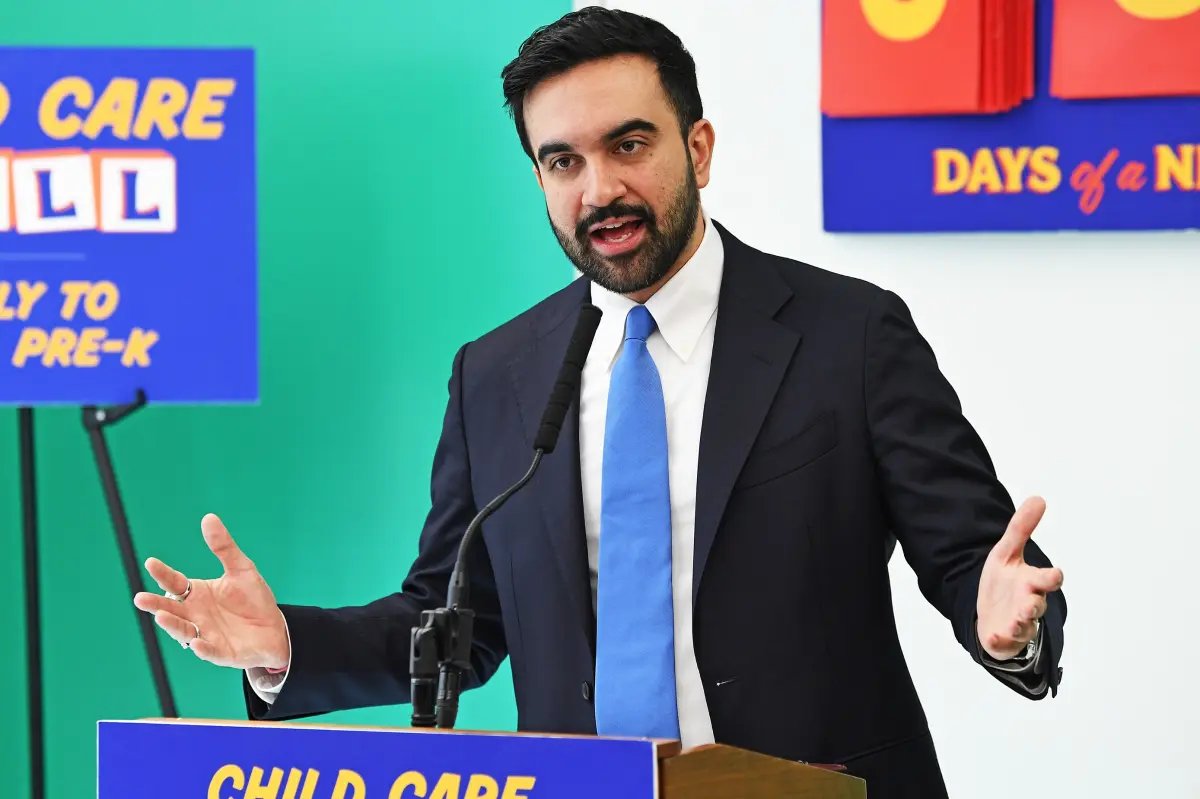

A union-friendly education law is saddling the Big Apple with billions in additional costs — but Mayor Zohran Mamdani won’t ask Albany to tweak the pricey edict.
Hizzoner has been pushing a tax increase to cover the city’s apparent $5.4 billion fiscal gap, all while he proposes growing the Department of Education’s bloated budget by $3 billion, including additional funding for the state class size reduction law.
His $127 billion preliminary budget plan, unveiled Tuesday, includes nearly $543 million in additional city spending for the next school year to reduce class sizes, an estimate that nearly doubles, to roughly $943 million, annually in the following three years.
Follow live updates on Mayor Zohran Mamdani’s socialist agenda and the latest in NYC politics
“The class size reduction mandate is an expensive law. We need to change the law,” said Yiatin Chu, co-president of Parent Leaders for Accelerated Curriculum and Education.
The law approved in 2022 — which Mamdani’s predecessor, Mayor Eric Adams, complained was an unfunded mandate — requires the city to cap class sizes at 20 students in the lower grades and to 25 in high schools.
Eighty percent of classes must meet those caps in the next school year, with 100% compliance by the 2027-28 school year.
Critics said the law is an unworkable and wasteful bust that has become a jobs protection program for the United Federation of Teachers, not to promote academic achievement.
“The legislature pass the class size reduction to protect the revenue of the UFT,” said Danyela Souza, an education researcher with the right-leaning Manhattan Institute think tank.
“The law has proved crippling for many schools,” she said. “Those that have not reduced class sizes—about a third of city schools—face challenges hiring additional qualified teachers or finding adequate space.”
A case can be made to lower class sizes, but the law has to be practical, said Eric Nadelstern, who served as deputy schools chancellor under Mayor Mike Bloomberg.
“Unfunded mandates that stick the city with the bill is generally not a good thing,” Nadelstern said.
Mamdani voted for the law as a Queens state assemblyman and backed it as a mayoral candidate — but is not asking Gov. Kathy Hochul and the legislature to pause or scale back.
Instead, Mamdani has called on Hochul and Albany lawmakers to raise taxes on millionaires — or else he’ll be “forced” to hike all New Yorkers’ property taxes by $9.5%.
Meanwhile, the spending plan for fiscal year 2027 boosts the DOE budget overall by $3 billion, to a total $38 billion — event as the public school system’s enrollment has cratered following the COVID-19 pandemic.
At the start of the 2019-20 school year, 1,002,200 kids were enrolled in the public schools. The total has dipped to 844,400 this school year, a 117,800 drop.
The highest performing schools in well-to-do neighborhoods have the largest class sizes and are doing fine academically.
So the law “primarily benefits wealthier, higher-performing schools at the expense of instability and increased costs,” Souza said.
For example, the Center School, a middle school in the Upper West Side, was informed it might be relocated due to building constraints caused by being forced to reduce class sizes.
The bigger problem is not overcrowding, Souza said, but emptied out schools.
There are now 112 schools in the city with fewer than 150 students, up from 80 last year.
She said Mamdani will need to downsize, close or merge schools to reflect a shrinking school and shave unnecessary costs.
Nadelstern said the DOE can better manage compliance by reassigning licensed teachers doing administrative duties back into classrooms.
He estimated that in some Title I schools serving a high percentage of disadvantaged students have as many as a third of licensed teachers who are not full-time instructors.
Mamdani’s press office referred The Post to testimony delivered in Albany by his schools chancellor, Kamar Samuels.
Samuels questioned whether schools would be able to hire the thousands of teachers needed to comply with the law, saying reaching the 80% classes in compliance target will be a “formidable undertaking.”
He cited a department survey that estimated the schools would need to hire an additional 6,000 teachers at a cost of $602 million to meet that mandate.
“This will be our most significant hiring target since the enactment of this legislation, and the sheer volume of candidates needed significantly exceeds our current pipelines,” Samuels said.
He said he would work with lawmakers and “union partners” on finding “pathways” to comply with the law.
But one influential lawmaker who championed the class size reduction law said he has no intention of watering the edict down, and insisted the mayor must abide by it.
“State foundation aid for NYC schools has already increased by $1.6 billion annually since passage of the class size law, but unfortunately successive mayoral administrations have misprioritized the use of the state funds,” said state Sen. John Liu, a Queens Democrat who chairs the panel on Big Apple schools.
“Though the current administration faces shortfalls due to misplaced priorities of the previous, it is still their responsibility to comply with state law and its state constitutional responsibility to provide NYC school kids with a sound basic education, which is not possible when classes remain overcrowded,” added Liu.
UFT president Michael Mulgrew defended the class size law as pro-student and pro-parent.
“Parents across the city say they have a shared experience: smaller classes have deepened the connection between their child and teacher. Families say they are already seeing the impact of smaller classes, both socially and academically,” Mulgrew said.
“Our New York City students deserve the same smaller classes children in the rest of the state already enjoy. We need to stay the course and bring smaller classes to all students.”