


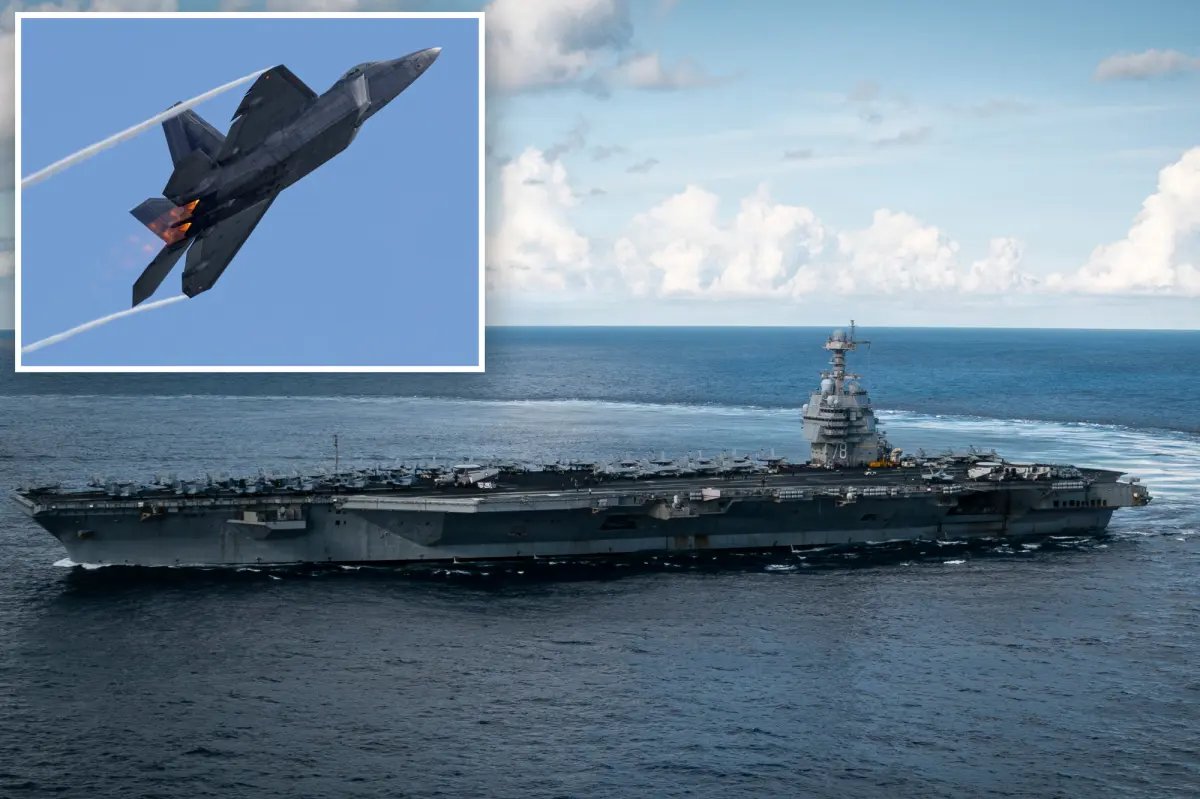

President Trump is sending the USS Gerald R. Ford, the world’s largest warship, to the Middle East, along with a huge fleet of aerial refueling tankers and F-22 and F-35 strike fighters, according to reports.
The massive buildup in military hardware is the biggest indication yet that Trump could be preparing for large-scale strikes against Iran if high-stakes negotiations over the Islamic Republic’s nuclear program and brutal crackdown on protesters fail.
The nuclear-powered aircraft carrier Ford and its carrier strike group set sail in the Atlantic on Tuesday and is heading for the Strait of Gibraltar, the entrance to the Mediterranean Sea, USNI reported.
It would join the USS Abraham Lincoln carrier strike group in the Middle East as a major show of force amid US negotiations with Iran over its nuclear program.
The Ford — America’s most advanced aircraft carrier and the largest ever built — is designed to carry more than 75 aircraft, including F-35C Lightning II stealth fighters and F/A-18F Super Hornets, as well as EA-18G Growler radar-jamming jets.
The strike group is accompanied by three destroyers, the USS Bainbridge, the USS Mahan and the USS Winston Churchill.
The vessel had been operating in the Caribbean Sea since mid-November as part of the US naval force supporting Trump’s operations in the South American nation.
The Ford’s deployment comes as part of a new military build-up in the Middle East, with Trump refusing to leave an attack on Iran off the table as negotiations stall.
Along with the Lincoln, the US has four destroyers operating in the Arabian Sea, with another three patrolling in the Strait of Hormuz.
The USS Delbert Black destroyer is in the Red Sea, with two combat ships currently in the Persian Gulf.
The US has also moved more than 50 fighter jets to the Middle East on Tuesday as part of the military buildup, according to Axios.
The airfleet includes F-16 Falcons, F-22 Raptors and F-35 jets, according to independent flight trackers.
The latter jets have stealth capability that could allow them to strike Iran without being detected by the nation’s air defenses.
The jets would join other warplanes that have been moved in recent weeks, including attack fighters based in Jordan, the United Arab Emirates, and Saudi Arabia.
The mass deployment would allow the US to conduct airstrikes deep within Iran while also providing defensive cover for US troops and allies in the Middle East, experts previously told The Post.
Iran has repeatedly warned of retaliatory strikes on US troops and allies should America attack, with Tehran shutting down the Strait of Hormuz earlier this week to conduct live missile drills.