



For years, the NBA All-Star Game had become basketball’s most glamorous scrimmage. A layup line dressed in designer sneakers. Defense was always an optional accessory.
On Sunday at the sparkling, $2 billion Intuit Dome, something shifted.
The league scrapped the tired East vs. West, and captains pick teams models, and introduced a USA vs. World format — a three-team, four-game round-robin tournament. Twelve-minute sprints. No coasting. No hiding. The top two teams advanced to a championship game, and suddenly, pride wasn’t just a marketing slogan. It was bragging rights.
The idea was borrowed from the NHL’s wildly competitive 2025 All-Star showcase, where Canada, Finland, Sweden and the United States skated with national urgency. The NBA All-Star Game needed a jolt. It got it.
From the opening tip, the temperature was different. Hands were active in passing lanes. Double-teams were executed. Players blocked shots and argued calls.
The first game went into overtime, where Raptors forward Scottie Barnes drilled a 3-pointer to stun Team World in the first competitive contest.
The second game featured the Young Stars vs. The NBA OGs. It was one of the more exciting and prideful games.
A back-and-forth battle saw both teams breaking a sweat and giving it their all in the final two minutes.
Anthony Edwards, one of the next faces of the league, scored five straight points to give the Young Stars the lead, but the current face of the NBA, LeBron James, walked the ball up the court and found Cavaliers guard Donovan Mitchell in the paint, but instead of shooting, he passed out to Spurs point guard De’Aaron Fox — who drilled a 3-pointer at the buzzer.
The third game delivered the signature moment.
On his home floor, Kawhi Leonard turned the All-Star stage into a personal workshop. He dissected Team World with surgical calm, scoring 31 of his team’s 48 points in a 12-minute sprint that felt like a playoff moment.
With three seconds left, Leonard rose from the right wing and buried a fading 3 over an outstretched Karl-Anthony Towns. The kind of shot that would have meant nothing in past All-Star exhibitions meant everything here.
Across from him, Victor Wembanyama poured in 19 points in the loss, stretching arms and expectations in equal measure. The future battled the present. The building leaned forward.
Team World was hampered by injuries. Luka Dončić logged just five minutes in the opener before a hamstring tightened and prudence prevailed.
“I think it was good. The game this year was a little better,” Dončić said afterward. “We didn’t make it. We had some injuries on our team again, but we’ll be better next year.”
The championship game provided the cleanest proof that this format works. It was a rematch of the second game, when the OGs stunned the Young Stars at the buzzer. But this time the young legs had nearly 45 minutes of rest, and in a tournament built on quick turnarounds, that rest was currency.
They spent it immediately.
The Young Stars blitzed to a 12-1 lead, attacking the rim like rent was due. The OGs, proud but winded, tried to summon muscle memory. They simply couldn’t close the gap.
The final game lacked the drama of the first three, as well as Leonard’s heroics, but it delivered something arguably more important: consequence.
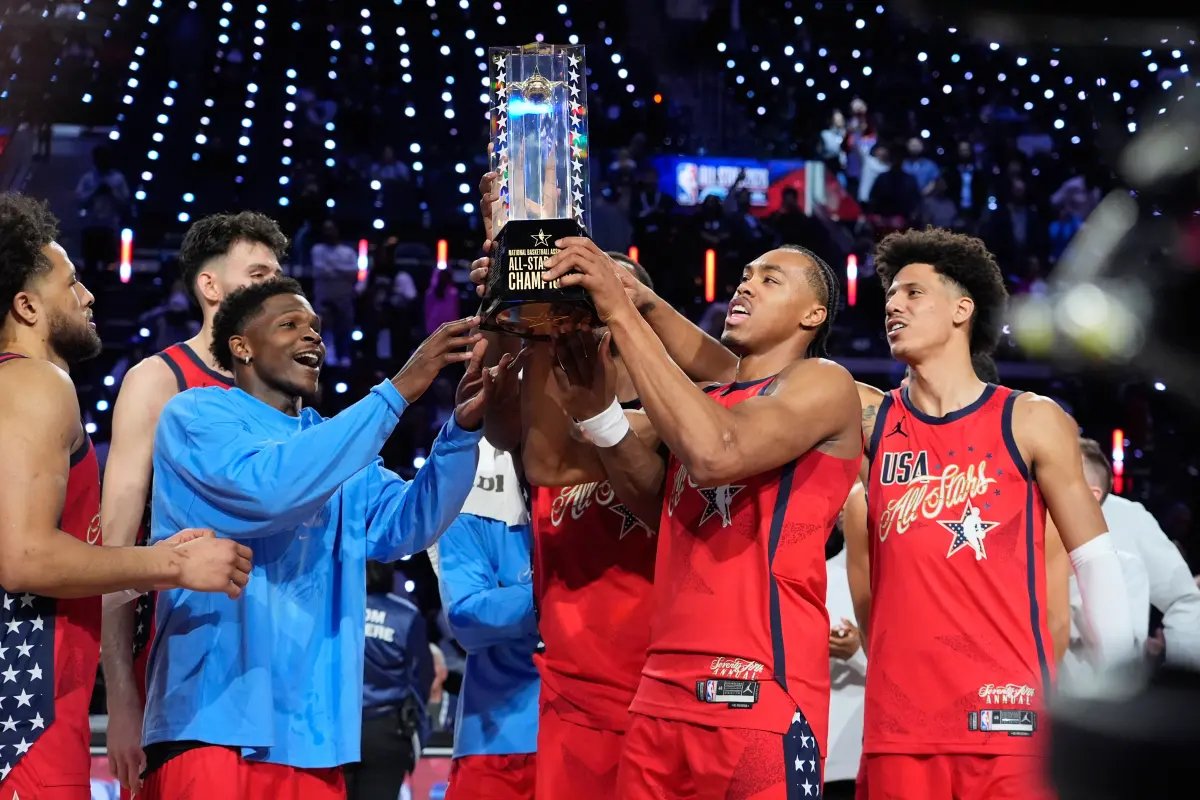
Led by Tyrese Maxey and Edwards, the Young Stars claimed the first USA vs. World Round Robin title for Team USA Stars. Maxey played with the giddy edge of someone who understands that bragging rights carry weight in this league.
“I didn’t want to lose to the OGs again, know what I mean?” Maxey said, grinning. “That gives them trash-talking. If I see these guys in two weeks when we play against them, I now have bragging rights. Those are fun to have.”
There were moments Sunday when bodies hit the floor and no one flinched. When a missed defensive rotation drew visible frustration. When Team World huddled like it was protecting something bigger than Instagram highlights.
The USA vs. World concept taps into the NBA’s most powerful truth: The league is global, and that globalism carries pride. International stars have reshaped MVP ballots for half a decade. American players have heard the noise. You put those identities in a tournament structure, add quick games that demand urgency, and you get something closer to real basketball.
Not perfect. But real.
“Wemby set the tone. He said ‘it’s on!’ and so we had to bring it,” said Edwards, the Timberwolves guard who was named the All-Star Game Tournament MVP. “We had to come out hard and give the red team the victory, and we did that. This was a lot of fun.”
Was every possession played at Finals intensity? Of course not. Let’s not romanticize it. This is still an exhibition wedged into a packed season. But compared with the defensive apathy of recent years, this felt like a correction.
It also helps that the stage matched the stakes. The Intuit Dome didn’t just host the event; it elevated it. On NBC’s broadcast, the arena glowed like the league’s future — sleek, ambitious, unapologetically expensive. A global game in a global city, framed by a format that acknowledges the sport’s shifting balance of power.
“This is the greatest building for basketball in the world. It’s been fantastic. Right now, we’re experiencing real competitive basketball,” Clippers owner Steve Ballmer said, beaming courtside as the arena lights danced off the Dome’s chrome bones.
Download The California Post App, follow us on social, and subscribe to our newsletters
California Post News: Facebook, Instagram, TikTok, X, YouTube, WhatsApp, LinkedIn
California Post Sports Facebook, Instagram, TikTok, YouTube, X
California Post Opinion
California Post Newsletters: Sign up here!
California Post App: Download here!
Home delivery: Sign up here!
Page Six Hollywood: Sign up here!
The social media reaction was swift and overwhelmingly positive. Fans praised the pace, the stakes, the pride. They noticed the difference because it was impossible not to.
The NBA didn’t just tweak the All-Star Game. It challenged its stars to care — at least a little more. Sunday proved that when you give elite competitors something tangible to play for, even if it’s just national pride and locker-room leverage, they respond.
For the first time in a long time, the All-Star Game wasn’t a punchline.
It was an actual contest.