


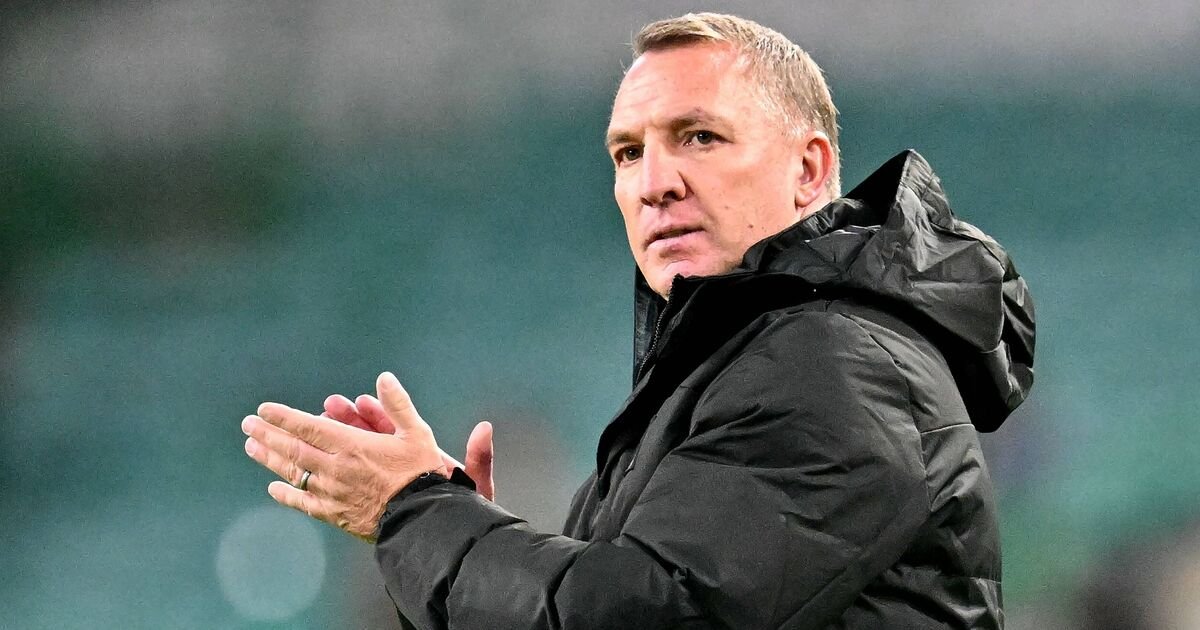
The news exploded like a bombshell late last night. Just an hour before the revelation that Brendan Rodgers had left Celtic for the second time, he was conducting business as usual, giving no hint of his impending departure. Rodgers was still exchanging text messages, with no indication that he was simultaneously penning his resignation letter.
So, when Celtic announced his immediate departure and the appointment of his successors, it felt like a bomb had detonated. The return of Martin O’Neill to Parkhead as interim boss, two decades after leaving the club’s dugout in 2005, added another layer of shock to the announcement.
This is indeed an extraordinary situation, made even more peculiar by Rodgers’ nonchalant behaviour, despite presumably knowing what was about to unfold. These days have been growing longer for Rodgers, with the past 10 months draining his enthusiasm for the job.
Yet, despite feeling let down in the transfer window and aware of backroom gossip, no one could have predicted this turn of events. Upon his return to the helm for a second stint, Rodgers pledged to the fans that he wouldn’t abandon ship again, having previously left for Leicester. His departure had sparked an intense backlash, damaging his relationship with the supporters beyond repair.
This is why he made it clear from the outset of his three-year contract that he intended to honour its full term. Hence, the reason behind this abrupt parting of ways seems utterly baffling.
Of course, he might provide his own explanation in the coming days, which will undoubtedly be intriguing.
Why now?
Why decide to throw in the towel at a juncture when Celtic’s season can still be salvaged?
A victory against Falkirk on Wednesday night, followed by eliminating Rangers from the Premier Sports semi-final at Hampden on Sunday, could have painted a much rosier picture than the one at Tynecastle on Sunday, where Rodgers suffered a second consecutive league defeat.
So, what exactly transpired between then and last night?
And was Rodgers even fully cognisant that his tenure as Celtic’s manager was nearing its end?
The part that requires serious explanation is whether Rodgers was aware of these plans being put in place. If not, he may feel compelled to break his silence in the coming days, accusing those involved of sabotage and betrayal.
Phone calls would undoubtedly have been made earlier in the day. Presumably, one of them would have come from Dermot Desmond to O’Neill.
Shaun Maloney, who will also step into the dugout as O’Neill’s right-hand man, would have had to be consulted too.
Yet all of this was announced at a blistering pace just before 10pm last night.
Perhaps Rodgers simply had nothing more to give. Maybe he was worn out by the stress of representing a club experiencing a crisis in its relationship with its supporters?
Perhaps he felt his messages were no longer resonating within his own dressing room.
There have certainly been indications that some of these players have mentally checked out, expecting to be elsewhere by now.
If Rodgers examined his final game in charge, he might have concluded that not enough players were on his side.
Indeed, for about 25 minutes of the first half, it seemed as though only captain Callum McGregor fully grasped the gravity of the situation and was resolutely determined to make a significant impact.
The remainder?
Were they still seething or sulking after being likened to a Honda Civic?
That remained a distinct possibility following Rodgers’ remarks in the wake of that Dundee defeat. It represented an enormously perilous gamble across the board.
However, it was Desmond’s scathing observations delivered late last night that introduced a nuclear dimension of mystery.
The Irish magnate savaged Rodgers and seemed to hold him directly accountable for the demonstrations targeting his boardroom, particularly chief executive Michael Nicholson and chairman Peter Lawwell.
Desmond disclosed that he had journeyed to Scotland for a three- to four-hour face-to-face meeting with Rodgers. During this confrontation, he had demanded Rodgers explain how the club had ‘either obstructed him or failed to support him’.
By Desmond’s account, Rodgers couldn’t provide a single instance.