

Fish sauce has remained an essential ingredient across various Asian cuisines for generations, serving as a flavouring agent in countless dishes.
However, individuals are only now discovering that making this condiment is far simpler than they initially thought.
While fish sauce enjoyed widespread usage in European cooking throughout history, especially within ancient Mediterranean gastronomy, most people today connect contemporary fish sauce with Eastern and South-Eastern Asia, where it’s continued to be a beloved seasoning.
Given its capacity to introduce a rich umami taste to culinary creations, it has gained worldwide approval among professional chefs and home cooks alike.
However several people still remain unaware that producing just a single bottle of fish sauce can take up to two years.
Posting on TikTok, user @vanvufromvietnam created a video demonstrating the straightforward yet time-consuming method for crafting fish sauce, leaving viewers astounded by how uncomplicated the process appears.
“Basically, fish sauce comprises of two elements: fish and salt,” she explained at the start of the video.
But how do merely these two components transform into a sauce? During production, the fish and salt are arranged in alternating layers within a wooden vat for 12 to 24 months to undergo fermentation.
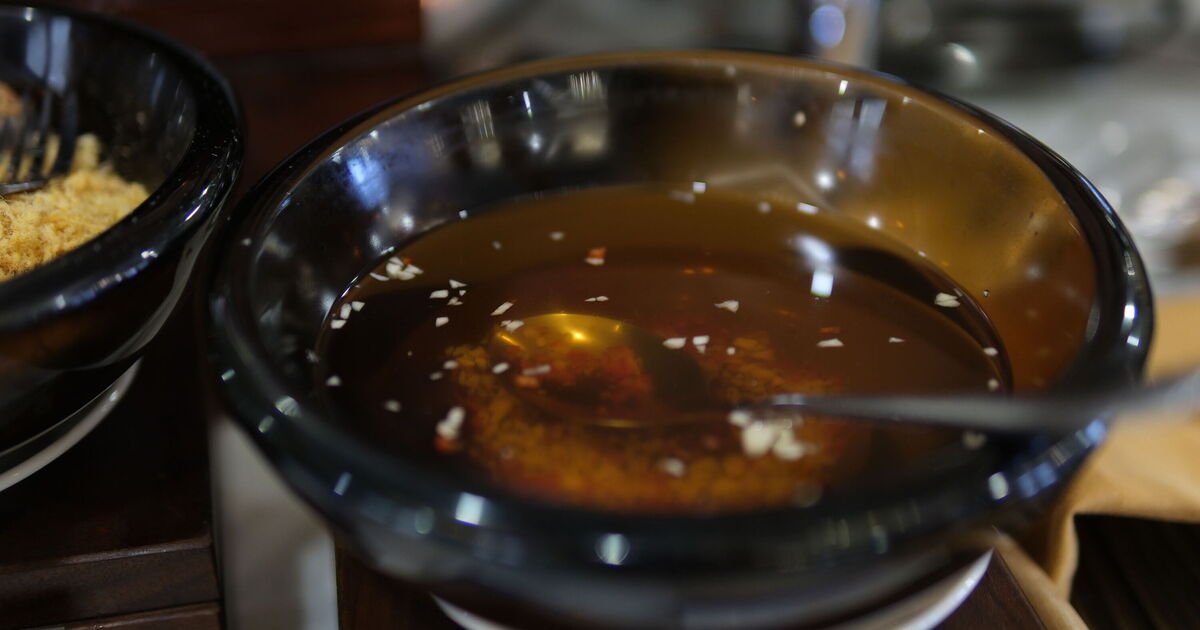
Once the fish begins fermenting, an amber-coloured liquid begins to drip down from the fish blend, as the fish starts breaking down due to the salt.
“The amber coloured liquid of the fermentation process seeps down and is drained,” she explained in the informative video. Given that the procedure is fairly straightforward, you can actually create it at home yourself.
This was precisely what a man called Johnny Kyunghwo chose to do, documenting his journey on social media for his followers.
In his first YouTube clip, he was spotted rinsing his fresh anchovies – which he’d acquired from the local food market that very morning – under running water.
“I don’t want to clean these too much, because I still want some of that fishy goodness,” he explained to his viewers.
Following this, it was time to combine the fish with salt. Choosing not to measure anything out, he began by adding several handfuls of fish into a sizeable metal bowl before incorporating an equivalent quantity of salt.
He proceeded to toss everything about with his hands, ensuring the two components were thoroughly mixed together.
Then he went on to move the fish mixture into a large glass container, which would allow him to observe the fish and salt transform into fish sauce.
As the jar became full, he added one final thick coating of salt to preserve the fish. He then wiped off the jar before firmly securing the lid and positioning it in a bright and warm area of his house, which would assist the anchovies in breaking down.
Two months later , the sauce was ready for the next stage of the process.
Choosing to use a Korean technique, he proceeded to ladle some of the now-liquid fish blend into a saucepan and brought it to the boil, before filtering it through three separate sieves, ensuring each sieve was more refined than the previous one, with the final one being a coffee filter.
Once the concoction had been filtered, Johnny was taken aback by the amber-coloured liquid that awaited his taste test in the glass bottle.
“I’m actually blown away at the flavour of this fish sauce, even after two months,” he exclaimed. “Of course it’s very salty, but the fish flavour coming through is super savoury and delicious.”
However, leaving the remaining fish mixture to ferment for a longer period in the heat would intensify the fish flavour even more.
