


I’ll never forget the smell of mould growing in places I didn’t know it could. The foul smell emanating from the powdery green mould coating my red slippers still inspires a shiver of disgust five years later.
It was 2020 and a few weeks before Christmas. I was crouching down in the spare room when a black line on the wall caught my eye — three-dimensional and squiggly, like a pencil-thin worm wiggling out of the wall. The bit of dread it inspired didn’t prepare me.
To get a better look, I pushed away a cardboard box to discover it had been concealing a waterfall of black mould on the wall. The damp was so vigorous that a patch of paint about 10 inches wide had bubbled and warped. Underneath it, the skirting looked as if sweating beads of black mould.
That wasn’t even the worst part. We followed the length of the wall into the spare room closet. Shining the torch from my mobile phone into the darkness revealed a coating of noxious-smelling, powdery mould coating our belongings like nuclear ash.
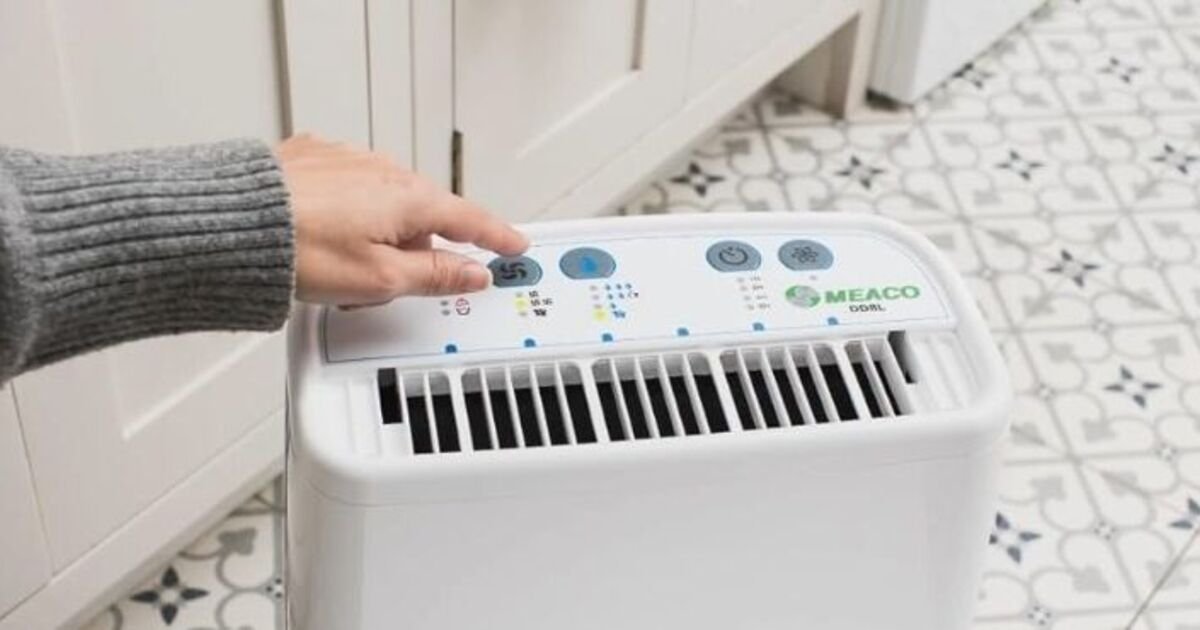
When everything had been sprayed, thrown out, and cleaned, it was time to bring in the big guns — a Meaco dehumidifier. Moving was not an option, and even though money was tight, a good dehumidifier model was now essential.
If you’ve ever complained about damp to an estate agent, they will suggest “just airing the room out” or “popping on the radiator” as if it were that simple. Common sense measures can’t fix buildings that aren’t fit for purpose.
What I didn’t know then was that exterior walls are notorious sources of damp, especially in poorly insulated buildings that are rife in the UK. Putting anything near (not even against) these cold walls creates a pocket of damp that encourages mould. That’s how I learned things like shoes, backpacks, and Ikea nightstands could harbour mould.
For anyone stuck in a mouldy living situation, I have a solution for you – desiccant dehumidifiers. Most people will be familiar with cheaper traditional dehumidifiers that passively absorb moisture in the air. They never worked for me.
It wasn’t until Mouldmageddon 2020 that I delved into the world of dehumidifiers and learned about the version that more effectively tackles damp, mould, and condensation. Not to mention, desiccant dehumidifiers blow out warm air, so they provide a bit of heat and help laundry dry faster.
Many desiccant dehumidifiers are above £100, with Meaco — the brand I kept seeing on Which?, Good Housekeeping, Reddit and Mrs Hinch Facebook groups — nearly £200. It was a lot of money, especially at that time in our lives, but we took a calculated risk on the Meaco DD8L dehumidifier.
Meaco dehumidifier review: five-year review
It’s been going strong for five winters and I recommend my Meaco dehumidifier with the zeal of a religious convert.
Standing outside our building, you could tell which flat was ours. The windows of other flats were teaming with condensation — moisture that dripped and streaked down the surface.
But when we use the dehumidifier, which we did nightly from October to through March, it visibly reduced the build-up of condensation of the room by at least half, often more.
It wasn’t a magic solution. Short of knocking down that godforsaken building and starting fresh, we still battled with mould and condensation. Meaco says the DD8L would suit flats or houses with up to five bedrooms, but the dehumidifier mainly benefitted the room it was in.
We turned it on the lowest setting overnight and placed it in the doorway between the spare room and hallway to reduce the worst of the humidity and warm up the coldest area of the flat.
In the daytime, we turned it on as needed in the open plan kitchen/living room where damp was rife (we once found mould growing in the cracks of a ceramic plate) or set up next to the laundry rack.
It was an unexpected lifesaver for the washing. It meant our laundry dried in two days, not four or more. It also helps save a bit on heating bills because it blows out a steady stream of warm air.
In total, the Meaco DD8L has three fan settings (including a turbo-charged laundry setting), four humidity settings, and four timer options, so you can really customise it to your needs and budget. Meaco says it costs 8p an hour to run on the lowest fan setting based on 27.03p/kWh.
It’s energy efficient. The humidifier will turn itself off once the target level has been reached and check the humidity every 30 minutes, turning itself back on as necessary.
Generally, desiccant dehumidifiers are quieter than compressor ones, one reason why we chose the latter. On the lowest fan setting, it has a light white noise effect and I didn’t mind propping the bedroom door open with it in the hallway outside. The noise ramps up with the medium setting and the highest fan setting (designated with a laundry symbol) is quite noisy.
All in all, it collected a full 8L tank of water about every other day. Dumping all that water down the drain is incredibly satisfying.
The only downside we’ve found is that it can leak erratically. This problem comes and goes and we haven’t figured out why. We place a couple paper towels underneath it to be safe.
What are compressor or desiccant dehumidifiers? What’s the difference?
Without getting too technical, a compressor dehumidifier works by creating a cold surface. When warmer, damp air from the room comes into contact with the surface, condensation forms and the water is removed. This is why compressor dehumidifiers don’t work as well in cold rooms — the inside of the dehumidifier needs to be colder than that air around it.
Desiccant dehumidifiers perform the same regardless of room temperature. They have a desiccant wheel inside that absorbs moisture in the air like a sponge. The reason they emit warm air is because the desiccant is regenerated by an internal heater and fan.
Here’s Meaco’s rule of thumb based on the average temperature of the room you’re intending to use it:
- Below 10°C: desiccant dehumidifier only
- Between 10°C and 15°C: desiccant dehumidifier or a large compressor dehumidifier (20L or 25L)
- Above 15°C: desiccant dehumidifier or any size compressor dehumidifier (10L, 12L, 20L or 25L)
- As a rule of thumb we would always recommend a desiccant dehumidifier if the room temperature is below 10°C, a desiccant dehumidifier or a large compressor dehumidifier (either a 20L or 25L) if the room temperature is between 10°C and 15°C and any type of dehumidifier, including a small compressor dehumidifier (10L or 12L), if the room temperature is above 15°C.