


In the final months of the Second World War, the XX Bomber Command of the United States Army Air Force (USAAF), based 1,500 miles to the south east on the Mariana Islands, unleashed an intense aerial bombardment over Japan.
Their air campaign would be initially applied through conventional high explosive raids, before strategists opted for indiscriminate firebombing raids and, ultimately, with the deployment of atomic bombs on Hiroshima and Nagasaki. While historians continue to debate the necessity and morality of the atomic bombings, a critical question remains: could the firebombing campaign alone have forced Japan to surrender, or were the atomic bombs essential to ending the war? Through three years of study for my latest book, conducting archival research and interviews with eyewitnesses on both sides, I considered the scale of destruction, human cost, military strategy and political context that shaped the final decisions of 1945.
Between 1942 and 1944, American chemists developed one of their deadliest weapons: napalm – a highly-flammable gel-like incendiary substance that would stick to surfaces and burn intensely, thus causing widespread fire damage and severe injuries on its target. Though it later found notoriety in the Vietnam War, entering the public consciousness in dozens of war movies, it was first used in industrial quantities against Japan in the spring of 1945. The country’s traditional architecture constructed of wood and paper was ripe for such an offensive and the firebombing of Japanese cities, especially Tokyo, would reach unprecedented levels of devastation.
On the night of March 9-10, 1945, in an operation codenamed “Meetinghouse”, some 330 American B-29 bombers of the XX Bomber Command led by General Curtis LeMay dropped nearly 1,700 tons of incendiary bombs on densely populated wooden neighbourhoods of Tokyo.
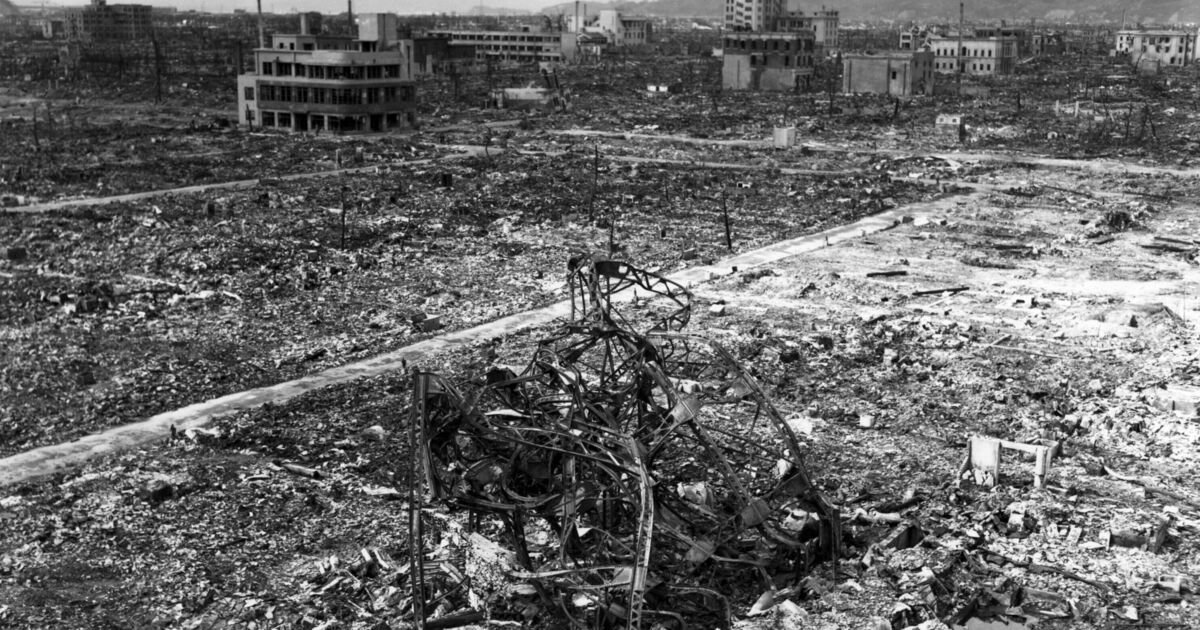
The resulting firestorm engulfed roughly 15.8 square miles of the city, killing an estimated 80,000 to 100,000 people in a single night – mainly women, children and the elderly and more than would be killed instantly in either of the August atomic bombings.
Historians believe this number could be far higher, but official records (rice ration cards) of those living in the capital went up in flames with the victims.
LeMay himself had confided to his staff that, if the United States lost the war to Japan, he would probably be executed as a war criminal.
A million-plus people were left homeless, and more than 267,000 buildings were reduced to ashes. The psychological and structural damage across the whole country would be staggering as the firebombing campaign continued over the following months. General LeMay extended his strategy to 60 cities, including Nagoya, Osaka, Kobe, and Yokohama. Each was targeted with the intent to decimate Japan’s industrial and civilian infrastructure, particularly small-scale armament manufacturers embedded in residential districts.
It was strategised that this would cripple Japan’s ability to wage war, and kill or maim anyone unfortunate enough to be on the receiving end.
By July 1945, LeMay’s firebombing had obliterated more than 40% of the urban areas in Japan’s major cities. An estimated 300,000 to 330,000 civilians were killed in these raids, and eight million were rendered homeless.
In addition to the loss of life, Japan’s wartime economy – already under strain from an American naval blockade – was collapsing.
The destruction was so extensive that American military planners began to run out of viable urban targets, turning increasingly to lesser cities as the war wore on.
Franklin D. Roosevelt died suddenly of a stroke on April 12, 1945, to be succeeded by Vice President Harry S. Truman, who quickly faced the immense responsibility of concluding the war in Europe with Joseph Stalin and Winston Churchill at the
Potsdam Conference in June-July. The new US leader had to contend with being rapidly brought up to speed on all aspects of the country’s war efforts, including the Manhattan Project – the top-secret programme to deliver the atomic bomb.
Truman had to both deliver peace to Europe and the Allies declaration to Japan for unconditional surrender. The atomic bomb gave him an ace in the hole.
Despite the tremendous damage inflicted by the firebombing campaign, and with American forces getting ever closer to the Home Islands in their island-hopping campaign, Japan’s leadership showed no immediate signs of capitulating. Its government and military leadership remained determined to fight on, hoping for more favourable surrender terms or even Soviet mediation. The fire bombings, while horrifying, did not achieve the psychological shock necessary to compel surrender.
Emperor Hirohito did visit Tokyo after the March firestorm, reportedly shaken by what he encountered, but his government’s official stance remained unchanged. Japan’s military command maintained strong influence over civilian leaders, many of whom believed surrender would dishonour the nation or result in the total eradication of the imperial system. Against this backdrop, the Truman administration prepared to deploy its most powerful new weapon. On August 6, 1945, the B-29 bomber Enola Gay piloted by Colonel Paul Tibbets Jnr dropped the uranium-based atomic bomb Little Boy on the port city of Hiroshima.
The explosion instantly killed an estimated 66,000 to 85,000 people, with total deaths rising to approximately 140,000 by the end of the year due to injuries and radiation sickness. Hiroshima was devastated: nearly 70% of all buildings were destroyed, and the city’s infrastructure, including hospitals and fire services, ceased to function.
Just three days later, on August 9, a second atomic bomb – this time a plutonium-based device named Fat Man – was dropped on Nagasaki. Though the city’s geography limited the spread of destruction compared to Hiroshima, an estimated 40,000 were killed instantly, with total deaths reaching around 70,000 by year’s end.
While the total number of civilians killed in the fire bombings exceeded those killed by the atomic bombs, the latter possessed an unprecedented psychological impact. Never before had a single weapon erased an entire city in a matter of seconds.
More than just military targets, Hiroshima and Nagasaki symbolised a terrifying new level of destructive power. This psychological shock – amplified by the fear of further atomic attacks – was a critical factor in the Japanese decision to surrender. However, the atomic bombings were not the only decisive factor.
On August 8, between the two bombings, the Soviet Union declared war on Japan and launched a massive invasion of Japanese-held Manchuria.
This unexpected betrayal shocked the Japanese leadership. Until that moment, many in Tokyo had hoped the Soviets, with whom Japan had signed a neutrality pact in 1941, would help broker peace with the Allies.
The sudden loss of a potential mediator and the appearance of a second powerful enemy advancing from the north led to a crisis among Japan’s top leaders – already trying to cope with a starving country verging on societal collapse. By August 14, Emperor Hirohito recorded a radio message announcing Japan’s unconditional surrender, a historic first for the country. In his speech, he cited the devastating power of “a new and most cruel bomb” as a reason for ending the war. Some analysts have argued that the firebombing campaign, combined with the naval blockade and the steady erosion of Japan’s industrial base, would have been sufficient to end the war – albeit more slowly and at great additional cost.
Studying the US Strategic Bombing Survey, conducted after the war, I would argue Japan likely would have surrendered before the end of 1945 without the atomic bombs and even without Soviet intervention.
This conclusion, I admit, remains controversial. It relies on hindsight and assumptions about Japan’s internal dynamics that may not fully reflect the complexities of wartime decision-making.
It is also worth considering the planned invasion of the Japanese home islands, scheduled for late 1945 and early 1946. American military estimates projected that such an invasion – Operation Downfall – could result in hundreds of thousands of American casualties and possibly millions of Japanese deaths.
The high casualty rates to capture the island of Okinawa that summer had proven the theory accurate. The prospect of such enormous bloodshed motivated the Truman administration to use the atomic bombs to force a swift end to the war.
From this perspective, the bombs were seen not as a shortcut, but as a tragic necessity to avoid a far worse calamity. In comparing the firebombing and atomic campaigns, several distinctions emerge. The firebombings caused greater cumulative civilian casualties and more widespread urban destruction. They demonstrated that conventional weapons, when used en masse, could rival the atomic bomb in sheer lethality.
Yet, the atomic bombs delivered their destruction instantly, with a single plane and a single bomb – achieving in seconds what hundreds of bombers took hours to do. More importantly, they introduced a terrifying new form of warfare, one that transcended all previous experiences of violence.
This psychological shockwave was what ultimately broke the stalemate. The morality of both firebombing and atomic warfare remains a subject of intense debate. Critics argue that deliberately targeting civilians, whether with incendiaries or nuclear weapons, constitutes a war crime.
Today the US justified both strategies on the grounds that they hastened the end of the war and saved lives overall. Still, the fact that hundreds of thousands of civilians died – many in horrific circumstances – has left a lasting stain on the legacy of Allied victory.
Many survivors of Tokyo, Hiroshima and Nagasaki that I interviewed continue to bear witness to this suffering – raising difficult ethical questions about how wars are fought and won.
Whether or not the atomic bombs were absolutely necessary remains debatable, but within the context of 1945, they were seen by American leaders as the surest way to end the war swiftly and prevent further carnage.
The terrible legacy of these choices continues to shape international debates on warfare, deterrence, and the human cost of total war.
● Iain MacGregor is author of The Hiroshima Men: The Quest to Build the Atomic Bomb, and the Fateful Decision to Use It (Constable, £25)