


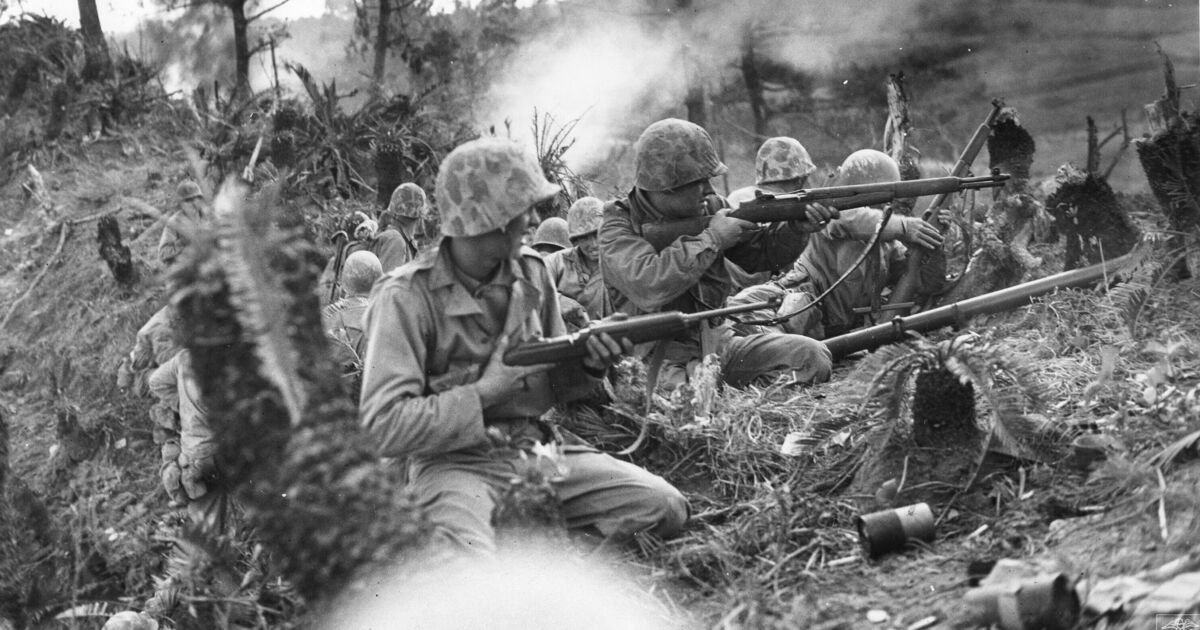
ON August 12, 1942, five days after the 19,000-strong 1st Marine Division had landed unopposed on Guadalcanal in the British Solomon Islands, the first American ground offensive of the war, Sergeant Jim McEnery came upon the aftermath of a slaughter of US Marines who had walked blindly into an ambush.
Not satisfied with mere killing, the Japanese had hacked the Americans to pieces. Random body parts littered the river bank. “Now,” wrote one Marine, “our killing potential was amplified. A second ingredient, hatred, had been added. What kind of warfare was this?” The invasion of Guadalcanal was designed to protect Australia and New Zealand, and begin the roll-back of Japanese advances in the Pacific that had followed the sneak attack on Pearl Harbor in December 1941.
In just five months, the Japanese had captured Guam, Wake Island, Kong, the Malayan Peninsula, the Dutch East Indies, the Philippines and parts of Burma and New Guinea. The Imperial Japanese Empire now stretched across seven time zones and contained 516 million people – many more than the 360 million under Hitler’s control at the height of German military success.
The fightback began in June 1942 with the hard-fought naval victory at Midway in the central Pacific when the US navy sunk four Japanese aircraft carriers for the loss of one of its own. But Guadalcanal was the first chance for US forces to go on the attack.
It was a brutal six-month campaign. As well as battling the harsh tropical climate, inadequate supplies, and chronic malaria and dysentery, the Marines had to contend with an enemy that largely refused to surrender and did not take prisoners.
When the Japanese finally withdrew in February 1943, they left the corpses of 30,000 soldiers, sailors and airmen. Total American fatalities were 7,100, including 1,769 Marines. Guadalcanal, concluded Major General Kawaguchi, was the “graveyard of the Japanese army”.
For US Army Chief of Staff General Marshall, it marked the “turning point in the Pacific” thanks to “the resolute defence of these Marines and the desperate gallantry of our naval task forces”. The next US target was the Japanese naval and air base at Rabaul at the eastern end of the 370-mile-long island of New Britain.
They would get there by two routes: advancing north along the coast of New Guinea and, at the same time, island-hopping through the Solomons, a bitter campaign that culminated in the capture of New Georgia and part of Bougainville in October and November 1943 respectively. The 1st Marine Division landed at Cape Gloucester, on the western tip of New Britain, on Boxing Day 1943. The landings were unopposed, apart from long-range machine-gun fire, and the Marines soon occupied their main objective, Cape Gloucester airfield.
But as they ventured inland, they faced a hot and humid rainforest – where some trees rose 200 feet and vines were as thick as a man’s arm – and heavily defended Japanese positions on a series of ridges, laced with “an elaborate network of camouflaged bunkers and machine gun emplacements”.
By April, half the island had been conquered and the Japanese stronghold of Rabaul was effectively neutralised. The decision had been taken to bypass it, and leave its 70,000-strong garrison to wither.
Elsewhere, Admiral Chester Nimitz’s naval forces had advanced across the central Pacific, capturing the Gilbert and Marshall Islands – including Tarawa, Kwajalein and Eniwetok – in a campaign from August 1943 to February 1944.
The key targets for that summer were the Mariana Islands of Saipan, Guam and Tinian to provide airfields from which the revolutionary new B-29 Superfortress bomber – developed at a cost of $3billion, and capable of flying 1,600 miles at high altitude, out of the reach of enemy fighters – could strike at Japanese cities and industry. The amphibious landings began at Saipan in June 1944 and, after a ferocious struggle, all three islands were secured by August.
US casualties on Saipan alone were 14,000 men, with 3,000 killed out of 71,000 who landed. Almost the entire Japanese garrison of 31,000 had perished, as well as many thousands of civilians (some jumping to their deaths from the so-called “Suicide Cliff” at the northern tip of the island).
While the fighting raged on Saipan, a huge naval clash took place off the Marianas between June 19 and 20 – known as the Battle of the Philippine Sea, it was the last of the five major carrier-versus-carrier engagements of the Pacific War – between the US Navy’s Fifth Fleet and the IJN’s Mobile Fleet. It resulted in a decisive defeat for the Japanese who forfeited three aircraft carriers (two sunk by submarines) and more than 600 aircraft in an aerial fight dubbed the “Great Marianas Turkey Shoot”. US losses, by contrast, were just 120 planes and a battleship damaged. An even more bitter fight was for the island of Peleliu, in the Palau Islands, where the Japanese had dug into the mountains, and the 1st Marine Division – having landed on September 15, 1944 – endured “30 days of the meanest, around-the-clock slaughter that desperate men can inflict on each other”.
One night, a Marine started yelling hysterically. Worried he would reveal their position, his comrades tried to comfort him, then gave him morphine, then punched him. Nothing worked. Finally, they hit him a little too hard with a shovel and killed him. A young Marine wrote of the “agony and distress etched on the strong faces” of the men who “had done what any of us would have had to do under the circumstances”.
By the time the battle ended in late November, more than 1,400 Americans had lost their lives, with 6,000 wounded. Japanese casualties were 10,900 killed and just 300 captured (most of whom were Korean labourers), victims of Tokyo’s fanatical determination to fight to the last. Even before the Peleliu campaign was over, General Douglas MacArthur’s forces had invaded the central Philippine island of Leyte, with their commander declaring as he splashed ashore: “I have returned!”
This was followed in early 1945 by a landing on the main island of Luzon, starting a brutal six-month campaign that resulted in 8,000 US and almost 200,000 Japanese deaths, the highest net casualty battle US forces fought in the entire Second World War.
In the central Pacific, meanwhile, Marines had landed in late February on the tiny volcanic island of Iwo Jima, 750 miles south of Tokyo, to secure airfields for fighters to protect the B-29 bomber raids on Japan. The next month saw some of the fiercest fighting in the Pacific. Three Marine divisions battled to overcome the Japanese. It ended on March 26 with total US casualties (26,000) exceeding those of their foe (21,000) for the only time, though fatalities were, as ever, far greater for the Japanese.
The final campaign – though nobody knew it at the time – was to capture the 70-mile long island of Okinawa, the most southerly of Japan’s prefectures, in the spring of 1945. Having invaded on April 1, it took the US Tenth Army almost three months to subdue the 110,000 Japanese defenders who had turned “several jagged lines of ridges and rocky escarpments” in the centre of the island into “formidable nests of interlocking pillboxes and firing positions”.
The dead included the vast majority of the Japanese garrison, 12,500 Americans – making it by far the bloodiest battle in the Pacific – and 125,000 civilians.
New US president Harry Truman’s decision to end the war by dropping two atomic bombs on Japan – on August 6 and 9, 1945 – was directly influenced by the bloodbath. He feared an invasion would cost more than a million US dead and kill countless Japanese soldiers and civilians.
“My object,” wrote Truman, “is to save as many American lives as possible but I also have a human feeling for the women and children of Japan.”
At the time, the men slated to invade Japan had no doubts. “Some people say,” wrote one Marine, “it was awful us using it. But I don’t think people have a damn clue what would have happened if we’d hit Japan. We would have killed millions of Japanese, and there’s no telling how many of us would have been wounded or killed, going in.”
● Saul David is the author of Devil Dogs (William Collins, £9.99) and Crucible of Hell (William Collins, £12.99). His new book Tunisgrad: Victory in Africa (William Collins, £25) is published on September 11