
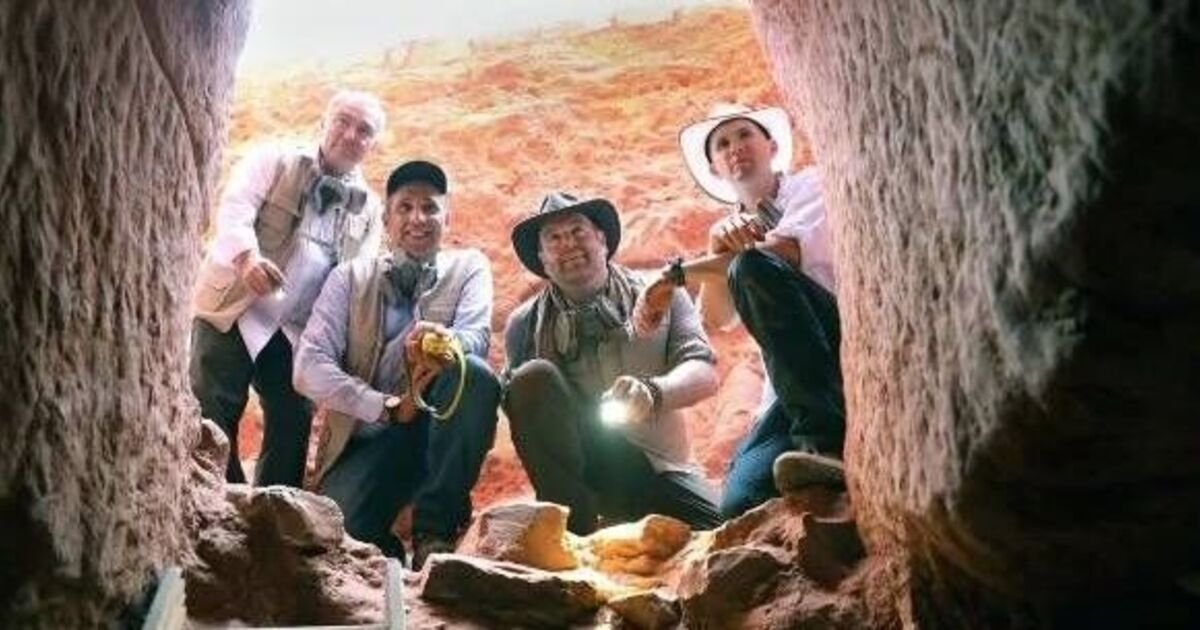

Archaeologists were left astounded after unearthing a 2,000 year old burial chamber beneath one of the seven wonders of the world.
Etched into the rose-coloured sandstone cliffs of Petra in Jordan sits an ornate monument called the Khaznah, or the Treasury – and a dozen skeletons were discovered beneath the edifice.
The ancient city is likely most familiar to audiences from its appearance in the 1989 blockbuster ‘Indiana Jones and the Last Crusade’, featuring Harrison Ford and Sean Connery.
A location of profound historical and cultural importance, Petra serves as a major tourist destination, welcoming nearly one million visitors each year.
Last year, CNN reported that Dr Pearce Paul Creasman, executive director of the American Center of Research, alongside a team of archaeologists, unearthed 12 human skeletons beneath the Khaznah, reports the Mirror.
The excavation also revealed a treasure trove of artefacts buried under Petra’s treasury, with the human remains thought to belong to individuals who lived two millennia ago.
Following the remarkable tomb discovery, Creasman extended an invitation to Josh Gates, presenter of Discovery Channel’s ‘Expedition Unknown’, to visit the location.
Gates remarked: “This is a hugely rare discovery – in the two centuries that Petra has been investigated by archaeologists, nothing like this has been found before. Even in front of one of the most famous buildings in the world, there are still huge discoveries to be made.”
Creasman’s team utilised state-of-the-art ground penetrating technology to pinpoint the whereabouts of the additional burial sites at the location. The data collected by his team corresponded with other intelligence gathered from areas where burial sites have been previously discovered.
Following presentation of the evidence, the Jordanian authorities granted permission for excavation beneath Petra city.
The artefacts unearthed were remarkably well-preserved, according to Creasman, though the human remains, whilst complete, were in a more fragile state than anticipated.
This deterioration has been blamed on Petra’s humidity and seasonal floods.
Porous sandstone within the burial chamber also trapped moisture, resulting in some skeletons being found with mould.
The discovery is notable as only a small number of tombs have been revealed in Petra over recent decades containing undisturbed burials.
Other graves had been disturbed, attributed primarily to travellers seeking shelter and refuge in the desert.
Two burial chambers were revealed beneath the treasury’s left side approximately two decades ago by Jordan Department of Antiquities archaeologists.
The tombs held partial skeletal remains, said Creasman, but owing to unpublished data, the exact number of bodies found there remained unclear.
Creasman added: “We were hopeful to find anything that might tell us more about the ancient people and place – human remains can be a really valuable tool in that regard. The burials in this tomb are articulated, so the bones haven’t been rummaged around and moved, so that’s exceedingly rare.”
