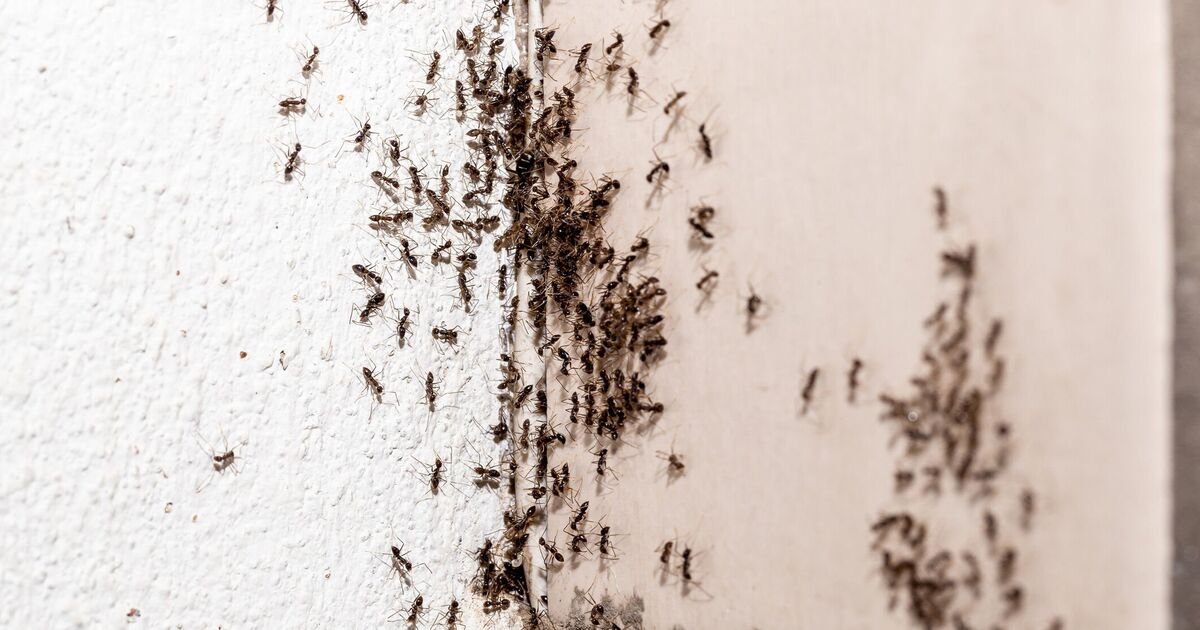

There’s nothing worse than seeing a thousand ants take over your home, and I was unfortunate enough to experience these pests this week. After a fun-filled Saturday out, my family returned home to see a colony of ants take over our kitchen. Despite having all the windows and doors closed, these tiny creatures made their way through the cracks of my garden door, which led straight into the kitchen.
My kitchen is relatively large, serving as a dining area as well as a space for laundry and cooking; therefore, the ants were spread everywhere, including into our drawers and around our appliances. Unsure of the best course of action, my family and I tested four different methods to remove all the ants, including two chemical solutions and two natural liquids.
1. Ant killer spray
Immediately, when we saw the long trail of ants on the floor and kitchen surfaces, we grabbed an ant killer spray. This spray was a quick fix for killing the large group of visible ants; however, it didn’t solve our problem.
Usually, ants stick together and move as a colony, but this wasn’t the case in our home. The next day, we still saw a large number of ants appear; the spray was basically useless in solving our problem and felt more damaging than helpful.
In a very squeamish panic, the children in my home would also pick up the very potent spray to kill any ant that they saw, but this was dangerous as ant sprays can be toxic for humans.
Pest experts Budget Brothers went on to further explain why insecticides are bad to use. They shared: “While sprays like Raid contain natural ingredients like pyrethrins, they also include potentially harmful chemicals such as cypermethrin and imiprothrin.
“Depending on the ingredients of the pesticide, it can be dangerous for babies and your furry and feathered friends. Symptoms of pesticide exposure may include headache, dizziness, weakness, and nausea.”
Before using any further chemical products or natural methods, we washed and wiped down our cookware and appliances that were left exposed. We then packed everything away into large storage containers before tackling the infestation.
2. Ant powder
Unlike the very smelly ant spray, ant powder has never failed us. According to Pestek, ant powder is usually made of permethrin, which kills scouting ants instantly.
This was easy to scatter throughout our home and the simplest way to reach any hidden ants. Despite the mess, it produced zero toxic fumes, and the children avoided interfering because they could see the powder on the surfaces and on the floor.
Ant powder is my favourite chemical method for getting rid of ants inside the home, as the results were fast and effective, but it was not the absolute solution to our infestation.
3. White vinegar
Ants leave a trail of scent to guide other ants to food sources or back to their nest. It is important to kill this scent so that no more ants can find their way into your home. Ants hate the smell of anything potent, such as vinegar, lavender, garlic and essential oils.
“Basically, anything with a strong odour can turn ants away,” reported Bulwark Pest Control. We let the ant powder sit overnight before vacuuming the residue. Afterwards, we mopped and wiped the surfaces with white vinegar, and rubbed vinegar along the lining of our garden door, which seemed to do the trick.
4. Hot water
As stated earlier, we only tackled the scouting ants inside our homes, but we needed to find the nest to destroy the rest of the colony. Searching through our garden, we found the ant’s nest and poured boiling water on top as well as across the lawn.
Experts at Shield Pest Control noted that boiling water is a good option. They explained: “The boiling water kills ants inside; however, it won’t destroy the entire colony. Boiling water will only disrupt the colony.
“This disruption will prompt the ants to move away from your home and relocate elsewhere.” However, this “disruption” has done the trick. It’s been a successful four days without spotting any more ants in my home. Fingers crossed, there are no more.
