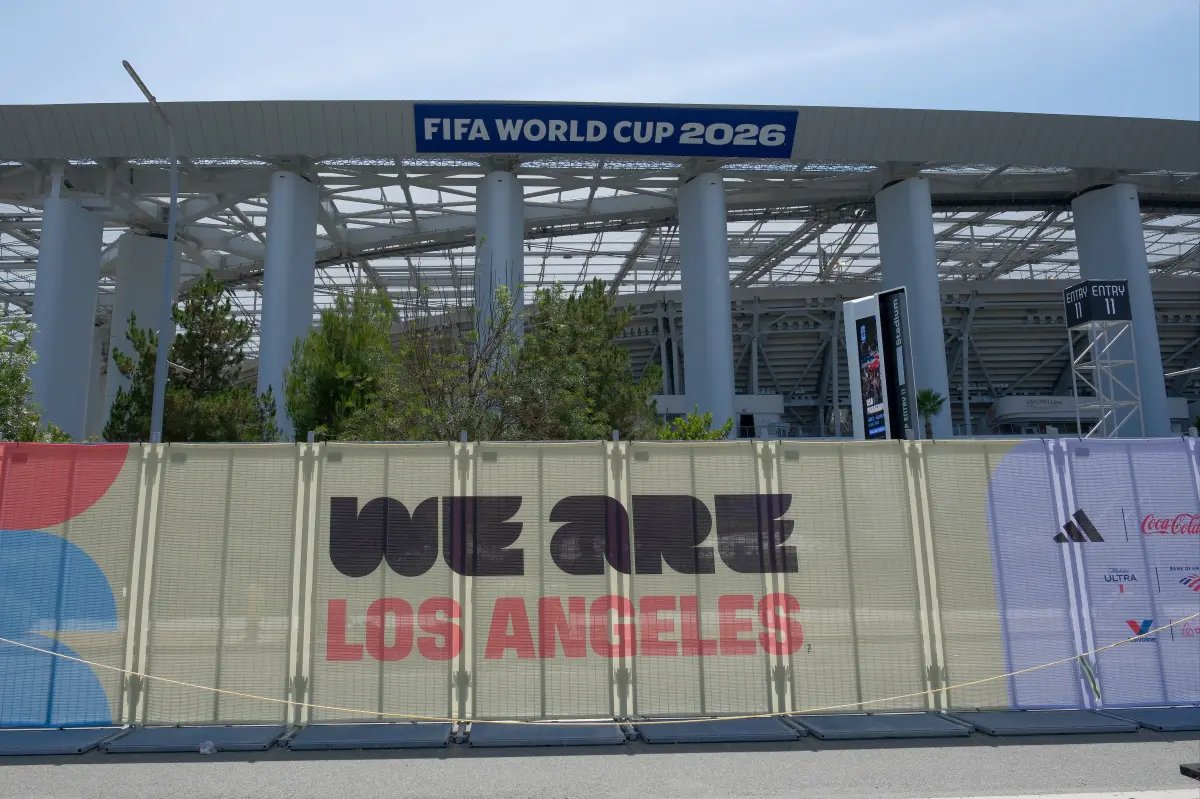


The world’s biggest sporting event is coming to Los Angeles, but the real impact will not be felt on the pitch.
It will happen in hotel lobbies, packed restaurants, crowded airport terminals and concession stands at SoFi Stadium (if a strike is averted).
According to a new analysis from Bookies.com, the 2026 FIFA World Cup is projected to generate an eye-popping $594 million in economic impact for the Los Angeles region.
The city alone is expected to welcome nearly 180,000 visitors during the World Cup from June 11 through July 19. Those visitors are projected to spend close to $60 million on food, transportation, entertainment and accommodations.
Local hotel revenue alone is expected to surge by 22 percent.
With eight World Cup matches scheduled for SoFi Stadium in Inglewood — including the U.S. men’s national team’s opening match against Paraguay on Friday — Los Angeles will not only serve as one of the tournament’s biggest stages but will also be one of the biggest financial winners of the tournament’s 16 host cities.
Los Angeles is projected to have the second-most visitors of the tournament, behind only New York City and New Jersey, which are also hosting eight matches, including the World Cup Final on July 19.
Helping that economic impact is the nearly $15 million SoFi Stadium is expected to generate in beer sales (barring a strike) alone across its eight matches. That’s enough beer to fill 1.2 million Starbucks Venti cups.
Unlike most sporting events that arrive for a just a weekend or a single game, the World Cup brings with it a six-week-long economic wave that washes across an entire metropolitan region.
“This is exactly the type of event cities spend decades trying to attract,” said Daniel McIntosh, faculty director of the Sports Business Program at Arizona State University.
McIntosh helped with the analysis for Bookies.com and noted that cities with strong tourism infrastructure, international appeal and multiple matches would be the ones that benefited the most from the World Cup.
And few cities check those boxes more than Los Angeles.
Only California and Texas will have two host cities making the economic impact statewide nearly twice as much as the others.
Los Angeles and the Bay Area, which will host matches at Levi’s Stadium in Santa Clara, are expected to generate close to $1 billion in total economic impact.
While Los Angeles is projected at $594 million, the Bay Area is projected at $400 million. The two California host markets together make the state the tournament’s most powerful economic engine.
Spread out across the country and the 2026 World Cup’s financial footprint is even more staggering.
Across all 11 US host cities, the total economic impact is expected to top more than $5 billion. FIFA estimates that the tournament will generate a $17.2 billion boost to the US GDP and create more than 290,000 jobs nationwide.
Attendance is expected to reach 6.5 million, nearly double the number that attended the 1994 World Cup in the U.S.
But not every city will benefit equally from the tournament.
Dallas, which will host the most World Cup matches with nine, is projected to lead the nation with roughly $1.8 billion in total economic impact, followed by Houston at $1.5 billion and Seattle at $929 million. Kansas City is expected to generate $653 million, while Los Angeles follows closely at $594 million. Miami is projected at $550 million.
More than half of all visitor expenditures are expected to come from food and beverage purchases. Hotels account for roughly one-third of spending, while transportation makes up the remainder.
With millions of visitors expected to flood LAos Angeles and the Bay Area, sports betting still remains illegal in the state. That means fans attending matches in California will be unable to place legal wagers on the tournament. That’s noteworthy because economists expect global World Cup betting activity to smash all previous records.
It’s been 32 years since the United States last hosted the World Cup, and California stands ready to cash in on soccer’s biggest spectacle. For the next six weeks, the state won’t simply host matches.
It will host the biggest event on the planet, and the economic impact will be massive.
Perhaps it will be a preview of what lies ahead when the world returns to Los Angeles in 2028 for the summer Olympics.
