


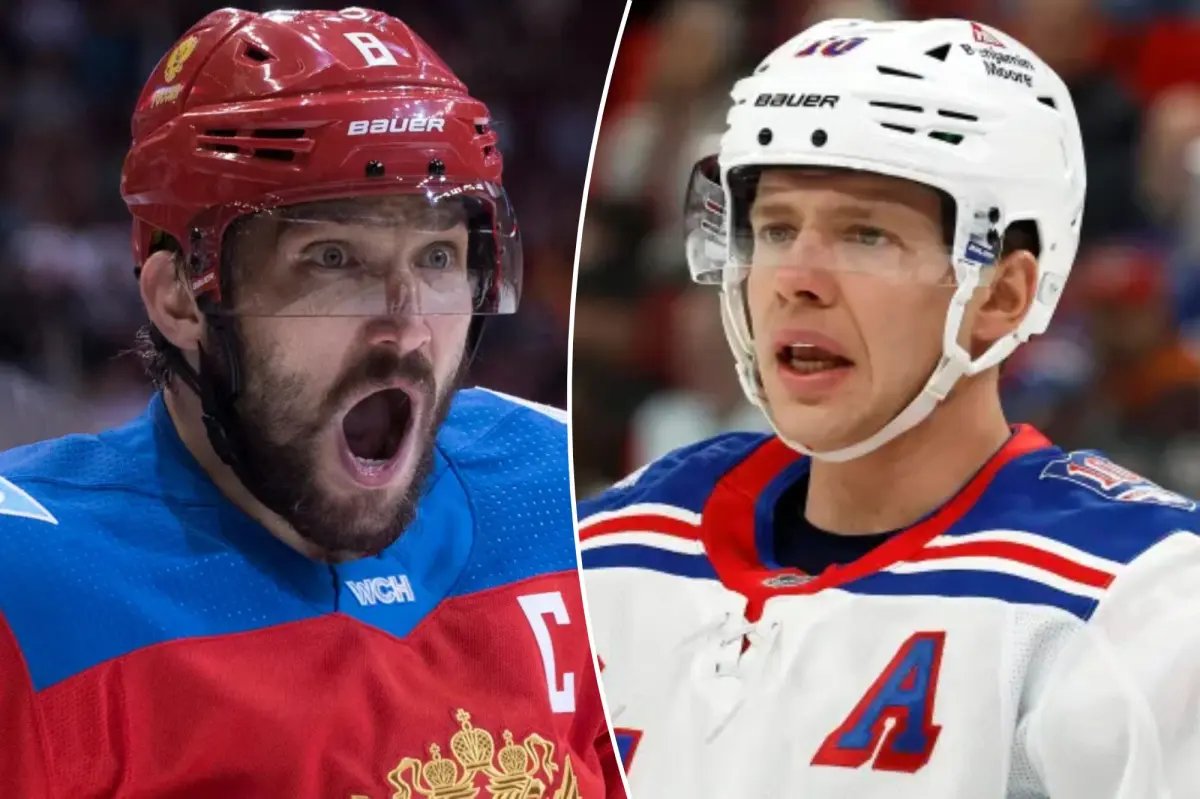
MILAN — The NHL’s return to the Olympics this year is the closest the world has come to international best-on-best hockey in more than a decade, but it isn’t quite that.
Russia’s absence from the men’s ice hockey tournament puts an asterisk on these games, whether we like it or not.
You simply cannot describe this 12-country circuit of talent as the crème de la crème without a nation that accounts for approximately 6.8 percent of the top professional hockey league.

A systemic doping scandal and the ongoing invasion of Ukraine has stripped Russia’s right to fly its flag at the Olympics since it hosted the Winter Games in Sochi in 2014.
As it pertains to war in Ukraine, however, this is how the sports world unites against tyranny.
That doesn’t make it any less unfair to the Russian athletes who had nothing to do with President Vladimir Putin’s full-scale attack on Ukraine.
“Obviously, I understand,” star Russian wing Artemi Panarin told The Post before the Rangers traded him to the Kings last week. “But also it’s pretty sad for athletes who play that sport all [their] life and then have dreams about that. For our side, it’s pretty sad, but we can’t control that. I hope people figure it out. Especially when speaking with other guys who are going to play in the Olympics, they wish Russia is going to be there. My guess is probably 98 percent of the hockey players would love to play against us and they’re not thinking about anything else, just play hockey.”
The hockey tournament will proceed without Nikita Kucherov, Alex Ovechkin, Mikhail Sergachev, Andrei Vasilevskiy and so many more NHL stars. Panarin, who will turn 35 near the start of next season, may never get a chance to represent his country on the Olympic stage.
The on-ice product won’t be as elite as it could be, but that is a small price to pay to take a global stand.
At the Milan Cortina Games, just 13 Russian athletes were cleared to compete as AINs — Individual Neutral Athletes. There are many other Russian-born athletes who have skirted the ban and are competing for other countries, but that is a common occurrence.
International Olympic Committee president Kirsty Coventry gave Russia’s return one of its largest votes of confidence earlier this month at the 145th IOC congress in Milan.

“Throughout the campaign and in many of our conversations since, I have heard the same message from many of you. Focus on our core,” Coventry said, per the Guardian. “We are a sports organization. We understand politics and we know we don’t operate in a vacuum. But our game is sport. That means keeping sport a neutral ground. A place where every athlete can compete freely, without being held back by the politics or divisions of their governments.
“In a world that is increasingly divided, this principle matters more than ever. It is what allows the Olympic Games to remain a place of inspiration where the athletes of the world can come together and showcase the best of our humanity.”
Coventry’s remarks came just one day after FIFA president Gianni Infantino called for the Union of European Football Associations to lift the ban on Russia. Infantino claimed bans and boycotts “create more hatred,” which naturally drew the ire of officials from Ukraine.
Ukraine’s sports minister, Matvii Bidnyi, told The Associated Press that what Infantino suggested is “irresponsible.” As the war approaches its fourth anniversary, Bidnyi noted that any changes to the ban would essentially condone Russia’s actions.
Just because the stance against Russia has softened, particularly in the U.S., doesn’t mean a reinstatement to international competition is imminent. NHL Players Association executive director Marty Walsh said he is in regular communication with Russian NHL skaters and plans to take a wait-and-see approach.
The decision to lift the ban — in regards to both the Olympics and the 2028 World Cup of Hockey — is essentially out of the NHL’s hands, and perhaps even the IOC’s.
First and foremost, the political echelon in European countries would need to be comfortable with the idea of their national teams playing on the same sheet of ice as Russia’s, an inherently uncomfortable thought given the propaganda value of sport. Who is to say the powers that be in other countries wouldn’t threaten to withhold their teams from competition if Russia is included?
That question might even supersede those involving ongoing ceasefire negotiations, or Donald Trump and his administration’s relative warmth toward Putin.
“I wouldn’t isolate the United States because of what’s going on here with the president and his relationship, or lack thereof, with Putin,” Walsh, who was secretary of labor under Joe Biden when Russian soldiers began marching toward Kyiv in February 2022, told The Post. “Nobody’s said to us, ‘Let the Russians play,’ as far as political leadership. It’s a world issue and I think it has to be resolved on a world stage.
“I don’t think Canada and the United States can even begin to open the door here. It really has to be Europe.”
It’s little secret that Russian players want to participate, though most have refrained from commenting on the geopolitical situation, in large part because doing so could affect their families at home.
The IIHF and IOC have signaled openness to allowing Russian and Belarusian athletes at the youth level to play starting in 2028.
“That’s entirely their call,” NHL commissioner Gary Bettman told The Post.