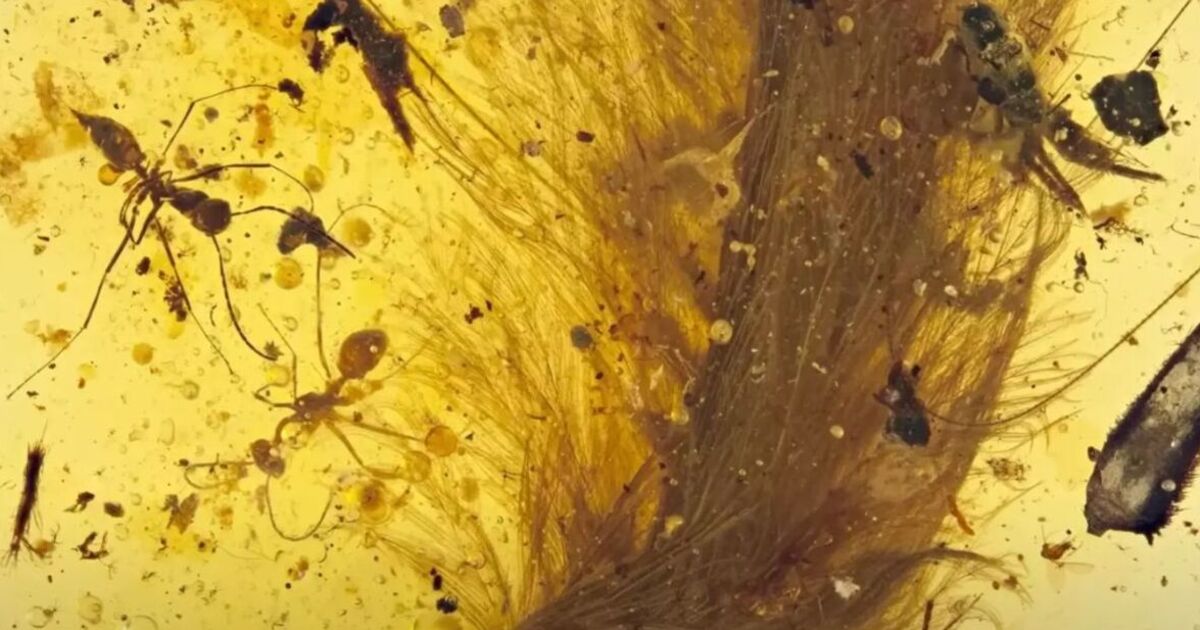

Scientists have made a one-of-a-kind discovery by uncovering an “extremely well-preserved” dinosaur tail.
In 2016, a team of scientists uncovered a specimen dating back to over 99 million years ago, providing incredible insight into the biology of a group that dominated Earth for more than 160 million years.
National Geographic photos detail the segment from the feathered tail which is preserved in amber, the tale was published in a report in a journal Current Biology.
The amber was found to contain a dinosaur tail, offering exciting insight into the evolution of prehistoric animals.
Current Biology that the piece of amber was found in Kachin State, Myanmar, and features an exciting feature – a tail with “a dense covering of feathers.”
Further inspection of the specimen suggests the tail was chestnut brown on top and white on its underside.
Co-author of the paper and palaeontologist at the Royal Saskatchewan Museum in Canada, Ryan McKellar, called the bird a “once-in-a-lifetime find”.
He said: “The finest details are visible and in three dimensions.
“The more we see these feathered dinosaurs and how widespread the feathers are, things like a scaly velociraptor seem less and less likely and they’ve become a lot more bird-like in the overall view.”
Dr McKellar said an examination of the tail’s anatomy showed it definitely belonged to a feathered dinosaur and not an ancient bird.
The research, led by paleontologist Lida Xing of the China University of Geosciences, was funded in part by the National Geographic Society’s Expeditions Council.
Ms Xing from the China University of Geosciences in Beijing, discovered the remarkable fossil at an amber market in Myitkina, Myanmar.
She could establish where it had come from by tracking down the amber miner who had originally dug out the specimen.
Ms Xing told CNN: “I realised that the content was a vertebrate, probably theropod, rather than any plant.
“I was not sure that (the trader) really understood how important this specimen was, but he did not raise the price.”
