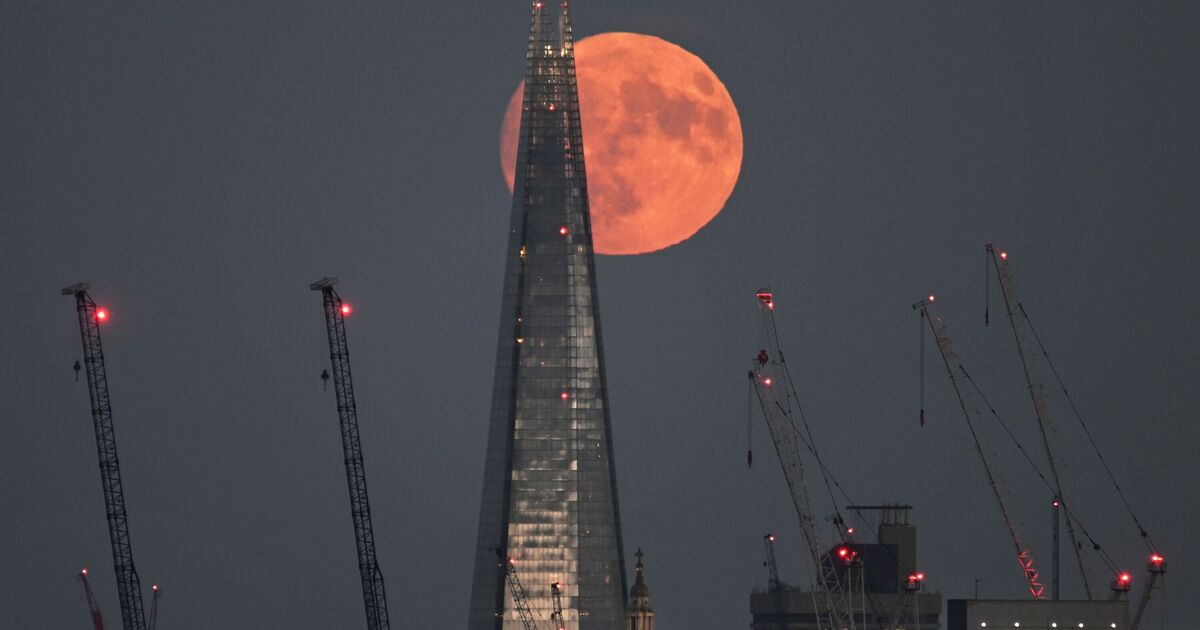

Stargazers in the UK and the rest of the northern hemisphere will be able to witness a rare Strawberry Moon this week, coupled with a rare phenomenon not seen in almost 20 years. The Moon will sit very low in the southern sky, making it appear much larger than usual.
Caused by an event known as a “major lunar standstill”, the opportunity will not arise again until 2043. The Strawberry Moon is the name given to the full Moon in June. According to the Old Farmer’s Almanac, it signals the time of year that wild strawberries were harvested by indigenous Americans. It is usually the lowest-hanging of the year in the Northern Hemisphere. However, it is likely to be even more impressive this year as a result of another rare phenomenon.
The Strawberry Moon is likely to be exaggerated this month as a result of a “major lunar standstill” which took place earlier this year – the effects of which can still be seen. This is when the Moon reaches the extremes of its orbit around the Earth, rising and setting at its most northerly and southerly positions on the horizon.
This phenomenon occurs every 18.6 years and its effects are most visible during a full moon. Another Moon this low is not expected until 2043.
Tuesday night could be the best time to see the Strawberry Moon with clear skies in the forecast for parts of the UK. The Moon will rise in the east and set in the west – like the Sun.
While the colour of the Moon has nothing to do with its name, it will appear with a reddish tinge. This is due to the Moon’s position. Being so close to the horizon means that light it reflects towards Earth passes through the thicker, lower layer of atmosphere. Shorter wavelengths of light (blue light) are scattered while longer wavelengths of light (red light) reach our eyes, making the Moon appear red.
The last time this phenomenon occurred was in 2006.
“Choose a spot with a clear, unobstructed view of the southeast horizon. Hills, open fields or coastlines are ideal,” Sky At Night Magazine advises.
“Tall buildings and trees are likely to hamper your view, but a few may add to the visual spectacle, provided they aren’t blocking the Moon completely.”
You can also use a moonrise calculator.
