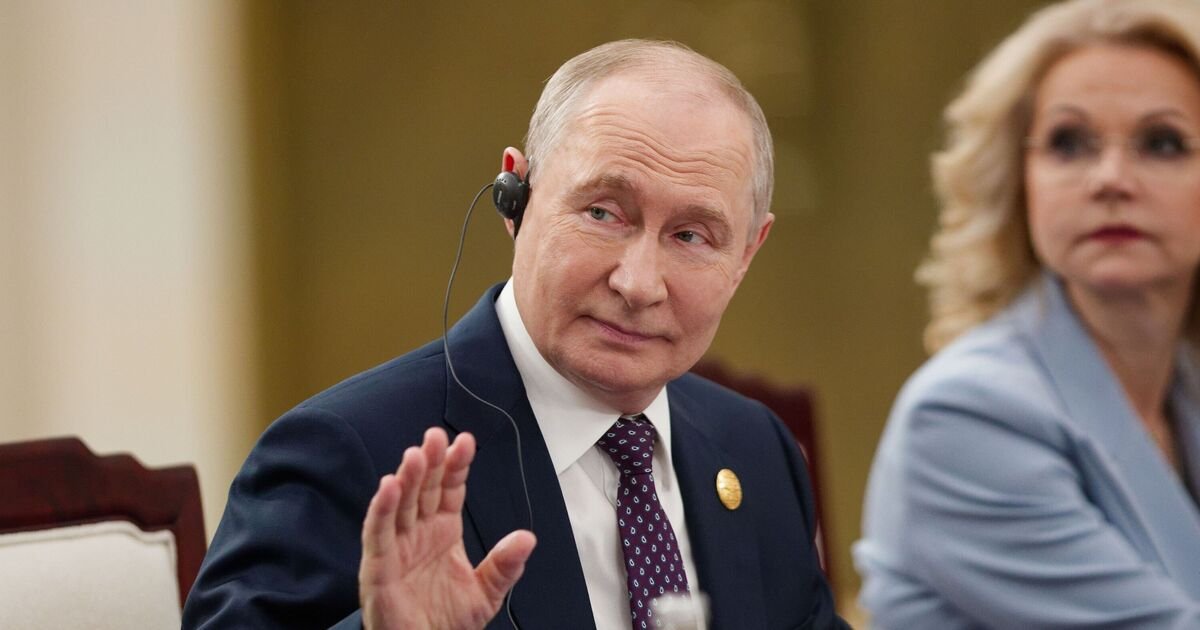

A candid photograph of Vladimir Putin alongside Donald Trump and Xi Jinping has prompted claims the Russian president was humiliated on the world stage. The image, highlighted by Ukrainian political commentator Anton Gerashchenko, shows the three leaders together at the Asia-Pacific Economic Cooperation (APEC) summit in Shenzhen, China. However, while Mr Trump and Xi are in conversation, Putin is shown sitting awkwardly at a different table. The diplomatic optics have attracted almost as much attention as the meeting itself, with the contrasting treatment of the Russian and American presidents raising questions about their respective relationships with Beijing. Mr Trump received a particularly lavish welcome when he arrived in Shenzhen, with Mr Xi personally greeting him on the red carpet.
The Chinese president embraced his American counterpart in a carefully choreographed reception featuring a military honour guard, crowds waving American and Chinese flags and a young girl presenting Mr Trump with flowers. Putin, meanwhile, was received by Cai Qi, head of the General Office of the Chinese Communist Party’s Central Committee and one of the country’s most senior political figures.
Mr Xi was not there to greet him personally. Mr Gerashchenko described the difference as a public humiliation for the Russian leader. Sharing the picture on X, he commented: “Suggest a caption for this photo. I’m exhausted, to be honest.”
In an earlier post, he pointed out claimed: “Putin was publicly humiliated in China. Cai Qi is 20 cm taller than Putin. Putin looked like a vassal. He was shown his place.” There were further awkward moments during the leaders’ appearances together.
At a group photograph, Mr Xi spent longer greeting Mr Trump, posing alongside him for the cameras, while his exchange with Putin appeared to be considerably shorter. Putin also appeared to try to engage Mr Trump before the photograph, with both presidents seemingly indicating where the Russian leader should stand.
The resulting picture showed Mr Xi in the middle, with Mr Trump on one side and Putin on the other, while Xi’s wife, Peng Liyuan, stood between the two visiting leaders. The symbolism was particularly significant given the increasingly close relationship between Beijing and Moscow since Russia launched its full-scale invasion of Ukraine in February 2022.
Western sanctions have restricted Russia’s access to international markets, leaving China an increasingly important economic partner. Beijing has continued buying Russian energy and maintaining diplomatic ties with the Kremlin.
However, the summit also exposed another potential source of embarrassment for Putin: the warmth with which Mr Trump has continued to treat the Russian leader.
The American president warmly shook hands with Putin ahead of their discussions and described him as a friend.
As they greeted one another, Mr Trump said: “Where is he? He’s my friend.”
The comments prompted criticism from American politicians, with concerns that Mr Trump was lending legitimacy to a leader whose country remains at war with Ukraine.
Democratic Senator Tim Kaine said the images of the two leaders together were troubling.
He said: “Some of the pictures troubled me, seeing the president stand with Putin and Xi, rather than seeing the president stand with the leaders of the global democracies.
“Vladimir Putin is not a friend, and so you know he was either being insincere or he is deeply deluded if he thinks Vladimir Putin is a friend.”
Senate Democratic leader Chuck Schumer was similarly critical, accusing the Russian and Chinese presidents of exploiting Mr Trump’s enthusiasm for personal diplomacy.
“Xi and Putin know that if they stroke Trump’s ego and distract him with pomp and circumstance, and flatter him a little bit, Trump will back down on the issues that matter most to Americans,” he said.
The encounter also attracted criticism in Europe. Polish Prime Minister Donald Tusk said: “Mr Putin is not our friend and will never be.”
For Putin, appearing alongside the American and Chinese presidents offered an opportunity to demonstrate that attempts to isolate Moscow have failed.
But the contrasting welcomes and carefully arranged photographs have also raised questions about the balance of power between Russia and China, and whether the Russian president is increasingly the junior partner in the relationship.
